Fusion-Bonded Epoxy (FBE)
Fusion-bonded epoxy is a thermoset powder coating melted onto hot steel to form a tough, well-bonded film. It is a leading external coating for pipelines and a standard protective coating for rebar.
Key takeaways
- FBE is a one-part epoxy powder that melts, flows and cross-links when applied to steel preheated to the product’s application temperature.
- It is widely used as an external pipeline coating, as the primer layer in three-layer polyethylene and polypropylene systems, and on reinforcing bar.
- FBE works together with cathodic protection; its resistance to cathodic disbondment is a key qualification property.
- Quality depends on surface cleanliness, profile, application temperature and full cure, all controlled in the coating plant.
Fusion-bonded epoxy is a special case of powder coating engineered for corrosion protection rather than decoration. Steel is cleaned, blasted and heated, then sprayed with an epoxy powder that melts on contact. The powder “fuses” into a continuous film and cross-links within seconds to minutes, often finishing its cure from the residual heat in the steel.
Because the process requires heating the steel, FBE is almost always applied in a plant to pipe, rebar, valves and fittings, with compatible methods used to coat field girth welds and repairs. For a wider view of pipeline systems, see Pipeline Coatings.
Chemistry and film properties
FBE powders contain solid epoxy resins, latent curing agents that react only when heated, pigments, fillers and flow additives, melt-mixed and ground to a fine powder. On the hot steel, the resin melts, wets the surface and cross-links into a dense, thermoset network bonded chemically and mechanically to the anchor profile.
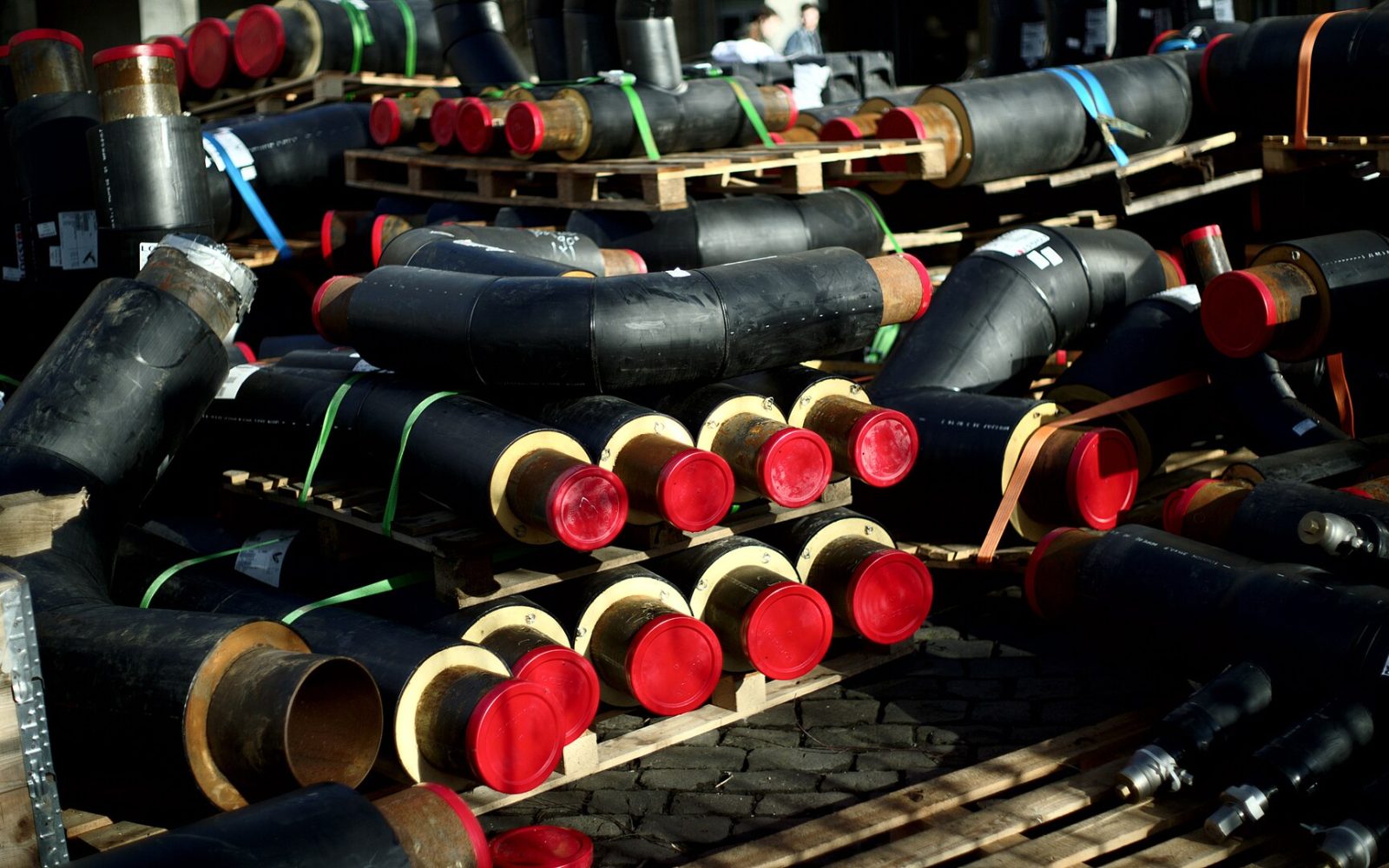
The resulting film has strong adhesion, good resistance to soil chemicals and moisture, and electrical resistance that makes it compatible with cathodic protection. Because a thin FBE film allows some passage of moisture and CP current, steel under a disbonded area generally still receives cathodic protection rather than being shielded, which is one reason FBE has a good field record. Its main weaknesses are limited impact and gouge resistance and gradual loss of properties in hot, wet service. Like other aromatic epoxies, FBE chalks in sunlight, so stockpiled pipe exposed for long periods may need protection.
Plant application process
- Inspect and preheat. Pipe is checked for defects and warmed to drive off moisture.
- Blast clean. Steel is cleaned to at least near-white metal (SSPC-SP 10/NACE No. 2), often better, with an angular profile commonly around 1.5–4 mils (40–100 µm).
- Pretreat (optional). Some specifications call for an acid wash or chromate-free pretreatment to improve disbondment resistance.
- Heat. Induction coils heat the pipe to the powder’s application range, often about 430–480 °F (220–250 °C); follow the product data sheet.
- Apply powder. Electrostatic guns spray the powder as the pipe rotates and advances.
- Cure and quench. After the specified cure time, the pipe is water-quenched for handling.
- Inspect. Thickness, holidays and appearance are checked and repairs made.
Application temperature is critical. Too cold and the powder flows poorly and under-cures; too hot and it can blister, foam or degrade. Calibrated temperature monitoring of the steel itself, not just the coil settings, is essential.
FBE system types
| System | Construction | Typical use |
|---|---|---|
| Single-layer FBE | One FBE layer, commonly about 10–20 mils (250–500 µm) | General buried pipeline service |
| Dual-layer FBE | FBE base plus a tougher abrasion-resistant overcoat (ARO) | Directional drilling, rocky soils, higher temperatures |
| Three-layer PE/PP | FBE primer, polymeric adhesive, thick polyethylene or polypropylene jacket | Severe handling, high-temperature or offshore service |
| Internal FBE | FBE lining inside line pipe or water pipe | Flow efficiency and internal corrosion control |
| Epoxy-coated rebar | FBE on reinforcing bar | Bridge decks and parking structures exposed to chlorides |
Standards and quality testing
Commonly referenced documents include CSA Z245.20 for plant-applied external FBE on steel pipe, NACE SP0394 for plant-applied single-layer FBE external pipe coating, AWWA C213 for FBE on steel water pipelines, and ASTM A775/A775M and ASTM A934/A934M for epoxy-coated reinforcing bar. Project specifications typically select one and add owner requirements.
- Holiday detection: 100% high-voltage inspection after coating; see Holiday Testing.
- Cathodic disbondment: resistance to coating loss around a deliberate holiday under CP; see Cathodic Disbondment Testing.
- Degree of cure: differential scanning calorimetry compares the glass transition temperature of the coating before and after a reheat scan.
- Flexibility: bend tests at low temperature check that the film will tolerate field bending.
- Adhesion and porosity: hot-water soak, adhesion and cross-section examinations.
A shift in the DSC results is one of the earliest signs of drifting oven or induction temperatures. Trending cure data, not just pass/fail, helps plants catch problems before a full production run is affected.
Field joints and repairs
Pipe ends are left uncoated for welding. Girth welds are then protected with field-applied FBE using portable induction heating, two-part liquid epoxy, or heat-shrink sleeves, depending on the specification and line coating. Small holidays are typically repaired with hot-melt patch sticks, while larger damage uses two-part epoxy repair coatings. The joint coating must be compatible with the line coating and with the cathodic protection system.
Advantages and limitations
Advantages
- Excellent adhesion and cathodic disbondment resistance
- Solvent-free, with high material utilization
- Fast, consistent plant application and cure
- Does not shield cathodic protection current
- Serves as the base layer in multilayer systems
Limitations
- Requires heating steel, so mostly plant-applied
- Relatively thin film with limited impact and gouge resistance
- Moisture uptake and property loss at elevated temperatures
- UV chalking during prolonged outdoor storage
Frequently asked questions
Is FBE the same as powder coating?
FBE is a type of thermoset powder coating, but it is formulated and applied for corrosion protection on heavy steel, usually at higher film builds and with plant quality-control testing.
Can FBE be applied in the field?
Mainly at girth welds, using portable induction heating and powder spray equipment. Most FBE is applied in coating plants.
What is dual-layer FBE?
A system with an FBE corrosion layer and a harder, abrasion-resistant overcoat, used where pipe is pulled through soil or rock, such as in directional drilling.
How hot can FBE operate?
Maximum operating temperature depends on the product and on moisture exposure. Standard grades are limited compared with specialty high-Tg powders; check the product data sheet and qualification testing.
Educational reference. Coating performance varies by formulation. Always follow the manufacturer’s product data sheet, safety data sheet and your project specification.