Structural Steel & Bridge Coatings
How bridges and structural steel are protected for decades — the three-coat zinc system, galvanizing and metallizing, maintenance painting and inspection.
Key takeaways
- The most common new-construction system for steel bridges is a three-coat zinc-rich primer, epoxy intermediate and aliphatic polyurethane topcoat.
- Galvanizing, thermal-sprayed metallizing, duplex systems and weathering steel are established alternatives, each with design limits.
- Maintenance strategy — spot repair, overcoating or full removal — depends on existing coating condition, adhesion and whether it contains lead.
- Faying surfaces of slip-critical bolted connections need coatings qualified for the required slip coefficient.
- Inspection hold points for surface cleanliness, profile, DFT and environmental conditions are the backbone of a bridge painting contract.
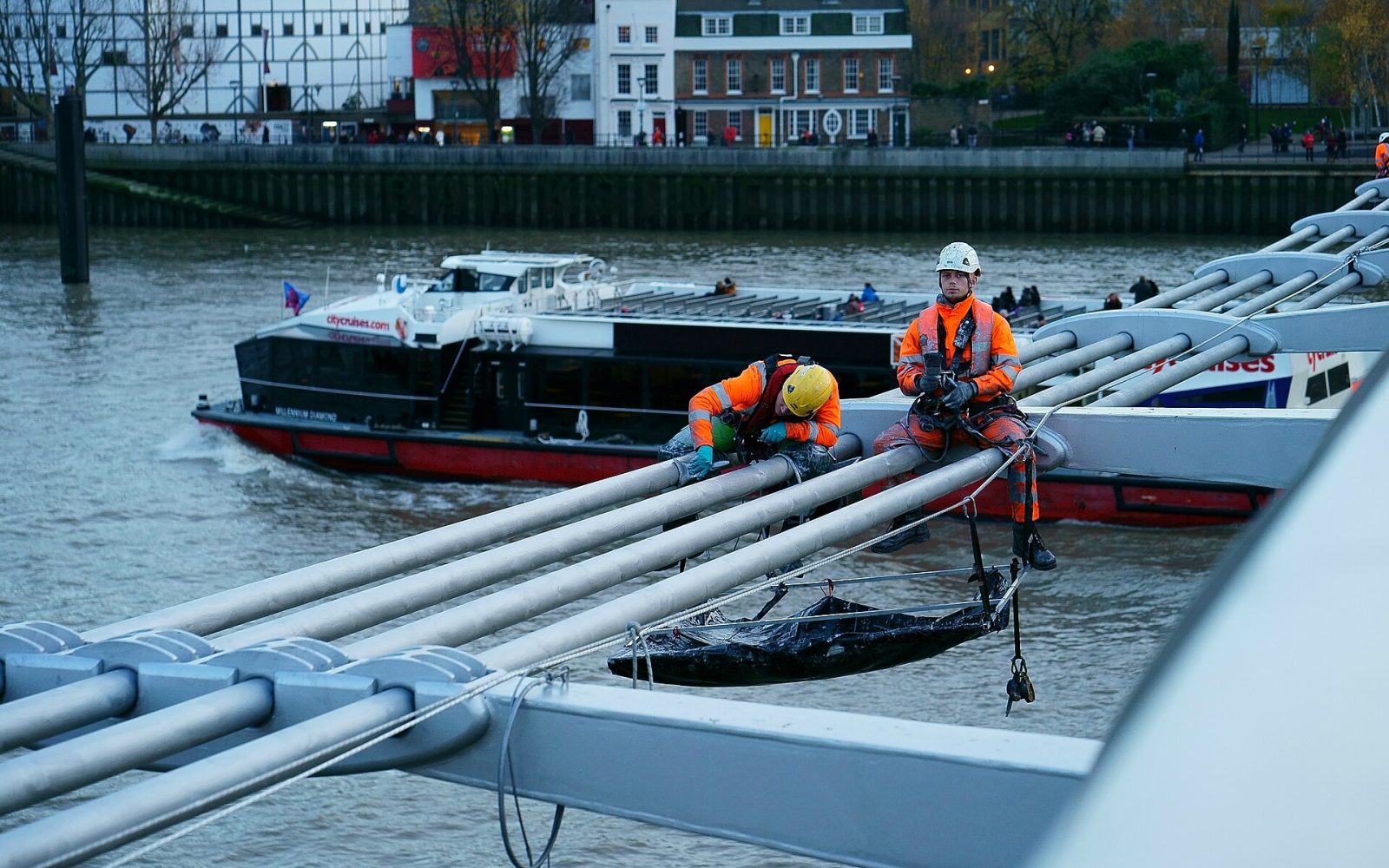
Steel bridges, transmission structures, stadiums, industrial frames and building steel all rely on coatings to resist atmospheric corrosion for decades. Bridges are among the most demanding cases: they are exposed outdoors for service lives commonly designed at 75 years or more, are often splashed with de-icing salts, and are expensive and disruptive to repaint because of traffic control, access and environmental containment.
This article covers the coating systems used on new structural steel, alternatives to paint, maintenance painting of existing structures and the inspection practices that tie it all together.
The three-coat zinc system
For new bridge steel in North America and many other regions, the workhorse is a shop-applied three-coat system:
- Zinc-rich primer — inorganic (ethyl silicate) or organic (epoxy or moisture-cure urethane) zinc, commonly about 3–5 mils (75–125 µm). The zinc provides galvanic protection at scratches and pinholes. See zinc-rich primers.
- Epoxy intermediate — commonly about 3–6 mils (75–150 µm). Builds barrier thickness and seals the porous zinc layer.
- Aliphatic polyurethane topcoat — commonly about 2–4 mils (50–100 µm). Provides UV resistance, color and gloss retention. See polyurethane coatings.
Total system thickness typically falls in the range of about 9–15 mils (225–375 µm), set by the owner’s specification. Many U.S. agencies require products that have passed performance evaluation through programs such as NEPCOAT or the AASHTO NTPEP structural steel coatings program, and ISO 12944-5 provides example systems and expected durability ranges by corrosivity category outside North America.
Why shop application dominates
Applying the primer — and often the full system — in a fabrication shop gives controlled temperature and humidity, better access to all surfaces, consistent abrasive blasting and easier inspection. Field work is then limited to touch-up of handling damage and coating of field connections. Some owners specify a shop primer only, with intermediate and topcoat applied in the field to minimize visible damage on the finished structure.
The faying surfaces of slip-critical bolted joints may only be coated with systems tested for slip coefficient under the Research Council on Structural Connections (RCSC) Specification. Many inorganic zinc primers qualify for the higher Class B slip coefficient, while ordinary topcoats are kept off these surfaces.
Alternatives and complements to paint
| Approach | How it protects | Strengths | Limitations |
|---|---|---|---|
| Three-coat paint system | Galvanic zinc primer plus barrier coats | Any color, flexible to fabricate, well-established inspection practice | Requires repainting over the structure’s life; quality-sensitive |
| Hot-dip galvanizing | Metallurgically bonded zinc layers | Robust, low-maintenance, coats inside and out | Member size limited by kettle dimensions; appearance; can distort thin members |
| Thermal-spray metallizing (zinc, aluminum or 85/15 zinc–aluminum) | Sprayed metal layer, usually sealed | Long life, applicable to large members, no cure time | Needs very clean, angular profile; specialized equipment and operators |
| Duplex (galvanized or metallized plus paint) | Metal and paint working together | Life often exceeds either component alone; color available | Paint adhesion to zinc requires careful preparation |
| Weathering steel (e.g. ASTM A709 Grade 50W) | Dense, adherent rust patina | Little or no painting in suitable environments | Not suited to persistently wet, salty or sheltered areas; beam ends under leaking joints often need painting |
Metallizing in North America is commonly specified under SSPC-CS 23.00/AWS C2.23M/NACE No. 12, the joint specification for thermal-spray coatings of aluminum, zinc and their alloys.
Surface preparation and application
- Solvent clean. Remove oil and grease per SSPC-SP 1 before blasting, since blasting spreads contamination rather than removing it.
- Condition edges and welds. Remove weld spatter, grind sharp edges and treat laminations so coatings can build adequate thickness.
- Blast clean. Zinc-rich primers generally require near-white metal blast cleaning (SSPC-SP 10/NACE No. 2, ISO 8501-1 Sa 2½) or white metal (SSPC-SP 5/NACE No. 1, Sa 3), as stated on the product data sheet.
- Verify profile. Measure the anchor profile per ASTM D4417; zinc primers commonly call for roughly 1.5–3.5 mils (38–89 µm) of sharp, angular profile.
- Check conditions. Surface temperature at least 5 °F (3 °C) above dew point and within the humidity range; inorganic zincs need adequate humidity to cure.
- Apply and stripe. Apply each coat by spray, stripe coating edges, bolts and welds, and observe recoat windows.
- Measure DFT. Measure dry film thickness per SSPC-PA 2 against minimum and maximum limits; excessive zinc thickness can cause mud cracking.
Background on blast cleanliness grades is in SSPC, NACE and ISO surface preparation standards.
Maintenance painting of existing structures
Most bridge coating work is maintenance on existing structures, and owners typically choose among three strategies:
- Spot or zone repair — clean and recoat corroded areas such as beam ends, bearings and areas under leaking expansion joints, which commonly fail first.
- Overcoating — clean the existing coating, spot-prepare rusted areas with power tools (for example SSPC-SP 3, SP 11 or SP 15) or water jetting, and apply a compatible system over the sound old paint. Penetrating sealers, calcium sulfonate alkyds, surface-tolerant epoxies and moisture-cure urethanes are common choices.
- Full removal and recoat — abrasive blast to bare steel and apply a new zinc system. It delivers the longest life but at the highest cost, especially where lead is present.
The decision usually depends on the percentage of rusted area, the adhesion and thickness of the existing coating, and the remaining life expected from the structure. Overcoating adds stress to old paint, so adhesion testing — typically cross-cut or knife tests on thick aged films, and pull-off testing per ASTM D4541 — and a field trial patch are prudent first steps.
Many older bridges carry lead-based paint. Disturbing it triggers worker protection requirements (in the U.S., OSHA 29 CFR 1926.62), environmental containment of debris — commonly designed using SSPC Guide 6 — and hazardous waste handling. These can dominate project cost and schedule.
Inspection and quality control
Bridge specifications typically define inspection hold points where work cannot proceed until the inspector accepts it:
- Environmental conditions (air and steel temperature, relative humidity, dew point) recorded before and during work.
- Surface cleanliness compared with the specified SSPC/NACE or ISO 8501-1 grade, and soluble salt testing where specified.
- Surface profile measured per ASTM D4417.
- Dry film thickness of each coat measured per SSPC-PA 2. See dry film thickness measurement.
- Cure verification — for example, solvent rub testing of inorganic zinc before topcoating.
- Visual checks for runs, sags, dry spray, pinholes and missed areas.
Over time, failures usually show as rust at edges, bolts and welds, and as undercutting and rust creep from damage. Periodic condition assessment lets owners plan maintenance before corrosion causes section loss.
Frequently asked questions
How long does a bridge coating system last?
A well-applied zinc/epoxy/polyurethane system in a moderate environment is commonly expected to provide decades of service before major maintenance, but life varies widely with exposure, de-icing salts, detailing and application quality. ISO 12944 frames durability in ranges rather than guarantees.
Why use inorganic rather than organic zinc?
Inorganic zinc silicates offer excellent corrosion resistance, heat resistance and slip-critical performance, but are sensitive to cure humidity and topcoating. Organic zincs are more forgiving and easier to topcoat and repair. Both are widely used.
Can new paint go straight over old lead paint?
Overcoating lead paint is common practice when the existing system is well bonded, because it avoids disturbing the lead. Its viability depends on adhesion testing, the condition of the old coating and the stresses the new coating will impose.
Does weathering steel ever need paint?
Yes, in some locations. Areas that stay wet, are exposed to de-icing salt spray or sit under leaking joints may not form a protective patina and are often painted.
Educational reference. Coating performance varies by formulation. Always follow the manufacturer’s product data sheet, safety data sheet and your project specification.