Undercutting & Rust Creep
How corrosion spreads beneath coatings from scratches, edges and welds, how to measure the true extent, and how to repair and prevent rust creep.
Key takeaways
- Undercutting, or rust creep, is corrosion that starts at a break in the coating and spreads sideways beneath intact-looking film.
- It almost always begins at damage, edges, welds, holidays or areas of poor surface preparation, and spreads faster where adhesion is weak or salts remain.
- The visible rust is usually smaller than the affected area; probing with a knife reveals how far the coating has lost adhesion.
- Zinc-rich primers, good edge preparation, stripe coating and prompt repair of damage are the most effective defenses.
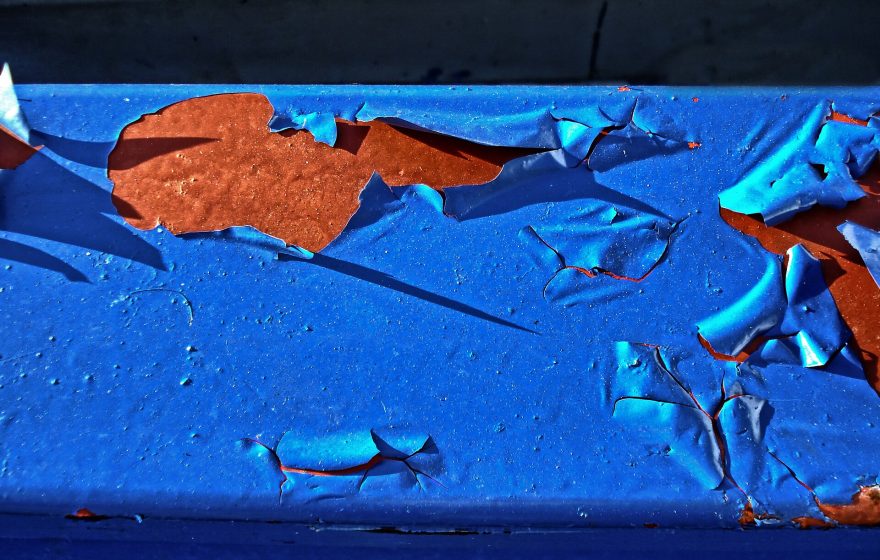
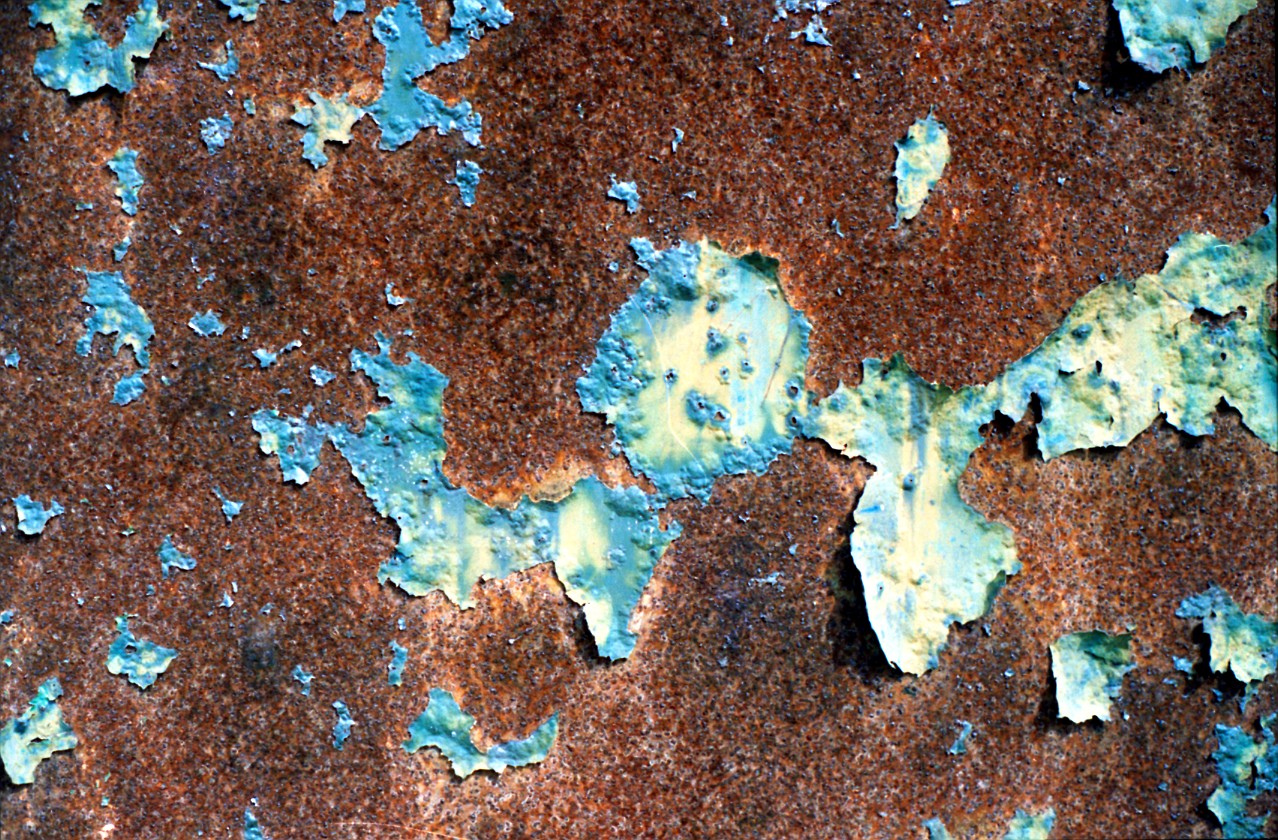
Undercutting is the progressive loss of adhesion and corrosion of steel beneath a coating, advancing outward from a defect. In accelerated testing it is measured as creep from a deliberate scribe; in the field it shows as rust bleeding from scratches, edges and welds, with the surrounding coating lifting, blistering or flaking. Left alone, small defects can grow into large areas of failure while most of the coating still looks sound from a distance.
Understanding undercutting requires some corrosion science: once water, oxygen and electrolyte reach the steel, the anodic and cathodic reactions of corrosion can separate the coating from the substrate faster than rust alone could.
What undercutting looks like
- Rust bleeding from scratches, impact damage, bolt holes or cut edges.
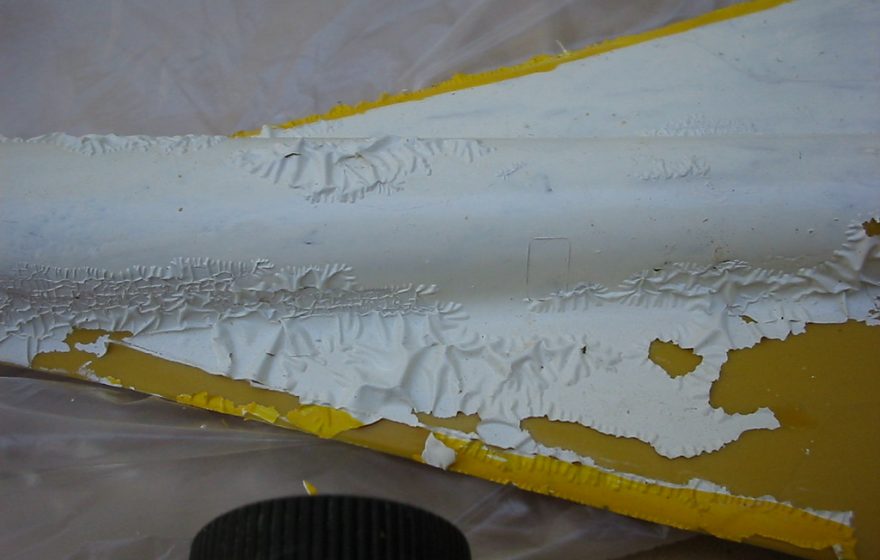
- Raised or cracked coating around the defect, lifted by voluminous corrosion products.
- Blistering at the margin of the corroded area, often with rust-colored or, on cathodic sites, alkaline fluid.
- Edge and weld corrosion — lines of rust along flange tips, plate edges and weld seams.
- Filiform corrosion — thread-like filaments of corrosion under thin coatings, most often on aluminum and on steel in humid environments.
Rust grade can be rated with ASTM D610 (also published as SSPC-VIS 2) or ISO 4628-3. Creep from a scribe or defect is rated with ASTM D1654 or ISO 4628-8, and filiform corrosion with ISO 4628-10.
Mechanisms and root causes
How undercutting spreads
Two processes work together. In anodic undermining, steel dissolves at the edge of the defect and the corrosion front advances beneath the film, with rust wedging the coating up. In cathodic delamination, oxygen reduction at cathodic sites just under the coating edge produces hydroxyl ions; the local alkalinity attacks the coating bond ahead of the corrosion front, opening a path for further spread. Chlorides and other salts raise conductivity and accelerate both processes.
Common root causes
- Mechanical damage during handling, erection or service that exposes steel and is not repaired promptly.
- Sharp edges and welds. Liquid coatings pull away from sharp edges as they cure (edge retraction), leaving thin coverage. Weld spatter, porosity and undercut provide further weak points.
- Inadequate surface preparation. Rust or mill scale left in place, or a profile that is too low, reduces adhesion and leaves corrosion sites under the film.
- Soluble salts. Salts trapped in pits or on the surface promote both undercutting and osmotic blistering — see soluble salt contamination.
- Low film thickness and holidays. Thin areas and pinholes provide easy starting points.
- Primer without sacrificial or inhibitive protection. Barrier-only systems resist creep less well once breached than systems with zinc-rich primers.
How to diagnose
- Survey and rate. Record location, rust grade and the distribution of corrosion — edges, welds, fasteners, damage, splash zones or water traps.
- Probe the extent. Starting at the rusted defect, lift the coating with a knife and work outward until it is tightly adhered. Measure and record the undercut distance; it is often several times the visible rust.
- Measure thickness at edges and welds. Compare DFT on edges and weld seams with flat areas to reveal edge retraction or missed stripe coats.
- Test for salts. Sample exposed steel and the underside of lifted coating for chlorides and sulfates.
- Identify the system. Confirm whether a zinc-rich primer is present and how thick it is, using cross-sections or a cutting gauge (ASTM D4138).
- Check adhesion nearby. Tape or pull-off tests on surrounding intact coating show whether poor adhesion is widespread or local.
Laboratory creep testing, from ASTM B117 and ISO 9227 salt spray to cyclic tests such as those in ISO 12944-9, is used to compare systems. Cyclic tests generally rank coatings more realistically than continuous salt spray — see salt spray and cyclic corrosion testing.
Causes, diagnostic clues and prevention
| Cause | Typical clues | Confirming check | Prevention |
|---|---|---|---|
| Unrepaired damage | Rust radiating from scratches or impacts | Knife probe of undercut distance | Inspect and touch up damage promptly |
| Sharp edges, poor welds | Rust lines along edges and weld seams | DFT at edges vs. flat areas | Round edges; prepare welds; stripe coat |
| Poor surface preparation | Rust or scale beneath lifted film | Underside inspection; profile check | Prepare to specified grade and profile |
| Soluble salts | Rapid creep with blistering; marine exposure | Salt sampling of exposed steel | Test and remove salts before coating |
| Low DFT or holidays | Pinpoint rust spreading into patches | DFT survey; holiday test | Verify DFT; repair holidays |
| Barrier-only primer | Wide creep from small defects | Cross-section of system | Zinc-rich or inhibitive primer where suitable |
How to repair undercutting
- Remove all undercut coating. Cut back until knife testing shows tightly adhered coating on all sides. Leaving undercut film in place traps corrosion beneath the repair.
- Clean the steel. Spot blast or power-tool clean to the specified grade, for example SSPC-SP 11 or SSPC-SP 15 where blasting is impractical, or SSPC-SP 10/NACE No. 2 by spot blasting (see surface preparation standards).
- Remove salts. Wash with clean water where salts are present and retest.
- Feather and abrade. Taper the edges of surrounding intact coating and scuff a band around the repair so new coats overlap onto sound, roughened film.
- Stripe coat. Brush-apply a stripe coat to edges, welds and fasteners within the repair area.
- Reapply the system. Spot prime with the specified primer (zinc-rich or a surface-tolerant product), then build up intermediate and topcoats to full DFT.
When rust grades are high or undercutting is widespread, spot repairs become uneconomic and the old coating’s remaining adhesion may not support an overcoat. A condition assessment should decide between spot repair, overcoating and full removal.
How to prevent undercutting
- Design and fabrication: round sharp edges (ISO 12944-3 recommends a radius of at least 2 mm), remove weld spatter and prepare welds to an appropriate ISO 8501-3 grade, and avoid crevices and water traps.
- Primer choice: zinc-rich primers or galvanizing provide galvanic protection at small breaks and markedly reduce creep in many environments.
- Stripe coating: apply extra coats by brush to edges, welds, bolts and corners.
- Surface cleanliness: achieve the specified grade, profile and salt limits.
- Film thickness: verify DFT, especially at edges, and holiday test where required.
- Maintenance: inspect regularly and repair damage and early rust before it spreads.
Frequently asked questions
Why is the rust spot small but the peeling area large?
Corrosion and cathodic delamination break the coating bond ahead of the visible rust, so adhesion is lost well beyond the stain. Probing reveals the true extent.
Do zinc-rich primers stop undercutting completely?
No, but at small defects the zinc corrodes preferentially and protects the exposed steel, which generally limits creep compared with barrier-only primers.
Can I just paint over rust bleeding?
Not durably. Corrosion continues under the new paint unless loose coating and rust are removed and the steel is prepared.
Educational reference. Coating performance varies by formulation. Always follow the manufacturer’s product data sheet, safety data sheet and your project specification.