Corrosion Science Basics
Why steel rusts, how the corrosion cell works, the main forms of corrosion, and the three ways coatings stop it: barrier, inhibition and sacrificial protection.
Key takeaways
- Corrosion is electrochemical: metal dissolves at anodes while oxygen (or hydrogen ions) is reduced at cathodes, with an electrolyte carrying ions between them.
- Remove any one of the four elements of the corrosion cell — anode, cathode, electrolyte, metallic path — and corrosion stops. Every protection strategy targets one or more of them.
- Moisture, oxygen, chlorides and sulfur pollutants drive atmospheric corrosion; ISO 9223 and ISO 12944-2 classify environments by severity.
- Coatings protect by barrier, inhibitive or sacrificial action, and are often paired with cathodic protection on buried and submerged steel.
Steel is made by putting energy into iron ore to strip away oxygen. Corrosion is nature taking that energy back: the metal returns toward the oxides it came from. The process cannot be repealed, but it can be slowed enormously — and almost every rule in coating work, from blast cleaning to stripe coats, makes sense once you understand how a corrosion cell works.
The corrosion cell
Aqueous corrosion needs four elements, all at once:
- Anode — where metal oxidizes and goes into solution: Fe → Fe²⁺ + 2e⁻.
- Cathode — where the released electrons are consumed. In neutral or alkaline water with dissolved oxygen: O₂ + 2H₂O + 4e⁻ → 4OH⁻. In acids: 2H⁺ + 2e⁻ → H₂.
- Electrolyte — water containing dissolved ions, which carries ionic current between anode and cathode. Even a thin, invisible moisture film qualifies.
- Metallic path — the metal itself, which carries electrons from anode to cathode.
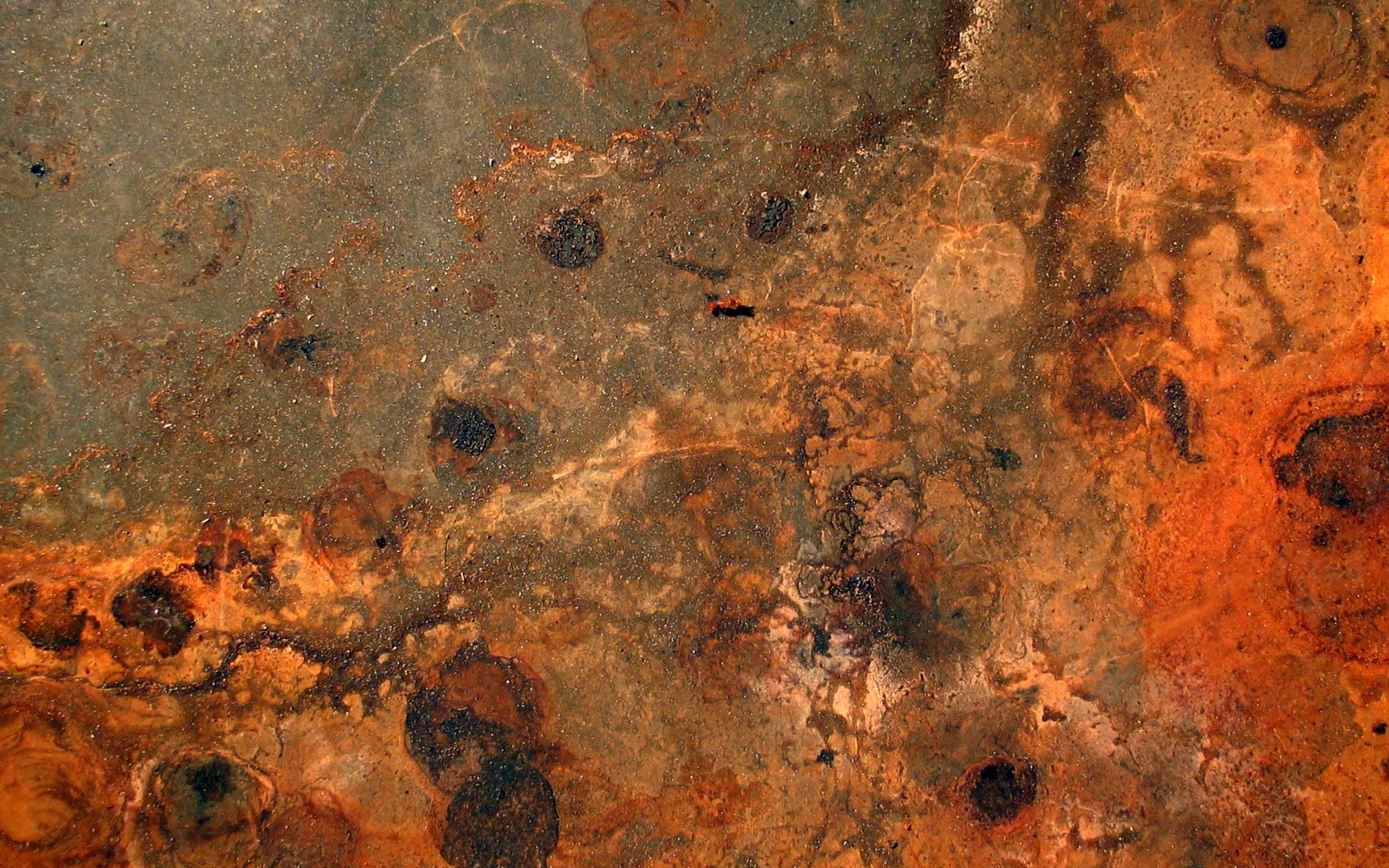
Ferrous ions and hydroxide ions combine to form ferrous hydroxide, which oxidizes further to a mix of hydrated iron oxides and oxyhydroxides — rust. Rust occupies several times the volume of the steel consumed. That expansion is why corrosion under a coating lifts and cracks it, and why pack rust can bend plates apart.
On a single piece of steel, anodes and cathodes form wherever there are small differences: composition, grain structure, stress, oxygen supply or surface contamination. Mill scale is a good example — it is cathodic to the underlying steel, so breaks in the scale become small anodes and corrode rapidly. That is one reason specifications require mill scale to be removed by blast cleaning before high-performance coatings.
What controls the corrosion rate
Moisture
Atmospheric corrosion only proceeds when the surface is wet. The older edition of ISO 9223 defined “time of wetness” as periods when relative humidity exceeds 80% at temperatures above 0 °C; in reality, hygroscopic contaminants such as salts absorb water and create an electrolyte film at considerably lower humidity. Condensation, dew cycles and poor drainage dramatically increase wet time.
Chlorides and sulfur compounds
Chlorides from sea spray and de-icing salts raise electrolyte conductivity, attract moisture and break down protective oxide films. Sulfur dioxide from industrial emissions acidifies moisture. Chlorides left on blasted steel are a major cause of premature coating failure — see soluble salt contamination.
Oxygen, temperature and pH
Dissolved oxygen feeds the cathodic reaction, so differences in oxygen supply create differential aeration cells: the oxygen-starved region becomes anodic. Higher temperature generally speeds corrosion, although it can also reduce dissolved oxygen and shorten wet time. In concrete, the high alkalinity of the pore solution passivates embedded steel; carbonation or chloride ingress destroys that passivity and reinforcement corrosion begins.
Common forms of corrosion
| Form | Mechanism | Where it appears |
|---|---|---|
| Uniform (general) | Anodes and cathodes shift continuously across the surface | Uncoated steel in the atmosphere |
| Pitting | Small stable anodes, often triggered by chlorides or mill scale breaks | Stainless steel in chlorides, partly scaled steel |
| Crevice | Oxygen depletion in tight gaps sets up a differential aeration cell | Lap joints, back-to-back angles, under gaskets |
| Galvanic | Dissimilar metals in electrical contact through an electrolyte | Mixed-metal fasteners and joints |
| Underfilm / undercutting | Corrosion spreads beneath a coating from a defect or edge | Scribes, damage, cut edges |
| Microbiologically influenced (MIC) | Microbial activity, e.g. sulfate-reducing bacteria, creates aggressive local chemistry | Wastewater, tank bottoms, buried pipe |
| Erosion-corrosion | Flow or impingement removes protective films | Pipe elbows, pumps, valves |
| Stress corrosion cracking | Tensile stress combined with a specific environment | Pipelines, stainless steel in hot chlorides |
Underfilm corrosion that creeps outward from damage is covered in detail in undercutting and rust creep.
The galvanic series and dissimilar metals
When two different metals are connected in an electrolyte, the more active one becomes the anode and corrodes faster, while the more noble one is protected. In seawater, the approximate order from most active to most noble runs: magnesium, zinc, aluminum alloys, carbon steel and cast iron, lead and tin, copper alloys, passive stainless steels, titanium, and graphite. Positions shift with environment and surface condition, so the series is a guide, not an absolute ranking.
The area ratio matters as much as the pairing. A small anode connected to a large cathode concentrates all the corrosion current on a small area — steel rivets in a large copper sheet fail quickly, whereas copper rivets in steel plate cause little harm.
If only one metal in a galvanic couple can be coated, coat the more noble one (the cathode). Coating only the anode leaves tiny holidays facing a huge cathode — the worst possible area ratio, which drives deep local attack.
How coatings stop corrosion
Barrier protection
No organic coating is completely impermeable: water and oxygen diffuse through all of them to some degree. Barrier coatings work largely by their high ionic resistance, which starves the corrosion cell of a conductive electrolyte at the steel surface, and by strong wet adhesion, which prevents water from collecting at the interface. Platelet pigments and greater thickness lengthen diffusion paths. Salts trapped under a barrier coating can draw water through it by osmosis, causing blistering.
Inhibitive protection
Inhibitive primers contain slightly soluble pigments that release ions able to passivate steel. Lead and chromate pigments were once standard but have largely been replaced by zinc phosphate and other less toxic inhibitors because of health and environmental concerns.
Sacrificial (galvanic) protection
Zinc is more active than steel, so zinc in metallic contact with steel corrodes preferentially and protects small exposed areas. Hot-dip galvanizing, thermal-spray zinc and zinc-rich primers all use this principle. It depends on electrical contact, which is why zinc-rich primers need clean, blast-cleaned steel and a high zinc content.
Coatings and cathodic protection
Cathodic protection (CP) makes the entire structure a cathode, either by connecting galvanic anodes (zinc, aluminum or magnesium alloys) or by applying an impressed current from a rectifier. It is standard for pipelines, ship hulls, offshore structures and tank bottoms. Coatings and CP are complementary: the coating reduces the exposed area so the current demand falls dramatically, while CP protects the inevitable holidays. Coatings used with CP must resist cathodic disbondment — the high pH generated at the cathode can undermine adhesion at defects — and excessive protection potentials can generate hydrogen that blisters the film. Pipeline coatings are qualified specifically for this service.
Corrosion control in practice
- Classify the environment. Use ISO 9223 or ISO 12944-2 to place the site in a corrosivity category (see ISO 12944 corrosivity categories).
- Design out traps. Avoid crevices and water-retaining pockets, provide drainage, seal-weld joints and round sharp edges.
- Prepare the surface. Remove mill scale, rust, oil and soluble salts, and create the specified profile.
- Choose the protection mechanism. Barrier, inhibitive, sacrificial, CP — or a combination — to suit the service.
- Apply and inspect. Stripe-coat edges and welds, verify film thickness and check for holidays where required.
- Maintain early. Spot-repair damage before rust spreads under the surrounding coating.
Frequently asked questions
Why does rust come back so quickly after painting over it?
Rust is porous and holds moisture and salts, so coating over it seals an active corrosion cell underneath. Without adequate removal of rust and contaminants, corrosion continues and the expanding rust lifts the new coating.
Does stainless steel need a coating?
Usually not in benign environments, because its chromium-rich passive film protects it. In chloride-rich or crevice-prone service, or under insulation, stainless steels can suffer pitting or stress corrosion cracking, and coatings are sometimes specified.
Is galvanizing better than a zinc-rich primer?
Both protect sacrificially. Hot-dip galvanizing forms a metallurgically bonded zinc layer, typically thicker than a primer, but is limited by bath size and done in a plant. Zinc-rich primers can be applied in the field and topcoated as part of a multi-coat system.
What does “corrosion allowance” mean?
It is extra metal thickness added at design stage to tolerate expected uniform corrosion over the service life. It does not protect against localized forms such as pitting or crevice corrosion.
Educational reference. Coating performance varies by formulation. Always follow the manufacturer’s product data sheet, safety data sheet and your project specification.