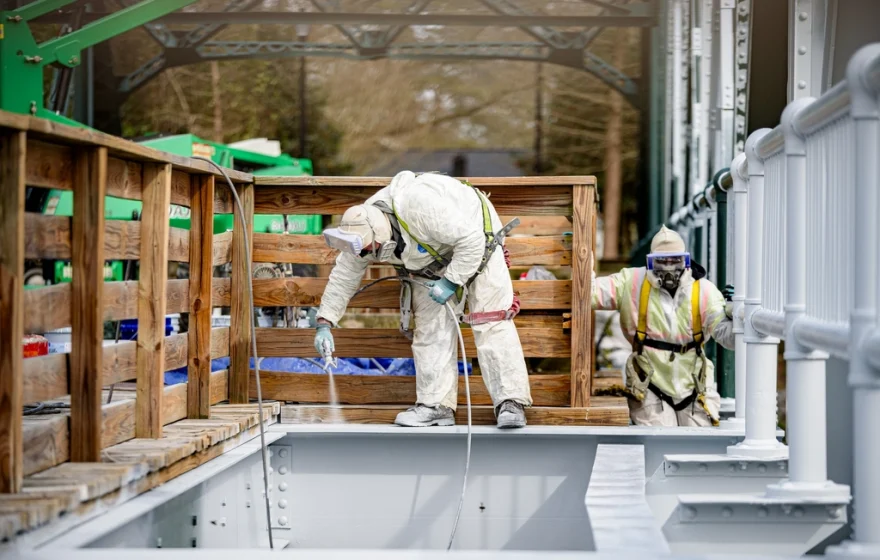
Estimating Coating Jobs
A practical framework for estimating coating work: measuring surface area, calculating material from volume solids, building labor from production rates, and pricing access, equipment and risk.
Key takeaways
- A coating estimate is built from four cost groups — labor, material, equipment and access — plus indirect costs, risk and margin.
- Material comes from surface area, specified DFT, volume solids and a realistic loss factor, not from a “gallons per job” guess.
- Labor is usually the largest and most variable cost. Build it from area divided by production rates drawn from your own job records.
- Surface preparation, access, environmental controls and inspection hold points are where estimates most often go wrong.
Estimating turns a specification and a set of drawings into a number a contractor can live with. Done well, it also produces the plan for the job: crew size, equipment, sequence and duration. Done poorly, it either loses the bid or wins a job that loses money.
This article sets out a general method. It is educational, not financial advice, and it deliberately avoids prices: labor rates, material costs and productivity vary too much by region, market and crew to quote. All numbers below are hypothetical and exist only to show the arithmetic.
What goes into a coating estimate
| Cost group | Includes | Main drivers |
|---|---|---|
| Labor | Surface preparation, application, stripe coats, touch-up, cleanup, supervision | Area, complexity, prep standard, number of coats, crew productivity |
| Material | Coatings, thinners, abrasive, masking, consumables | DFT, volume solids, loss factor, abrasive consumption |
| Equipment | Compressors, blast pots, dust collectors, spray rigs, dehumidifiers, gauges | Duration on site, own versus rent, fuel and maintenance |
| Access | Scaffold, lifts, rigging, containment, confined space setup | Height, geometry, containment class, duration |
| Indirect | Mobilization, permits, insurance, bonds, travel, testing, waste disposal | Contract terms, location, regulatory requirements |
Overhead and profit sit on top. How a firm allocates overhead — as a percentage, per labor hour or per job — is a business decision best made with an accountant who knows the company’s numbers.
Surface area takeoffs
Every other number depends on the area, so measure it carefully and record how it was derived. For flat work — floors, walls, tank shells — dimensions from drawings or field measurements are straightforward. Structural steel is harder: estimators commonly use published surface-area-per-length values for each section shape, or surface area per ton by member size, and then add connections, stiffeners and bracing.
Area alone does not capture effort. Record complexity separately:
- Edges, welds, bolts and back-to-back angles that need stripe coating.
- Pipe racks and lattice steel, where overspray losses climb and production falls.
- Elevated or confined work, overhead application and restricted access.
- Existing conditions — heavy rust, pack rust, deteriorated concrete or hazardous coatings.
Calculating material
Theoretical coverage comes from volume solids: coverage (ft²/US gal) = 1604 × VS ÷ DFT (mils), or in metric, coverage (m²/L) = 10 × VS (%) ÷ DFT (µm). Practical coverage then subtracts a loss factor for overspray, surface roughness, over-application, mixing waste and material left in hoses and kits.
Hypothetical example. A coat specified at 6 mils (152 µm) DFT, using a product with 75% volume solids, over 10,000 ft² (929 m²):
- Theoretical coverage = 1604 × 0.75 ÷ 6 ≈ 200 ft²/gal (about 4.9 m²/L).
- Assume a 30% loss factor for spray work on moderately complex steel: practical coverage ≈ 200 × 0.70 = 140 ft²/gal.
- Material needed ≈ 10,000 ÷ 140 ≈ 72 gal (roughly 270 L), rounded up to whole kits.
Loss factors vary widely — brush and roller on flat surfaces lose far less than spray on open steelwork in wind — so track actual consumption on completed jobs. Abrasive, thinner and consumables deserve the same discipline. The coverage calculators on the tools page speed up the arithmetic.
Labor and production rates
Labor hours are usually estimated as area divided by a production rate for each task, then adjusted for complexity. The rates that matter are your own, taken from job cost records, because they reflect your crews, equipment and typical conditions.
Hypothetical example. If records show a blaster averaging 120 ft² per hour to a near-white finish on similar steel, blasting 10,000 ft² needs about 83 blaster-hours of nozzle time. Add time for setup, abrasive handling, blowdown, inspection, moving equipment and weather delays, and the crew-hours on the job will be noticeably higher than nozzle time alone.
Repeat for each operation: masking, preparation, stripe coats, each full coat, touch-up and cleanup. Higher surface preparation grades, tight profile requirements and soluble salt limits all reduce production and should be reflected explicitly rather than buried in a general factor.
Keep a production database by task, substrate, access type and preparation standard. After every job, compare estimated with actual hours. Within a few seasons the database becomes the most valuable estimating tool a contractor owns.
Equipment, access and environmental control
Equipment cost depends on duration, so it should be derived from the schedule rather than estimated separately. Include fuel, delivery and maintenance as well as rental or ownership cost. Access frequently rivals coating labor on bridges, tanks and elevated steel, and containment adds again where blasting debris must be captured.
Where the specification sets humidity or temperature limits, dehumidification and heating may be required to work at all. Those units run continuously, including through cure, and need power, fuel and monitoring.
An estimating workflow
- Read the documents. Study the specification, drawings, general conditions and addenda. List questions and submit them before the deadline.
- Visit the site. Confirm access, existing conditions, utilities, laydown space, operating constraints and hazardous materials.
- Take off quantities. Measure area by system and by complexity zone, and record assumptions.
- Price material. Calculate each coat from volume solids, DFT and loss factor; add abrasive and consumables.
- Build labor. Apply production rates per task, then crew-size the job and check the resulting duration against the owner’s schedule.
- Add equipment, access and indirects. Derive durations from the schedule; include testing, permits, disposal and mobilization.
- Review risk. Identify unknowns, add contingency or clarifications, and have a second person check the math.
Assumptions that never appear on paper become disputes later. If the estimate assumes a single mobilization, owner-supplied power or a particular existing-coating condition, state it in the proposal.
Frequently asked questions
Should coating jobs be estimated per square foot?
A unit price is useful for checking and comparing jobs, but it should be the output of a detailed estimate, not a substitute for one. Two jobs with the same area can differ several-fold in effort.
What loss factor should I use?
There is no universal value. It depends on method, geometry, wind and crew skill. Start from your own consumption records and adjust for the specific job.
How do I account for inspection hold points?
Treat each hold point as a scheduled event with potential crew idle time. If the specification requires third-party inspection before each coat, include realistic waiting time in labor and equipment duration.
Educational reference. Coating performance varies by formulation. Always follow the manufacturer’s product data sheet, safety data sheet and your project specification.