Isocyanate Chemistry
The reactive NCO group behind polyurethanes, polyureas and polyaspartics: how isocyanates react, why aromatic and aliphatic types behave differently, and why moisture matters.
Key takeaways
- Isocyanates contain the highly reactive –N=C=O (NCO) group, which reacts with hydroxyls to form urethanes and with amines to form ureas.
- Aromatic isocyanates (MDI, TDI) are fast and economical but yellow in sunlight; aliphatic types (HDI, IPDI, H12MDI) give light-stable, weatherable films.
- Coatings use low-monomer prepolymers and oligomers rather than free monomers, which lowers volatility but does not remove the need for exposure controls.
- Water is a competing reactant: it consumes NCO groups and releases carbon dioxide, which can cause bubbles, pinholes and poor cure.
Isocyanate chemistry underpins some of the toughest and most versatile coatings in use: polyurethane topcoats, polyurea elastomers, polyaspartic floors, moisture-cure urethanes and many adhesives and foams. Understanding how the NCO group behaves explains mix ratios, humidity limits, cure speed and the safety precautions these products demand.
This article covers the chemistry. Practical protection for workers is covered separately in isocyanate safety.
The isocyanate group
An isocyanate is any compound containing the functional group –N=C=O. The central carbon is strongly electrophilic, so it reacts readily with molecules that carry an active hydrogen — alcohols, amines, water, and even urethane and urea groups already formed in the film.
Molecules with two or more NCO groups (di- and polyisocyanates) can link with di- or polyfunctional co-reactants to build polymer chains and crosslinked networks. In two-component products the isocyanate is usually the B-side or “hardener” in polyurethanes, while spray-foam and polyurea suppliers often call it the A-side — always check the labeling convention on the product data sheet.
The reactive content of an isocyanate component is expressed as %NCO by weight. Formulators use it, with the hydroxyl or amine equivalent weight of the co-reactant, to set the mix ratio.
Key reactions
With hydroxyl groups: urethanes
NCO + –OH → urethane linkage. This is the basis of two-component polyurethane coatings, where polyols such as acrylic, polyester or polyether resins react with a polyisocyanate. The reaction is moderate in speed at ambient temperature and is commonly accelerated with catalysts such as organotin compounds or tertiary amines.
With amines: ureas
NCO + –NH₂ → urea linkage. Primary amines react extremely fast — often in seconds — which is why spray polyurea requires heated, high-pressure plural-component equipment. Sterically hindered secondary amines such as polyaspartic esters slow the reaction enough to allow hand application.
With water: CO₂ and urea
NCO + H₂O → unstable carbamic acid → amine + CO₂. The newly formed amine then reacts with another NCO group to form a urea. This sequence is deliberately exploited in moisture-cure urethanes and polyurethane foams, but in two-component coatings it is a side reaction that wastes isocyanate and releases gas.
Secondary reactions
Excess NCO can react with existing urethane groups to form allophanates and with urea groups to form biurets, adding crosslinks. Isocyanates can also self-react to form trimers (isocyanurates), a route used deliberately to make durable coating hardeners.
Aromatic versus aliphatic isocyanates
The structure attached to the NCO group largely determines reactivity, cost and weathering.
| Isocyanate | Type | Reactivity | UV stability | Typical coating uses |
|---|---|---|---|---|
| MDI (methylene diphenyl diisocyanate) | Aromatic | High | Yellows and chalks in sunlight | Spray polyurea, primers, linings, foams |
| TDI (toluene diisocyanate) | Aromatic | High | Yellows in sunlight | Prepolymers, some wood and industrial finishes |
| HDI (hexamethylene diisocyanate) | Aliphatic | Moderate | Excellent color and gloss retention | Polyurethane topcoats, polyaspartics |
| IPDI (isophorone diisocyanate) | Cycloaliphatic | Lower, harder films | Excellent | Topcoats, aliphatic polyureas |
| H12MDI (dicyclohexylmethane diisocyanate) | Cycloaliphatic | Moderate | Excellent | Light-stable elastomers and coatings |
Aromatic rings absorb ultraviolet light and form colored degradation products, which is why aromatic systems are usually topcoated or reserved for interior, immersion and buried service. The effect is discussed in yellowing and discoloration.
Monomers, prepolymers and oligomers
Free diisocyanate monomers are volatile enough to present significant inhalation hazards. Coating formulators therefore use higher-molecular-weight forms:
- Prepolymers — a diisocyanate pre-reacted with a polyol, leaving NCO-terminated chains. Common in polyurea and moisture-cure products.
- Polyisocyanate oligomers — HDI biurets and isocyanurate trimers, for example. These have higher functionality and very low volatility and are the standard hardeners for aliphatic topcoats.
- Blocked isocyanates — NCO groups temporarily capped by a blocking agent that releases on heating, commonly somewhere in the range of roughly 120–180 °C (250–355 °F) depending on chemistry. Used in one-component baked coatings and some powder coatings.
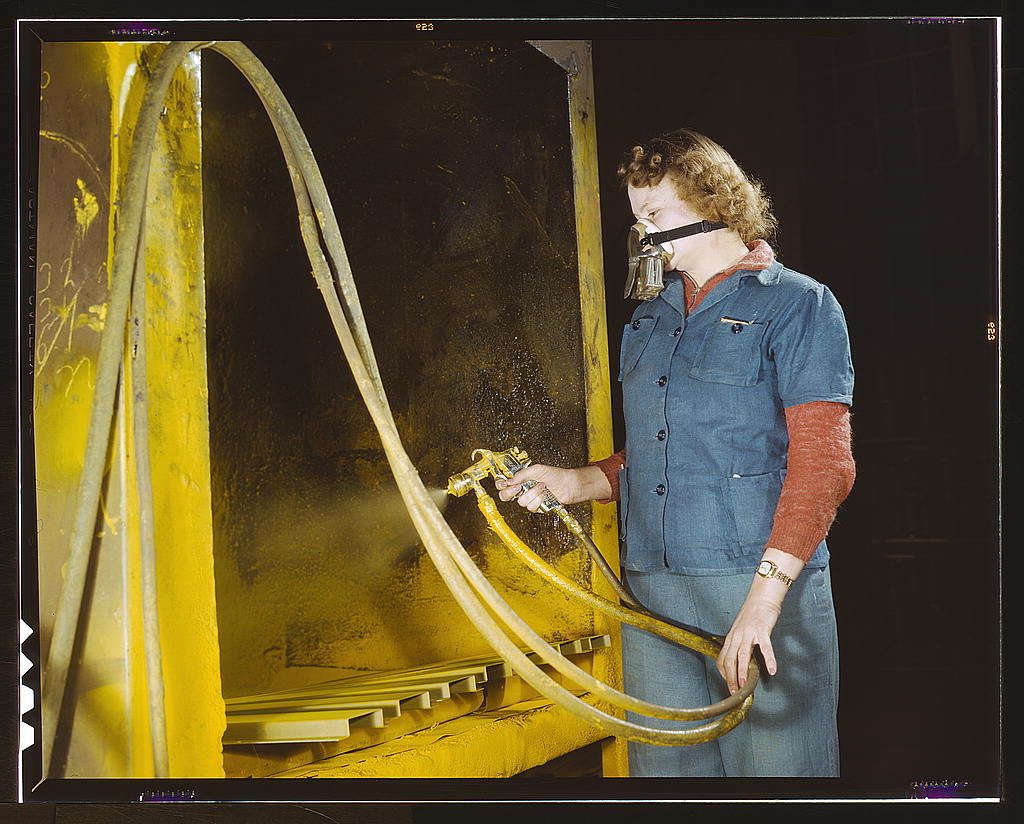
Low monomer content reduces vapor hazard, but spraying creates aerosols that carry isocyanate regardless of volatility. Follow the SDS and use the respiratory protection your safety program specifies.
Stoichiometry and the isocyanate index
The ratio of NCO groups to reactive hydrogen groups is called the index (or NCO:OH ratio), with 1.00 meaning exact equivalence. Coatings are often formulated slightly above 1.0 so that some excess NCO compensates for moisture losses and contributes extra crosslinks.
- Too little isocyanate leaves unreacted resin, giving soft, tacky or solvent-sensitive films.
- Too much isocyanate can make films brittle and, in humid conditions, more prone to gassing.
In the field, off-ratio mixing from worn pumps or poor hand mixing is a common cause of cure problems. Proportioner checks are part of routine plural-component spray practice.
Moisture sensitivity and handling
Because water reacts with NCO, isocyanate components must be protected from humidity:
- Keep containers sealed. Reseal partly used containers promptly, often under a dry nitrogen blanket.
- Use desiccant breathers on bulk drums and plural-component supply tanks.
- Watch storage temperature. Some MDI-based products can crystallize or thicken in the cold; follow the supplier’s storage guidance.
- Respect environmental limits. Apply within the product’s humidity and dew-point limits, and on dry substrates.
- Inspect the material. Skinning, crusting or cloudiness in the hardener indicates moisture contamination.
Pinholes and microbubbles in a urethane film applied on a humid day often point to the water–isocyanate reaction rather than to substrate outgassing. Check application humidity and hardener condition before blaming the surface.
Frequently asked questions
Are all polyurethanes made with isocyanates?
Conventional polyurethanes are. Non-isocyanate polyurethanes based on other chemistries exist and are under active development, but they remain a small share of the coatings market.
Why do aromatic polyureas change color outdoors?
Aromatic isocyanate segments absorb UV light and degrade into colored products. The film usually remains protective, but appearance changes, so an aliphatic topcoat is used where color matters.
What does %NCO on a data sheet mean?
It is the weight percentage of reactive isocyanate groups in the component, used to calculate mix ratios and to check that the material has not been degraded by moisture.
Is cured polyurethane still hazardous?
Fully cured films are generally considered far less hazardous than the liquid components. Heating, cutting or grinding cured material can still release hazardous substances, so follow the SDS.
Educational reference. Coating performance varies by formulation. Always follow the manufacturer’s product data sheet, safety data sheet and your project specification.