Pitting & Crevice Corrosion
Localized corrosion can perforate a wall while most of the surface looks untouched. Learn how pits and crevices start, why they accelerate and how design and coatings stop them.
Key takeaways
- Pitting and crevice corrosion concentrate metal loss in small areas, so penetration rates can be far higher than average corrosion rates suggest.
- Both are driven by a local cell: a small, acidic, chloride-rich anode surrounded by a large cathode.
- Stainless steels and other passive alloys are especially susceptible; resistance improves with chromium, molybdenum and nitrogen content.
- Good design eliminates crevices, and coatings must be applied without holidays to avoid creating new pitting sites.
Uniform corrosion is predictable: steel thins at a measurable rate and engineers add a corrosion allowance. Localized corrosion is different. A pipe can leak through a single pit while wall-thickness readings a few centimeters away look normal. Pitting and crevice corrosion are among the most common localized forms, and they explain many failures on stainless steel, coated carbon steel and equipment exposed to chlorides.
Why localized corrosion is dangerous
In a corrosion cell, the rate of metal loss at the anode depends on how much current the cathode can support. When the anode is tiny and the cathode is large, all that current is concentrated on a small spot. The result is deep, narrow attack.
Localized corrosion is also hard to detect. Pits may be covered by corrosion products or deposits, crevices are hidden by design, and a coating can look intact over active corrosion. Failures therefore often appear suddenly.
How pitting starts and grows
Stainless steel, aluminum and other passive metals depend on a thin oxide film for protection. Chloride ions, and to a lesser extent other halides, can break this film down at weak points such as inclusions, scratches or surface deposits.
Once a pit starts, it tends to become self-sustaining:
- Metal dissolves at the bottom of the pit, releasing positive metal ions.
- Chloride migrates in to balance the charge, concentrating inside the pit.
- Hydrolysis acidifies the solution as metal ions react with water, lowering the local pH.
- Repassivation becomes impossible in the acidic, chloride-rich environment, so dissolution continues while the surrounding surface remains passive and acts as the cathode.
On carbon steel, which has no passive film in neutral water, pitting commonly develops under deposits, at breaks in mill scale and at holidays in coatings. Microbial activity can also produce severe pitting, as described under microbiologically influenced corrosion.
How crevice corrosion works
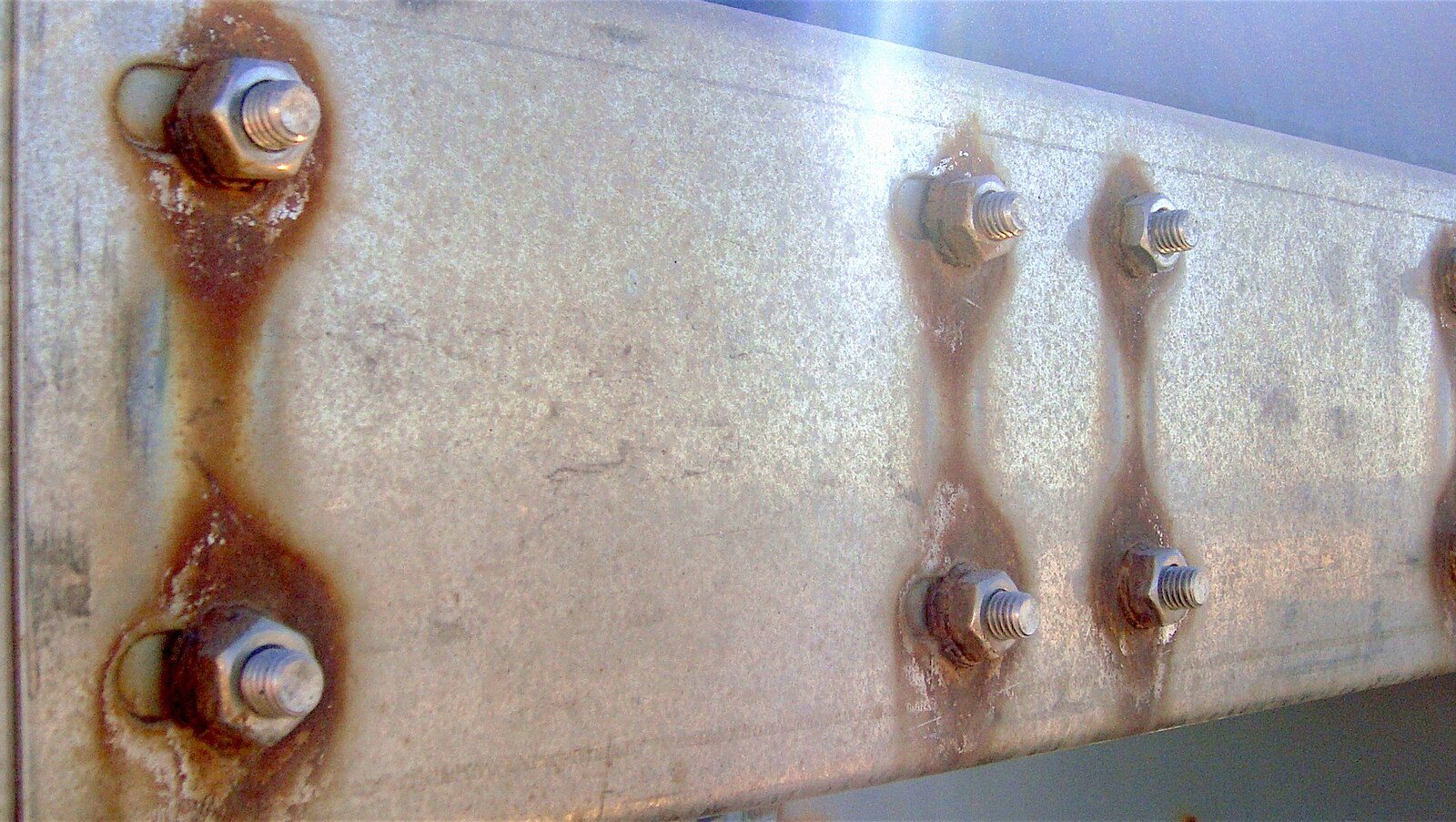
Crevice corrosion occurs in narrow gaps where liquid enters but cannot easily circulate: under gaskets, washers and bolt heads, at lap joints and skip welds, beneath deposits and under disbonded coatings or tapes.
At first, the metal inside and outside the crevice corrodes slowly at the same rate. Oxygen inside the crevice is soon consumed and cannot be replenished, so the inside becomes the anode while the oxygen-rich outside surface becomes the cathode. From that point, the same acidification and chloride concentration seen in pits takes over. Crevice corrosion often starts at lower temperatures and chloride levels than pitting on the same alloy, which is why a stainless steel that resists pitting may still fail at a gasket.
Pack rust between back-to-back angles and at riveted connections is a form of crevice corrosion on carbon steel. The expanding corrosion product can distort plates and break bolts or rivets.
Alloy resistance and PREN
For stainless steels, resistance to localized corrosion is commonly estimated with the Pitting Resistance Equivalent Number. A widely used form is PREN = %Cr + 3.3 × %Mo + 16 × %N. Higher values indicate better resistance, though PREN is only a ranking tool: surface finish, welding quality, temperature and chloride level all matter.
| Alloy group (example) | Approximate PREN | General resistance to chlorides |
|---|---|---|
| Austenitic 304/304L | About 18–20 | Modest; susceptible in marine and chloride service |
| Austenitic 316/316L | About 23–26 | Better; can still pit or crevice-corrode in warm seawater |
| Duplex 2205 | About 34–36 | Good in many chloride environments |
| Super duplex and 6Mo super-austenitic | About 40 or higher | High; used for seawater systems |
Laboratory methods such as the ferric chloride tests in ASTM G48 are used to compare alloys and welds, and ASTM G46 gives guidance on examining and evaluating pits. Results are comparative and should not be read as direct predictions of service life.
Preventing localized corrosion: design and coatings
Design first
- Use continuous seal welds instead of skip or stitch welds in corrosive environments.
- Avoid back-to-back angles, lap joints and pockets that trap water and debris; provide drainage.
- Choose non-absorbent gaskets and seal unavoidable crevices with compatible sealants.
- Keep stainless surfaces clean and free of embedded iron and deposits; restore passivity after fabrication where specified.
Coating considerations
A coating eliminates the electrolyte contact that drives localized attack, but defects can make matters worse by concentrating corrosion at small exposed spots. Good practice includes:
- Stripe coating edges, welds, bolts and crevice openings so these vulnerable areas receive full film thickness; see stripe coating.
- Removing soluble salts before coating, because chlorides trapped at the interface initiate pitting under the film.
- Holiday testing immersion linings so pinholes are found and repaired; see holiday testing.
- Coating stainless steel where chloride exposure, temperature or crevices exceed the alloy’s capability, with appropriate surface preparation; see coating stainless steel.
On submerged and buried structures, cathodic protection can suppress pitting at coating holidays.
When maintaining older structures, caulk or seal small crevices that cannot be eliminated after cleaning and priming, rather than bridging them with paint alone. Paint films alone tend to crack across moving or wet crevices.
Inspecting for pits and crevices
Localized corrosion is best found by combining methods: careful visual inspection after removing deposits, pit-depth gauges, ultrasonic thickness scanning rather than spot readings, and inspection of disassembled joints during maintenance. Measured pit depths and densities help engineers decide whether to repair, fill and coat, or replace components.
Frequently asked questions
Is stainless steel immune to corrosion?
No. Stainless steels resist uniform corrosion well but can suffer pitting and crevice corrosion in chloride environments, particularly at elevated temperatures and in stagnant conditions.
Can pits be repaired with coating?
Shallow pits on carbon steel are often cleaned, filled where needed and coated. Deep pits may require weld repair or replacement. Pits must be thoroughly cleaned of salts and corrosion products, which can be difficult.
Why do pits form under deposits?
Deposits create a shielded area with restricted oxygen, similar to a crevice. They can also harbor chlorides and microbes, both of which promote localized attack.
Educational reference. Coating performance varies by formulation. Always follow the manufacturer’s product data sheet, safety data sheet and your project specification.