Airless Spray Application
How airless pumps, tips and technique combine to apply thick, uniform protective coatings at high production rates — and how to do it safely.
Key takeaways
- Airless spray atomizes coating by forcing it through a small tip at high fluid pressure — commonly 1,500–3,500 psi (100–240 bar) — with no compressed air at the gun.
- It is the workhorse method for protective and industrial coatings because it delivers high production rates and heavy film builds in a single pass.
- Tip selection (orifice size and fan width) controls flow rate, film build and pattern; pressure should be set to the lowest value that fully atomizes the material.
- High-pressure fluid can penetrate skin. Injection injuries are surgical emergencies, so tip guards, trigger locks and a pressure-relief procedure are non-negotiable.
Airless spray is the most widely used method for applying protective coatings to steel, concrete and large architectural surfaces. Instead of using compressed air to break the coating into droplets, an airless pump pressurizes the liquid itself. When that pressurized fluid leaves a precisely machined carbide tip, the sudden pressure drop shears it into a fan-shaped spray of fine droplets.
The result is a fast process that lays down thick, uniform films of high-viscosity materials such as epoxies, elastomeric wall coatings and high-solids primers.
How airless spray works
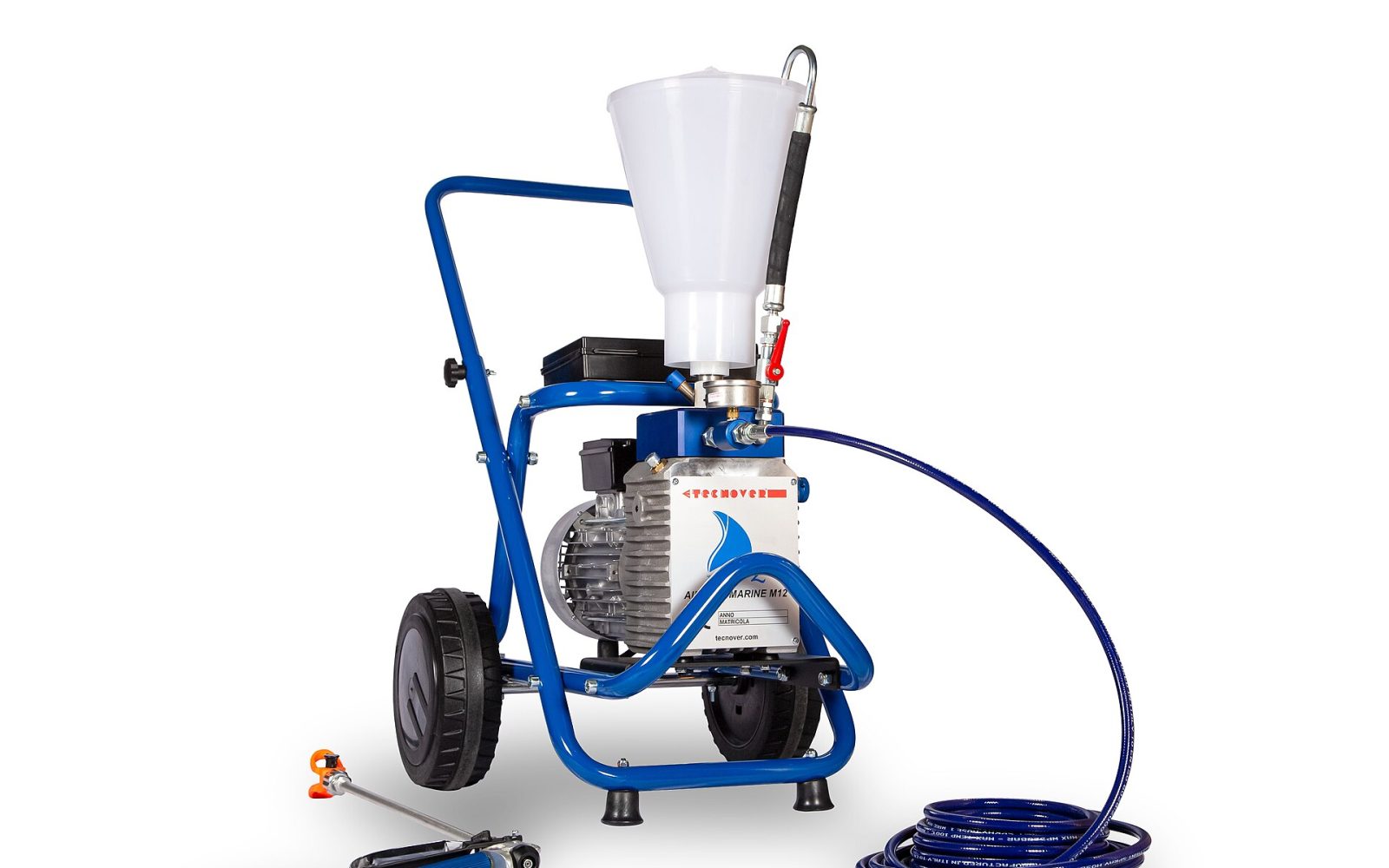
An airless system has four main components: a pump that pressurizes the coating, a high-pressure hose, a spray gun with an on/off trigger valve, and a reversible tip that meters flow and shapes the fan. Inline filters at the pump manifold and in the gun handle catch debris that would otherwise plug the tip.
Atomization depends on the energy released as fluid exits the orifice. Too little pressure produces “tails” or “fingers” — heavy bands at the top and bottom edges of the fan. Too much pressure wastes material as overspray, accelerates tip wear and increases bounce-back. The goal is the lowest pressure that gives a fully atomized, even fan with soft edges.
Pump types
- Electric piston and diaphragm pumps are common for architectural and light industrial work and are convenient where compressed air is unavailable.
- Air-driven (pneumatic) piston pumps dominate heavy industrial and marine work. They are described by a ratio — a 45:1 pump, for example, can theoretically produce 45 times its inlet air pressure at the fluid outlet, so 100 psi (6.9 bar) of air yields up to about 4,500 psi (310 bar) of fluid pressure.
- Hydraulic pumps driven by gas engines are popular on large field projects and spray rigs where high, steady flow is needed.
Choosing the right tip
Most airless tips carry a three-digit code. In the common North American convention, the first digit multiplied by two gives the approximate fan width in inches when sprayed about 12 in (305 mm) from the surface, and the last two digits give the orifice diameter in thousandths of an inch. A 517 tip therefore produces roughly a 10 in (254 mm) fan through a 0.017 in (0.43 mm) orifice.
Orifice size governs flow rate and must suit the coating’s viscosity and solids content. Fan width governs how that flow is spread: the same orifice in a wider fan deposits a thinner wet film per pass.
| Coating type | Typical orifice range | Common fan widths |
|---|---|---|
| Stains, sealers, thin lacquers | 0.009–0.013 in | 4–8 in (100–200 mm) |
| Waterborne acrylics, enamels | 0.013–0.017 in | 8–12 in (200–305 mm) |
| Primers, alkyds, standard epoxies | 0.015–0.021 in | 8–14 in (200–355 mm) |
| High-build and high-solids epoxies | 0.019–0.027 in | 10–16 in (255–405 mm) |
| Elastomerics, block fillers, mastics | 0.025–0.035 in+ | 10–18 in (255–455 mm) |
These ranges are starting points only. The coating manufacturer’s product data sheet (PDS) usually lists a recommended tip range, pump ratio or fluid pressure, and the permissible thinning — always check it first.
Tips wear. As the orifice erodes, flow rises and the fan narrows, so a worn tip quietly increases film build and material use. Many crews replace tips on a schedule for abrasive coatings such as zinc-rich primers, and they check the fan width against a new tip of the same size.
Spray technique
Good technique delivers uniform wet film thickness (WFT) and avoids runs, sags, dry spray and holidays.
- Distance: hold the gun roughly 12–18 in (300–450 mm) from the surface, closer for fine finishes and slightly farther for high-build work.
- Angle: keep the gun perpendicular to the surface. Arcing the wrist at the end of a stroke tilts the fan and thins the film at the edges of each pass.
- Overlap: overlap each pass by about 50% so the film builds evenly.
- Triggering: start moving before pulling the trigger and release before stopping, to avoid heavy spots at the ends of each pass.
- Edges first: on steel, stripe-coat edges, welds, bolts and corners — often by brush — before the full coat, because spray films pull thin at sharp edges.
Measure wet film frequently with a notch gauge per ASTM D4414 and adjust speed or tip size as needed. Expected dry film thickness (DFT) is the WFT multiplied by the coating’s volume solids, adjusted for any thinner added. Our WFT/DFT converter does the arithmetic, and volume solids and coverage explains the relationship in detail. Final acceptance is based on dry film thickness measurement, not wet readings.
Air-assisted airless
Air-assisted airless (sometimes called “air-assist”) is a hybrid. The fluid is pressurized to a moderate level — commonly a few hundred to about 1,500 psi — and a small amount of atomizing air from horns on the air cap refines the pattern and eliminates tails. It gives a finer finish and less overspray than straight airless with higher production than conventional air spray, which makes it popular in shop finishing of steel fabrications and machinery. For finishing work at lower film builds, see HVLP and conventional air spray.
Advantages and limitations
Advantages
- High production rates on large surfaces such as tanks, hulls, bridges and walls.
- Handles high-viscosity, high-solids coatings, often with little or no thinning.
- Heavy film build per coat reduces the number of coats needed.
- Good penetration into pits, crevices and the profile of blasted steel.
- No compressed air contact with the coating, so no risk of oil or water contamination from the air supply at the gun.
Limitations
- Overspray and drift require masking and wind control outdoors.
- Finish is typically less refined than air spray for high-gloss cosmetic work.
- Serious injection-injury hazard from high fluid pressure.
- Pot life still applies to mixed two-component coatings; for very fast-curing chemistries see plural-component spray equipment.
- Tips plug and wear, especially with zinc-filled or aggregate-filled products.
Setup, cleaning and shutdown
- Prepare the material. Condition the coating to the temperature range on the PDS, mix thoroughly with a power mixer, observe any induction time for two-component products, and strain if required.
- Check the equipment. Confirm filters are clean and match the coating (coarser mesh for heavily pigmented products), the hose is rated for the pump’s maximum pressure, and the tip guard is fitted.
- Ground the system. Ground the pump and the object being sprayed and use a conductive hose. Solvent-borne coatings can build static charge as they flow, and a spark near solvent vapor can ignite it.
- Prime and flush. Flush storage fluid with a compatible solvent, then prime with coating until it flows clean.
- Set pressure and test. Start low and raise the pressure until tails disappear. Spray a test panel and check the pattern and WFT.
- Clean promptly. At breaks and shutdown, relieve pressure, flush with the solvent the PDS recommends, and clean the tip and filters. Mixed two-component materials must be flushed before their pot life expires or they will cure inside the pump and hose.
Safety considerations
An airless injection injury can look like a minor cut yet inject coating and solvent deep into tissue. It requires immediate emergency surgical treatment — tell medical staff exactly what material was injected. Never point the gun at anyone, never put a hand or finger over the tip, and always engage the trigger lock and relieve pressure before cleaning, changing tips or clearing a clog.
Other key hazards include solvent vapor (ventilation, respiratory protection and ignition control), hose failure at kinks or worn couplings, and slips on overspray. Environmental conditions also matter: substrate temperature, humidity and dew point limits apply to every spray job — see environmental conditions for coating.
Frequently asked questions
What pressure should I use for airless spraying?
Use the lowest pressure that fully atomizes the material without tails. For many coatings that falls somewhere between about 1,500 and 3,000 psi (100–210 bar), but high-solids and high-build products may need more. Follow the product data sheet, which often lists a pump ratio or minimum fluid pressure.
What does a 517 airless tip mean?
In the common convention, the 5 indicates a fan roughly 10 in (254 mm) wide at about 12 in (305 mm) from the surface, and 17 indicates a 0.017 in (0.43 mm) orifice. Manufacturers vary slightly in how they rate fan width, so check their charts.
Can I thin coatings to spray them through a smaller tip?
Only within the limits the manufacturer allows. Excess thinning lowers volume solids, reduces dry film per coat, can raise VOC content above local limits, and increases the risk of sags and solvent entrapment. Choosing a larger tip or a higher-ratio pump is usually the better fix.
Is airless spray suitable for zinc-rich primers?
Yes, but zinc-rich primers are heavy and abrasive. They typically need continuous agitation to keep the zinc in suspension, appropriately sized filters or no fine filters at all per the PDS, and more frequent tip replacement.
Educational reference. Coating performance varies by formulation. Always follow the manufacturer’s product data sheet, safety data sheet and your project specification.