Chalking & Fading
How UV light breaks down coating binders and pigments to cause chalking, gloss loss, fading and yellowing — and how to test, restore and prevent them.

Key takeaways
- Chalking is the formation of a loose, powdery layer on a coating surface as ultraviolet light, oxygen and moisture break down the binder and release pigment.
- Fading is a change in color caused by pigment degradation, chalk scattering light, or both; gloss loss is usually the first visible stage.
- Aromatic epoxies chalk readily in sunlight; aliphatic polyurethanes, polysiloxanes and fluoropolymers are chosen as topcoats because they resist it.
- Chalk must be removed before recoating or it will act as a bond breaker.
Chalking and fading are weathering failures of the outermost coat. They are often treated as cosmetic, and in early stages they mostly are. But chalking is a sign that the binder is eroding, and over years it can thin the film until barrier protection is reduced. Chalk is also a common cause of adhesion failure when weathered surfaces are overcoated without proper cleaning.
What chalking and fading look like
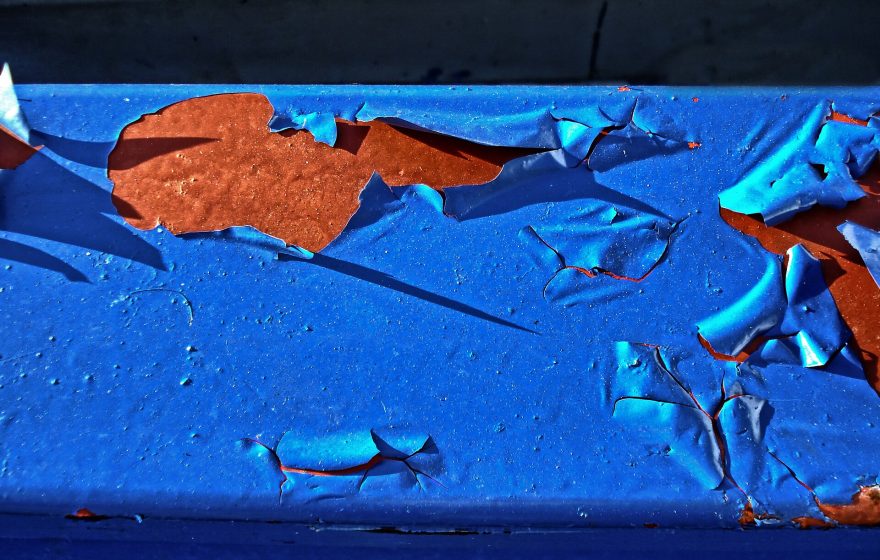
- Chalking: a powdery residue that transfers to a finger or dark cloth. Colors look washed out, and dark colors look lighter and hazy. Chalk may run down walls as streaks after rain.
- Gloss loss: a dull, flat surface caused by micro-roughening as the binder erodes — typically the earliest stage.
- Fading: a color shift that remains after the surface is washed, often showing first in reds, yellows and some blues.
- Yellowing: a darkening or ambering, common in epoxies and in some alkyds and aromatic systems.
A quick field distinction: if wiping with a damp cloth temporarily restores the original color, the change is mostly chalk; if the color stays shifted, the pigment itself has faded.
Root causes
Photo-oxidation of the binder
Ultraviolet radiation breaks chemical bonds in the polymer at the surface. With oxygen and moisture present, the damaged binder erodes away, leaving pigment and extender particles loosely held as chalk. Binders containing aromatic structures absorb UV strongly; that is why aromatic epoxy coatings chalk and yellow in sunlight, sometimes within months of exposure, even though they perform well out of the sun.
Pigment selection
Titanium dioxide comes in two crystal forms. Anatase is more photoactive and can accelerate binder breakdown; surface-treated rutile grades are used in durable exterior coatings. Some organic pigments have limited lightfastness and fade relatively quickly, while many inorganic and high-performance organic pigments hold color far longer.
Unsuitable resin for exterior exposure
Resins differ greatly in UV resistance. Broadly, aliphatic polyurethanes, polysiloxanes, polyaspartics and fluoropolymers retain gloss and color well; acrylics vary with formulation; alkyds tend to chalk and lose gloss sooner; aromatic epoxies and aromatic polyureas chalk or discolor readily unless topcoated.
Exposure severity and film thickness
High UV intensity, high temperatures, humidity cycling and orientation (south- and west-facing surfaces in the northern hemisphere) all accelerate weathering. A topcoat applied thin has less material to lose before the underlying coat is exposed.
Moisture works alongside UV: repeated wetting and drying carries degraded binder and loose pigment away and exposes fresh surface to attack. That is why chalking is usually heaviest on surfaces that receive both strong sun and frequent dew or rain, and lightest under eaves and on shaded faces.
How to diagnose
- Rate the chalk. ASTM D4214 describes cloth, finger and tape methods compared against photographic references; ISO 4628-6 uses a tape method. Test several orientations and compare with sheltered areas.
- Measure gloss. Use a glossmeter per ASTM D523, typically at 60°, or 20° for high-gloss finishes, and compare with the original specification or a retained panel.
- Measure color. Instrumental color readings with the difference calculated per ASTM D2244 quantify fading or yellowing. Clean a spot first to separate chalk effects from true fading.
- Check remaining thickness. Survey DFT to see how much topcoat has eroded and whether the underlying coat is exposed.
- Identify the topcoat. Records or lab analysis (FTIR) can confirm whether a UV-sensitive product was used where a UV-stable topcoat was intended.
Accelerated weathering tests such as ASTM G154 (fluorescent UV) and ASTM G155 (xenon arc) are useful for ranking products, but correlation with real outdoor exposure varies. Natural exposure data from sunny test sites carries more weight when it is available.
Causes, diagnostic clues and prevention
| Cause | Typical clues | Confirming check | Prevention |
|---|---|---|---|
| UV-sensitive binder | Heavy chalk and yellowing on sun-exposed faces | ASTM D4214 or ISO 4628-6; FTIR of topcoat | UV-stable topcoat over epoxy |
| Photoactive pigment | Rapid chalking of white or pastel coatings | Formulation data | Durable, surface-treated rutile TiO₂ |
| Low-lightfastness pigment | Color shift that remains after washing | ASTM D2244 color difference | Lightfast inorganic or high-performance pigments |
| Binder erosion | Dull surface; gloss drops over time | ASTM D523 gloss readings | Resin with proven gloss retention |
| Thin topcoat | Underlying coat showing through | DFT survey | Apply specified topcoat DFT |
| Epoxy left untopcoated | Chalked interface beneath peeling topcoat | Tape test of lower coat; records | Topcoat within the epoxy recoat window |
How to repair chalked or faded coatings
- Assess the system. Confirm the remaining DFT and that the coating beneath is well adhered. Chalking alone does not require removal of a sound system.
- Remove the chalk. Wash with detergent and scrubbing or pressure washing, then rinse thoroughly with clean water and allow to dry.
- Verify. Repeat a tape or cloth test; the surface should transfer little or no chalk.
- Abrade where needed. Scuff-sand hard, glossy or fully cured coatings such as epoxies so the new coat can bond.
- Prime if required. Where some chalk cannot be removed, use a primer the manufacturer recommends for chalky surfaces.
- Recoat with a UV-stable topcoat. Apply a compatible, weathering-resistant finish at the specified DFT.
Painting directly over chalk is a frequent cause of delamination. The new coat bonds to loose powder rather than to the old film and can peel within a season.
How to prevent chalking and fading
- Select for exposure. For sun-exposed steel, specify a UV-stable topcoat over epoxy rather than relying on epoxy alone.
- Specify performance. Ask for gloss and color retention data from accelerated and, ideally, natural weathering.
- Choose lightfast colors. Bright reds, yellows and some blues may need premium pigments; dark colors show chalk more visibly.
- Topcoat on time. Apply the finish within the primer’s or intermediate’s recoat window to avoid a chalked interface.
- Apply full DFT. Verify topcoat thickness to provide a reserve against erosion.
- Maintain. Periodic washing removes chalk and contaminants and extends the time before recoating is needed.
Frequently asked questions
Is chalking a coating failure?
Some chalking is normal weathering for many coatings. It becomes a failure when it exceeds what the specification allows, erodes the film too far, or occurs on a product that was supposed to resist it.
Why did my epoxy floor or tank exterior turn yellow and powdery outdoors?
Aromatic epoxies absorb UV, which degrades and discolors the surface. They are normally topcoated with a UV-stable finish for outdoor exposure.
Does washing a chalky surface fix it?
Washing restores appearance temporarily and prepares the surface, but the binder will keep eroding. A durable topcoat is the longer-term fix.
How fast does a coating chalk?
It varies widely with resin, pigment, color and climate. A UV-sensitive epoxy in strong sun can chalk noticeably within its first season, while a high-performance fluoropolymer or polysiloxane finish may retain gloss and color for many years. Manufacturer weathering data is the best guide for a specific product.
Educational reference. Coating performance varies by formulation. Always follow the manufacturer’s product data sheet, safety data sheet and your project specification.