Efflorescence
The white, powdery salt deposits that bloom on concrete, brick and masonry — where they come from, how they push coatings off, and how to remove and prevent them.
Key takeaways
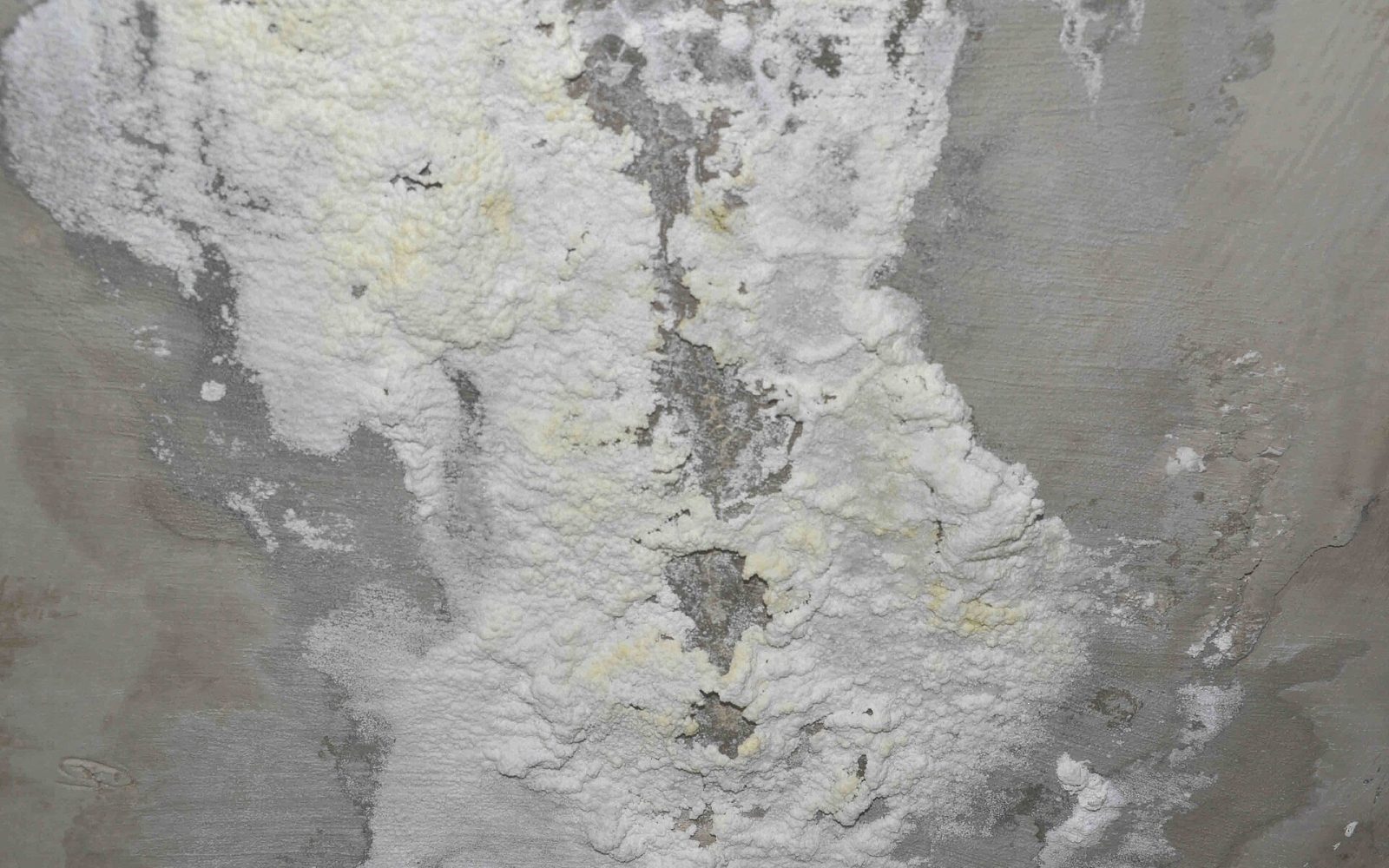
- Efflorescence is a crystalline salt deposit, usually white, left on the surface of concrete or masonry when water carrying dissolved salts evaporates.
- Three things must be present: soluble salts, enough water to dissolve and transport them, and a pathway to a surface where the water can evaporate.
- Under a coating, salts can crystallize at the interface and push the film off — a failure sometimes called subflorescence or cryptoflorescence.
- Cleaning without stopping the water is temporary; durable fixes address moisture sources and use coatings suited to damp, alkaline substrates.
Efflorescence is one of the most common blemishes on concrete, brick, block, stucco and stone. On bare masonry it is mainly cosmetic, but on coated surfaces it signals that water is moving through the substrate and that soluble salts are being delivered to the coating interface — conditions that can lead to blistering, peeling and premature failure.
It is often confused with mold, chalking or saponification. The distinguishing feature is that efflorescence is a mineral deposit that often dissolves or fizzes, while those defects are biological growth or degradation of the coating itself.
What efflorescence looks like
- White, gray or occasionally yellowish powdery or crystalline deposits on the surface, sometimes fluffy, sometimes a hard crust.
- Patterns that follow water: along mortar joints, cracks, below windowsills and copings, at the base of walls and around floor joints.
- Bubbles or blisters in coatings containing white powder, and peeling paint with salt crystals on the back of the flakes.
- Seasonal behavior: often worse in cool, damp seasons on exteriors and after a wet construction phase on new buildings.
How efflorescence forms
Where the salts come from
Portland cement contains calcium hydroxide and alkali compounds that dissolve in water. Brick, sand, aggregates, mixing water, admixtures, groundwater, de-icing salts and even air pollution can add sulfates, chlorides and nitrates. When calcium hydroxide reaches the surface it reacts with carbon dioxide from the air to form calcium carbonate, a hard white deposit that is not readily water soluble.
Primary and secondary efflorescence
Primary efflorescence appears on new construction as mixing and curing water leaves the material, usually within the first months, and often diminishes as the structure dries. Secondary efflorescence appears later when external water — rain penetration, leaks, groundwater, condensation — enters and dissolves salts. Secondary efflorescence persists as long as the water source does.
Water pathways
Typical sources are failed flashing and sealants, cracks, rising damp from ground contact, water tables under slabs-on-grade without effective vapor retarders, and condensation in cold walls. Hydrostatic pressure on below-grade walls is a particularly strong driver.
When salts crystallize just below the surface, inside the pores rather than on top, they can generate enough pressure to spall brick and concrete faces. Coatings that restrict evaporation can move the crystallization zone inward and make this worse.
Efflorescence and coating failure
Efflorescence affects coatings in two ways. If salts are on the surface when the coating is applied, they reduce adhesion and, under a low-permeability film, attract water by osmosis, a mechanism closely related to osmotic blistering. If water moves through the substrate after coating, salts are delivered to the interface where they crystallize and force the film away. Breathable coatings may allow some salt to pass through and deposit on their surface, producing white staining over an otherwise sound film.
On floors, efflorescence beneath epoxy or other dense coatings is a warning sign of moisture vapor emission or hydrostatic pressure in the slab. See floor coating failures.
Diagnosing efflorescence
- Confirm it is salt. Many deposits dissolve when a small amount of water is applied; calcium carbonate does not dissolve readily but fizzes under a drop of dilute acid. Mold, by contrast, smears and may be fuzzy or dark.
- Trace the water. Map deposits against roof drainage, sealant joints, cracks, grade lines and plumbing.
- Measure moisture. Use moisture meters on masonry and recognized methods such as ASTM F2170 or ASTM F1869 on slabs; see concrete moisture testing.
- Analyze if needed. Laboratory analysis of collected deposits identifies the salts and can suggest their source, such as de-icing chlorides or sulfates from soil.
| Cause | Clues | How to check | Prevention |
|---|---|---|---|
| Construction moisture | Uniform bloom on new work | Building age, moisture readings | Allow drying before coating |
| Rain penetration | Deposits below sills, joints, cracks | Water test, sealant survey | Repair flashing, sealants, cracks |
| Rising damp | Band near base of wall | Moisture profile up the wall | Damp-proofing, grading, drainage |
| Slab moisture vapor | Salts under floor coating blisters | ASTM F2170 / F1869 testing | Vapor retarder; moisture-tolerant primer |
| Salts on surface at coating | Early peeling with crystals behind film | Inspect back of flakes, surface wipe | Clean and rinse before coating |
Removal and repair
- Dry brushing with a stiff nylon brush removes loose, fluffy deposits; vacuum rather than washing them back into the surface.
- Water rinsing removes soluble salts, but use as little water as practical and allow thorough drying.
- Mild acid cleaners formulated for masonry may be needed for calcium carbonate crusts. Pre-wet the surface, follow the product directions, then rinse thoroughly to remove all acid and dissolved salts. Test first on an inconspicuous area, as acids can etch or discolor masonry.
- Remove failed coating where salts have lifted it, clean the substrate, and let it dry before recoating.
Pressure washing and heavy acid washing can drive water and dissolved salts deeper, feeding the next round of efflorescence. Always fix the water source first and let the substrate dry before applying any coating.
Prevention
- Design and maintain good drainage, flashing, copings and sealant joints.
- Use low-alkali materials, clean aggregates and good curing practice in new work.
- Allow new concrete and masonry to dry before coating and check moisture.
- Select breathable coatings or penetrating silane and siloxane water repellents on vertical masonry where vapor must escape.
- On slabs, confirm moisture and use moisture-mitigating primers where readings are high.
Frequently asked questions
Will efflorescence go away on its own?
Primary efflorescence on new construction often fades as the building dries and rain washes the surface. Secondary efflorescence will keep returning while water keeps entering.
Can I seal over efflorescence?
Not until the salts are removed and the water source controlled. Sealing over salts and moisture typically leads to peeling or blistering.
Is efflorescence harmful to the structure?
Usually it is cosmetic, but it indicates water movement. Persistent moisture and salt crystallization can damage masonry, corrode reinforcement and destroy coatings over time.
Educational reference. Coating performance varies by formulation. Always follow the manufacturer’s product data sheet, safety data sheet and your project specification.