Mill Scale
Mill scale is the blue-gray iron oxide crust formed on hot-rolled steel. It looks protective, but it cracks, drives galvanic corrosion and undermines coatings unless it is removed.
Key takeaways
- Mill scale is a layered iron oxide skin formed on steel during hot rolling and other high-temperature processing.
- It is electrochemically more noble than steel, so where the scale cracks, the exposed steel corrodes preferentially, often as pitting.
- Coatings applied over intact mill scale fail when the scale cracks or detaches, taking the coating with it.
- Abrasive blasting to SSPC-SP 10/NACE No. 2 (Sa 2½) or better is the usual requirement for high-performance coatings; brush-off and power-tool methods leave tight scale behind.
Hot-rolled steel leaves the mill with a dark, blue-gray finish. That surface is mill scale, a thin crust of iron oxides formed when hot steel reacts with air. It can look tough and even protective, and on new steel it can be tightly bonded. For coating purposes, however, it is one of the most important things to remove.
Understanding mill scale explains why so many specifications for coating carbon steel start with blast cleaning rather than simple cleaning.
How mill scale forms
When steel is rolled or forged at high temperature, its surface oxidizes rapidly. As the steel cools, the oxide grows in layers whose composition changes from the steel outward:
- Wüstite (FeO) next to the steel, the most iron-rich layer, which partially transforms as it cools.
- Magnetite (Fe₃O₄), typically the bulk of the scale, dark and magnetic.
- Hematite (Fe₂O₃), a thin outer layer.
Scale thickness and adhesion depend on rolling temperature, cooling rate, steel grade and section size, and it is commonly in the range of tens of micrometres (a few mils at most). Cold-rolled steel generally does not carry the same heavy scale, though it may have oils and thin oxides of its own. Similar oxide scales form on steel during heat treatment and on and around welds.
Why mill scale is a problem for coatings
Galvanic corrosion
Mill scale conducts electrons and is cathodic to the underlying steel. Where the scale has cracked or been chipped off, the small exposed area of steel becomes the anode in a cell with the large scale-covered cathode. This large-cathode, small-anode arrangement concentrates corrosion and is a classic cause of deep pitting on steel that was coated over scale (see galvanic corrosion).
Mechanical failure
Scale and steel expand at different rates with temperature, and the brittle oxide cracks as steel flexes. Moisture and oxygen then enter the cracks and rust forms beneath the scale, lifting it. Any coating bonded to the scale lifts with it, typically as large flakes.
Poor anchor pattern
Scale is smooth and dense. Even where tightly adherent, it provides little profile for the coating to key into, and its adhesion to the steel varies across the same piece.
“Tight” mill scale is relative. Scale that resists a dull putty knife today will loosen with weathering, thermal cycling and flexing. That is why most high-performance and immersion specifications require complete removal rather than allowing tight scale to remain.
Describing mill scale: ISO 8501-1 rust grades
ISO 8501-1 defines four initial conditions of uncoated steel, referred to as rust grades, with photographic references. They describe how much scale and rust is present before preparation:
| Rust grade | Condition before preparation | Practical meaning |
|---|---|---|
| A | Largely covered with adherent mill scale, little if any rust | New steel; scale tight and continuous; slowest to blast |
| B | Mill scale beginning to flake, with some rust | Scale cracking and lifting in places |
| C | Mill scale rusted away or scrapable, slight pitting visible | Mostly rust; scale largely gone |
| D | Mill scale rusted away, general pitting visible | Heavily corroded; pits may hold salts |
The final appearance after blasting depends on this starting grade, so visual standards show, for example, a blast-cleaned grade A surface and a blast-cleaned grade C surface separately. SSPC-VIS 1 uses a similar set of initial conditions.
Removing mill scale
How much scale may remain is defined by the cleanliness standard (see surface preparation standards):
- SSPC-SP 7/NACE No. 4 (brush-off, Sa 1) and SSPC-SP 2/SP 3 (hand and power tool cleaning) permit tightly adhering mill scale to remain.
- SSPC-SP 6/NACE No. 3 (commercial, Sa 2) and SSPC-SP 10/NACE No. 2 (near-white, Sa 2½) remove mill scale but allow limited staining on a specified percentage of each unit area.
- SSPC-SP 5/NACE No. 1 (white metal, Sa 3) removes all scale, rust and staining.
- SSPC-SP 11 (power tool cleaning to bare metal) removes scale where blasting is impractical, though slowly.
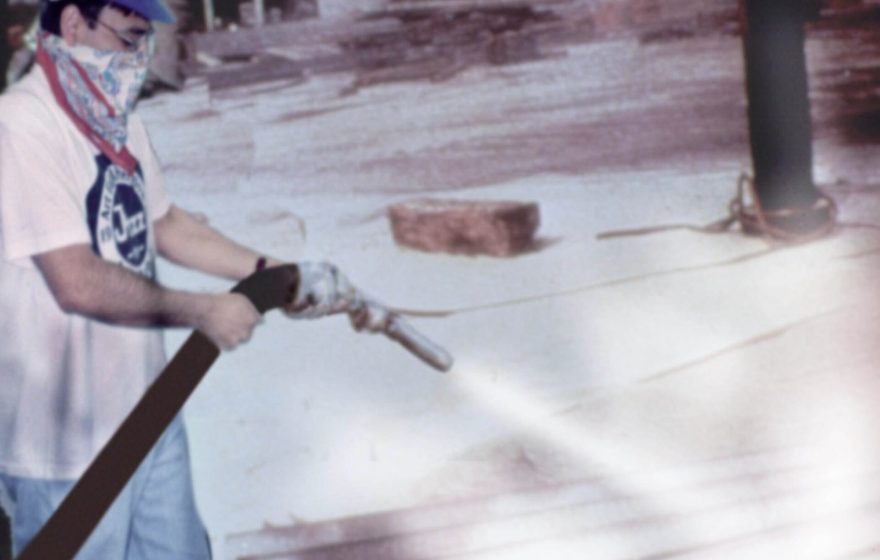
In practice, abrasive blasting with angular steel grit or mineral abrasive is the standard method. In fabrication shops, centrifugal wheel blasting with steel shot and grit mixes removes scale efficiently from plate and sections before or after fabrication. Pickling in acid is used for some products such as sheet and before galvanizing.
- Assess the steel. Identify the rust grade and any welds, heat-tinted areas or laminations.
- Pre-clean. Remove oil and grease per SSPC-SP 1 before blasting.
- Blast to the specified grade. Use abrasive sized to break scale and give the required profile.
- Inspect closely. Look for thin, glossy islands of remaining scale, particularly on rust grade A steel, at heat-affected zones and in corners.
- Coat before rust-back. Prime within the specified window and environmental limits.
Remaining mill scale can be hard to see under shop lighting, especially on dark abrasive-blasted steel. Inspect with a strong, raking light; scale shows as smooth, slightly bluish patches without profile. Some inspectors use a copper sulfate spot test, which deposits copper on bare steel but not on scale.
Weathering, shortcuts and surface-tolerant coatings
Leaving steel outdoors to “weather off” its scale is an old practice that converts grade A steel toward grade C. It makes scale easier to remove, but also introduces rust, pitting and soluble salts that are harder to clean. It is not a substitute for blasting.
For maintenance work where blasting is not possible, surface-tolerant epoxy mastics are designed to penetrate and bond to tight scale and rust remaining after hand or power-tool cleaning. They can extend service life, but performance is generally lower than on blasted steel, and they are not appropriate for immersion linings unless the manufacturer says so.
Frequently asked questions
Can I paint over mill scale?
You can, but expect shorter life. Scale eventually cracks and lifts, and the coating with it. For long service life, remove it by blast cleaning to the specified standard.
Is mill scale the same as rust?
No. Mill scale forms at high temperature during manufacture and is mostly magnetite; rust forms at ambient temperature through corrosion and is mainly hydrated iron oxides.
Does mill scale protect steel?
Only while it is completely intact. Once it cracks, it accelerates corrosion at the breaks because it is cathodic to steel.
What abrasive removes mill scale best?
Angular abrasives such as steel grit and hard mineral abrasives fracture scale efficiently. Shot alone peens rather than cuts and is usually blended with grit for scale removal.
Educational reference. Coating performance varies by formulation. Always follow the manufacturer’s product data sheet, safety data sheet and your project specification.