Fireproofing Structural Steel
How spray-applied fire-resistive materials, intumescent coatings and boards slow steel heating so buildings and plants keep standing long enough to evacuate.
Key takeaways
- Fireproofing does not make steel fireproof; it slows heating so the structure retains enough strength for the required rating period.
- Required thickness comes from a tested, listed design and depends on the rating, the section’s weight-to-heated-perimeter ratio and the fire type.
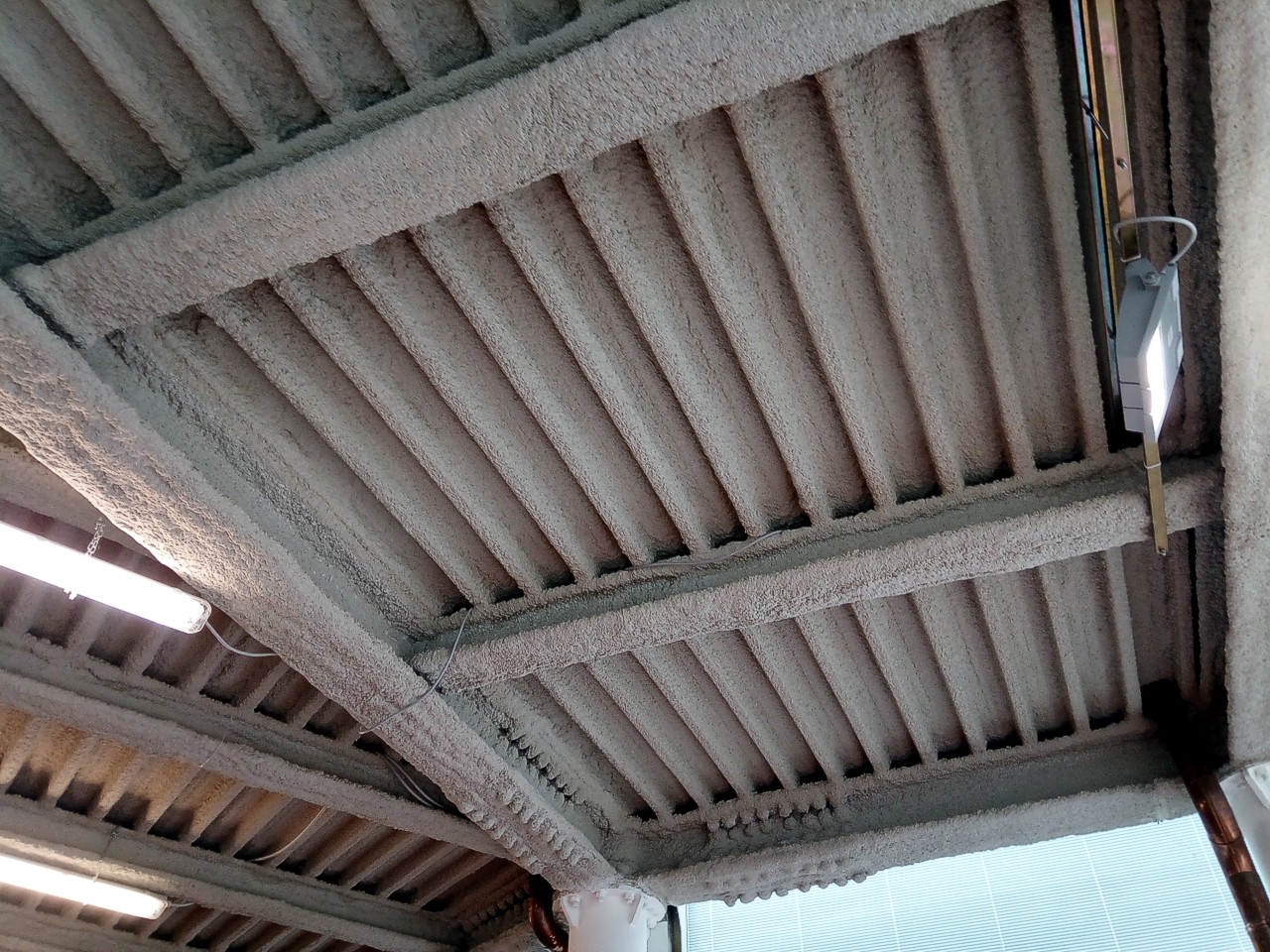
- Spray-applied fire-resistive materials (SFRM) are economical for concealed steel; intumescent coatings suit exposed, architectural and many exterior applications.
- Primer and topcoat compatibility must be confirmed against the fireproofing listing, not assumed.
- Thickness, density and bond strength are verified in the field, and damaged fireproofing must be repaired before the space is closed in.
Structural steel does not burn, but it loses strength and stiffness rapidly as it heats. Above roughly 1,000 °F (about 540 °C), carbon steel has lost a substantial share of its room-temperature yield strength, and an unprotected member in a severe fire can reach that range in minutes. Passive fire protection insulates the steel so it heats slowly, buying time for evacuation, firefighting and, ideally, preventing collapse.
Fireproofing is a life-safety system governed by building codes and tested assemblies, so the coating specialist’s job is to install exactly what a listed design requires and to integrate it properly with the corrosion protection system beneath it.
Fire types and how ratings work
Fire-resistance ratings are earned in furnace tests that follow a standard time–temperature curve. Two broad fire scenarios matter:
- Cellulosic (building) fires burn ordinary combustibles and rise in temperature relatively gradually. In North America, ratings are established under ASTM E119 and its counterpart UL 263; ISO 834 is the comparable international curve.
- Hydrocarbon pool fires in refineries, chemical plants and offshore facilities reach very high temperatures within minutes. UL 1709 is the common North American rapid-rise test for these exposures, and jet-fire resistance is assessed separately where pressurized releases are possible.
Ratings are usually expressed in hours (commonly 1, 1½, 2, 3 or 4). The tested product, thickness and member type are published as a listed design by a certification body; designers select a design and installers must match it.
Fireproofing materials compared
| Material | Typical thickness | Strengths | Limitations |
|---|---|---|---|
| Cementitious SFRM (gypsum- or Portland-based) | Roughly ½–2+ in (13–50+ mm) | Low material cost; fast coverage on large areas | Rough appearance; damage-prone; mostly concealed interior use unless rated for exterior |
| Fiber-based SFRM | Similar to cementitious | Light weight, good insulation | Soft; easily damaged; interior concealed spaces |
| Thin-film intumescent | Often ~20–200+ mils (0.5–5+ mm) DFT | Smooth paint-like finish for exposed steel | Higher cost; needs compatible primer and often a topcoat |
| Epoxy intumescent (thick-film) | Commonly several to 25+ mm | Hydrocarbon and jet-fire ratings; tough, weather-resistant | High cost; skilled application; mesh reinforcement in many designs |
| Boards and wraps | Per listed design | Dry install, predictable thickness | Labor-intensive around connections |
| Concrete encasement | Per design | Very robust, long-lived | Heavy; adds dead load |
The chemistry and char behavior of reactive coatings are covered in detail in intumescent fireproofing coatings.
What drives the required thickness
A heavy, compact section heats more slowly than a light one because it has more mass per unit of surface exposed to fire. This is captured in the W/D ratio (weight per foot divided by heated perimeter) in North American practice, and the equivalent section factor (heated perimeter divided by cross-sectional area, Hp/A) in European practice. Light members with low W/D need more fireproofing for the same rating.
Other factors include whether the member is a beam, column or brace, whether the assembly is classified as restrained or unrestrained, and whether the rating is based on a limiting steel temperature or on loaded assembly performance. Engineers or the fireproofing manufacturer typically produce a thickness schedule from these inputs; installers should not substitute products or adjust thicknesses without approval.
Primers, galvanizing and topcoats
Many interior SFRM applications go directly over unprimed steel, and some listings restrict which primers may be used beneath them because a smooth or incompatible primer can reduce bond strength. Where corrosion protection is needed, the primer must be one the fireproofing manufacturer accepts, and a bonding agent or mechanical lath may be required.
Intumescent coatings almost always go over a compatible primer applied to blast-cleaned steel, and exterior or humid exposures generally call for a sealer or topcoat. Galvanized steel needs special attention to adhesion; see coating galvanized steel. The corrosion protection system for the underlying steel follows the principles in structural steel and bridge coatings.
Never substitute a primer, topcoat or fireproofing product because it is “equivalent.” A fire rating applies only to the tested combination. Obtain written compatibility confirmation from the fireproofing manufacturer for every layer.
Installation and quality assurance
- Verify the substrate. Steel must be free of oil, loose mill scale and rust, and any primer must be compatible and fully cured.
- Coordinate sequencing. Clips, hangers and ductwork supports should be installed before fireproofing so it is not knocked off later.
- Apply to the schedule. Spray in passes to the required thickness for each member size, maintaining specified temperature and ventilation conditions.
- Measure. SFRM thickness and density are verified per ASTM E605; intumescent DFT is measured with gauges as described in DFT measurement, often with more readings than standard paint work.
- Test bond. Cohesion and adhesion of SFRM are checked per ASTM E736 where specified by code or contract.
- Repair and inspect. Patch damage from other trades and complete special inspections before ceilings and walls conceal the work.
Industrial and exterior fireproofing
In refineries and petrochemical plants, fireproofing protects pipe racks, vessel skirts and equipment supports from hydrocarbon fires. Dense concrete and exterior-grade cementitious products have been used for decades, but water can wick behind cracked or poorly sealed fireproofing and cause severe hidden corrosion. NACE SP0198 addresses corrosion under insulation and fireproofing, and plant inspection programs routinely target these areas. Epoxy intumescents are widely used for their weather resistance and lower weight. Broader plant coating strategy is covered in chemical processing plant coatings.
Frequently asked questions
Is intumescent paint better than spray fireproofing?
Neither is universally better. SFRM is usually more economical for concealed steel, while intumescents provide a thin, decorative finish for exposed steel and better weather resistance in many grades.
Can fireproofing be applied over existing paint?
Only if the fireproofing manufacturer confirms compatibility and adhesion. Unknown or aged coatings often need removal or adhesion testing first.
How is fireproofing thickness checked?
SFRM is measured with depth gauges and density samples per ASTM E605. Intumescent coatings are measured with dry film thickness gauges at frequencies set by the specification or listing.
Does fireproofing also protect against corrosion?
Not reliably. Some fireproofing can trap moisture against steel, so a compatible corrosion-protective primer and good sealing are important in humid and exterior environments.
Educational reference. Coating performance varies by formulation. Always follow the manufacturer’s product data sheet, safety data sheet and your project specification.