Sewer & Manhole Rehabilitation Coatings
Spray- and trowel-applied linings that restore corroded manholes, wet wells and large sewers and protect them from hydrogen sulfide attack without digging them up.
Key takeaways
- Hydrogen sulfide from sewage is converted by bacteria into sulfuric acid that dissolves concrete above the waterline, especially at crowns and in turbulent structures.
- Rehabilitation coatings rebuild lost section and add a corrosion barrier, avoiding excavation and traffic disruption.
- Active leaks must be stopped and acid-contaminated concrete removed before any liner is applied.
- Cementitious, epoxy and polyurethane/polyurea systems each have a place; many projects combine a cementitious rebuild with a polymer barrier.
- Manholes and wet wells are hazardous confined spaces with toxic gas risk; entry procedures are mandatory.
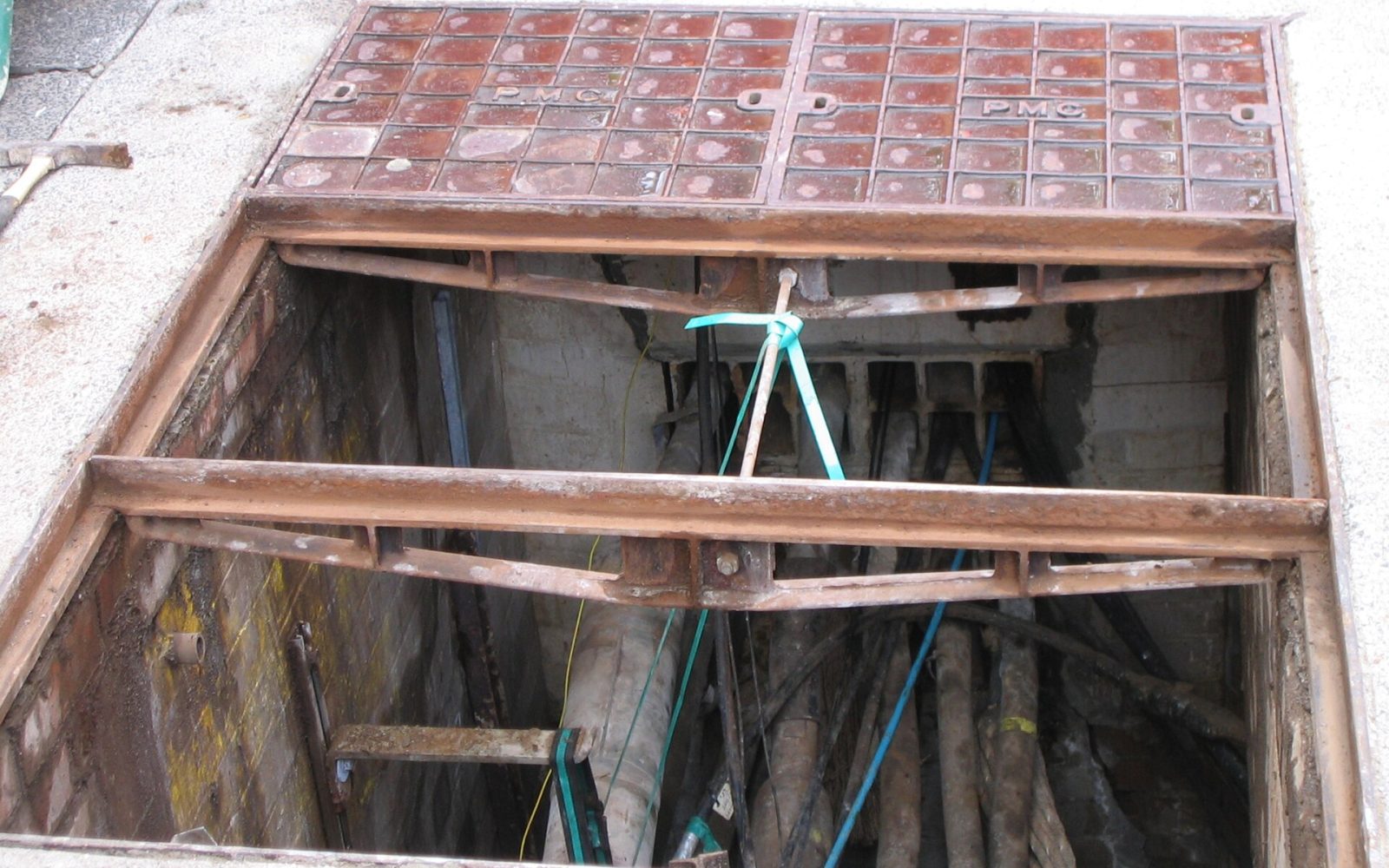
Concrete sewers, manholes, lift station wet wells and junction chambers built decades ago are reaching the end of their unprotected life. Corrosion eats away the concrete surface, exposes aggregate and reinforcing steel, and lets groundwater and soil infiltrate the system, which increases treatment costs and can undermine streets. Excavating and replacing these structures is expensive and disruptive, so utilities increasingly rehabilitate them in place with spray- or trowel-applied linings.
This article covers coating-based rehabilitation of manholes and other man-entry structures. Treatment plant coatings are covered in water and wastewater coatings.
How sewer concrete corrodes
The damage is a form of microbiologically influenced corrosion. In the slime layer below the flow line, sulfate-reducing bacteria convert sulfates in sewage to hydrogen sulfide (H₂S). Turbulence at drops, force main discharges, junctions and pump stations releases H₂S into the headspace. On moist concrete above the flow, sulfur-oxidizing bacteria convert it to sulfuric acid, which attacks the cement paste and can drive surface pH very low. The softened, gypsum-rich surface then sloughs off, exposing fresh concrete to continued attack.
Damage is usually worst at pipe crowns, manhole cones and chimneys, wet well walls and downstream of force main discharges. Long detention times, warm sewage and low flows all increase H₂S generation.
Assessment and planning
Rehabilitation starts with a condition assessment: visual and video inspection, measurement of concrete loss, identification of infiltration points, and in many cases H₂S monitoring over days or weeks to understand exposure severity. Many utilities use standardized inspection and condition-grading programs to prioritize structures. Key planning decisions include:
- Whether the structure is still structurally sound or needs a structural liner or replacement.
- The corrosion severity, which drives liner chemistry and thickness.
- Flow management — bypass pumping or flow diversion — to keep the work area dry during preparation and cure.
- Traffic control, access and permitting for work in streets.
Rehabilitation liner systems
| System | Typical thickness | Strengths | Limitations |
|---|---|---|---|
| Polymer-modified cementitious mortar | Commonly ½–2 in (13–50 mm) | Rebuilds lost section; tolerant of damp surfaces; economical | Limited acid resistance; not a barrier in severe H₂S |
| Calcium aluminate mortar | Commonly ½–2 in (13–50 mm) | Better resistance to biogenic acid than Portland cement mortars | Not immune in very severe exposure |
| Geopolymer mortar | Varies by product | Rebuilds section; marketed for improved acid resistance | Performance varies widely by formulation |
| High-build epoxy | Often ~80–250+ mils (2–6+ mm) | Strong chemical barrier; good adhesion to prepared concrete | Needs dry, sound surface; rigid |
| Polyurethane / polyurea | Often ~100–500 mils (2.5–12.5 mm) | Fast cure, flexible, short bypass times | Moisture and outgassing sensitive during application |
| Cementitious rebuild + polymer topcoat | Combined | Restores section and adds barrier | Two trades or crews; cure time before topcoat |
Pipe segments between manholes are usually rehabilitated with trenchless methods such as cured-in-place pipe or sliplining, but large-diameter, man-entry pipes and box culverts can be spray-lined. Sheet liners of PVC or HDPE cast into new or rebuilt structures are another long-lived option.
Infiltration control and surface preparation
- Divert flow and ventilate. Set up bypass pumping or plugs, then test and ventilate the atmosphere before entry.
- Stop active leaks. Inject chemical grout or set fast-setting hydraulic cement plugs at weeping joints, cracks and pipe penetrations; liners will not bond over running water.
- Remove deteriorated concrete. High-pressure waterjetting is the usual method, removing softened, acid-contaminated material down to sound concrete with an open, rough profile.
- Check surface condition. Verify that residual acidity has been removed (surface pH testing is common), that the surface is sound, and that moisture is within the limits the liner allows.
- Rebuild and level. Apply cementitious mortar to restore section and fill voids, finishing to the texture required for any topcoat.
- Apply the barrier. Spray or trowel the polymer liner to the specified thickness, sealing into frames, benches and pipe connections.
Concrete in a corroding manhole often releases air as temperature changes, and it can be damp from groundwater. Polymer liners applied over outgassing or wet concrete develop pinholes and blisters that let acid through. Prime, apply when the substrate is stable or cooling, and use products formulated for damp concrete where conditions require it.
Inspection and testing
Typical quality checks include wet film thickness readings during spraying, thickness verification of cured liners, adhesion testing with pull-off methods per ASTM D7234 (see concrete pull-off testing), and visual inspection for pinholes, sags and missed areas. Polymer barrier liners on concrete are commonly checked for continuity using high-voltage spark testing as described in ASTM D4787, which relies on the concrete being sufficiently conductive or on a conductive primer beneath the liner; see holiday detection testing. Cementitious liners are tested differently, often with thickness probes and compressive strength samples.
Safety in sewer structures
Manholes and wet wells are permit-required confined spaces under OSHA 29 CFR 1910.146 and similar rules elsewhere. H₂S is toxic and can deaden the sense of smell at higher concentrations, oxygen can be depleted, and solvent or isocyanate vapors from coatings add further hazards. Continuous atmospheric monitoring, forced ventilation, rescue planning, fall protection and respiratory protection are standard. Follow the employer’s confined space program, the coating’s SDS and local regulations; background is in confined space coating work.
Frequently asked questions
How long does a manhole rehabilitation liner last?
It depends on H₂S severity, liner type and installation quality. Barrier liners installed over well-prepared concrete in moderate exposure can provide long service, while thin cementitious liners in severe exposure may need earlier renewal.
Can a manhole be lined without bypass pumping?
Sometimes, for small flows, by plugging lines briefly or working above the flow. Most polymer liners need a dry surface during application and initial cure, so flow control is usually required.
Why not just use concrete repair mortar?
Ordinary Portland cement mortars are attacked by the same biogenic acid that destroyed the original concrete. In corrosive structures, acid-resistant mortars or a polymer barrier are needed.
Educational reference. Coating performance varies by formulation. Always follow the manufacturer’s product data sheet, safety data sheet and your project specification.