Osmotic Blistering
How soluble salts and other water-soluble material drive osmotic blisters in immersed coatings, how to investigate them, and how to repair and prevent them.
Key takeaways
- Osmotic blistering occurs when water passes through a coating and dissolves soluble material beneath or within it, creating a concentrated solution that draws in more water.
- Soluble salts left on the substrate are the most common driver; hydrophilic solvents and unreacted or water-soluble formulation components can also contribute.
- Pure, soft or demineralized water is often more aggressive than seawater, because the concentration difference across the film is larger.
- Lasting repairs require removing the soluble contamination and verifying cleanliness with salt testing before recoating.
Osmotic blistering is the most common blistering mechanism in immersion service, from ballast tanks and potable water tanks to fiberglass boat hulls and secondary containment. It can appear within weeks of filling or emerge slowly over years. The blisters are usually liquid-filled and, in steel structures, often lead to underfilm corrosion.
This article explains the osmotic mechanism in depth. For an overview of all blistering types, see blistering.
How osmotic blistering works
Organic coatings are not perfect barriers. Water molecules diffuse through them at rates that depend on the resin, pigmentation, crosslink density and thickness. The film behaves like a semipermeable membrane: water can pass, but dissolved ions pass much less readily.
- Water diffuses in. Water from immersion or condensation migrates through the coating.
- Soluble material dissolves. At the interface, or at contaminated layers between coats, the water dissolves salts or other soluble species and forms a concentrated solution.
- Osmotic pressure builds. Water moves from the dilute side (outside) toward the concentrated side (beneath the film) to equalize concentration.
- The film lifts. Pressure exceeds the coating’s local adhesion, forming a blister that grows until the solution is diluted or the film ruptures.
- Corrosion may follow. On steel, the solution under the blister can drive corrosion, which can enlarge the blister further.
The larger the concentration difference, the stronger the driving force. That is why demineralized water, steam condensate and soft potable water can blister coatings that perform well in seawater. Temperature gradients, as in heated tanks, add a further driving force. See soluble salt contamination for the sources of salts.
What it looks like
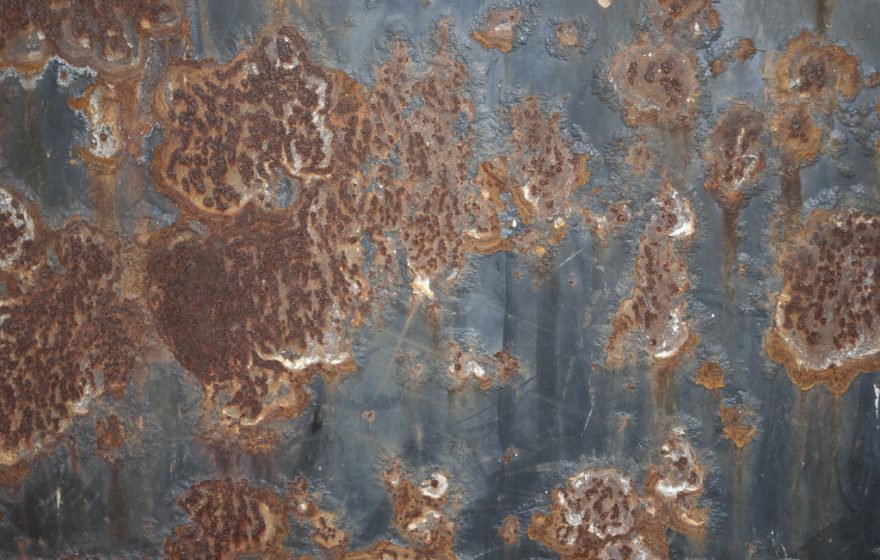
- Dome-shaped blisters, usually liquid-filled, from pinhead size to several centimeters across.
- Random distribution, often concentrated in areas of previous pitting or where salts were hard to remove.
- On steel, a fluid that may be clear or rust-colored, with corrosion products beneath.
- On fiberglass, blisters in the gelcoat or laminate that may contain an acidic, sometimes vinegar-smelling fluid. See coating fiberglass and FRP.
- Intercoat blisters when contamination lies between coats rather than on the substrate.
Causes and diagnosis
| Cause | Clues | Check | Prevention |
|---|---|---|---|
| Soluble salts on substrate | Blisters at interface; corrosion beneath; worse in pitted areas | Chloride and conductivity of blister fluid and substrate | Wash and verify salts below spec limits |
| Salts between coats | Blisters between coats, lower coat intact | Salt test on exposed lower coat | Wash exposed coats before overcoating |
| Hydrophilic retained solvent | Blisters soon after filling, no salts found | Thinner used, cure and recoat records | Correct thinner; full cure before immersion |
| Water-soluble formulation components | Widespread blistering across a batch or product | Lab analysis of film; product suitability | Use products qualified for the immersion |
| Thin film or holidays | Blisters at low-DFT areas | DFT survey; holiday testing | Meet minimum DFT; test continuity |
| Pure or warm water service | Blistering in condensate or hot water tanks | Service conditions vs. product data | Select coatings tested for that service |
Investigating blisters
- Photograph and rate blister size and density, for example with ASTM D714.
- Extract fluid from intact blisters with a syringe and measure pH, conductivity and chloride.
- Open blisters and record whether the failure is at the substrate or between coats.
- Test the exposed substrate for salts using methods described in soluble salt testing methods, such as the ISO 8502-6 extraction with ISO 8502-9 conductivity measurement.
- Review records of surface preparation, salt testing and environmental conditions.
Salt contamination is often invisible after blasting. Chlorides and sulfates concentrate in the bottoms of pits, where abrasive blasting alone may not remove them. Wet methods such as waterjetting or washing between blast passes are often needed.
Repair
- Assess the extent. Small, scattered blisters may be spot-repaired; widespread blistering usually calls for full removal.
- Remove the coating in blistered areas plus a margin of sound coating, typically by abrasive blasting or waterjetting.
- Decontaminate. Wash with clean, low-conductivity water, sometimes followed by reblasting, until salt levels meet the specification.
- Verify cleanliness. Test salts at a frequency set by the specification and record results; do not coat until limits are met.
- Recoat with a system qualified for the service, at full specified thickness, followed by holiday testing.
Recoating over blisters that were simply popped and sanded rarely works. The soluble material remains, and the new coating will blister again, often faster.
Prevention
- Specify and enforce maximum soluble salt levels before coating, especially for immersion. Acceptable limits vary with the service and coating system, so follow the specification and manufacturer’s guidance.
- Keep blasted surfaces and exposed coats free from contamination, and test intermediate coats exposed to marine or industrial air.
- Use low-permeability, high-crosslink-density systems suited to the water and temperature, such as glass flake coatings where appropriate.
- Use only specified thinners, and allow full cure before immersion.
- Apply the full specified film thickness, and holiday test immersion linings.
Frequently asked questions
Why do coatings blister in fresh water but not seawater?
The osmotic driving force depends on the concentration difference across the film. Fresh or demineralized water creates a larger difference than seawater.
Can thicker coatings prevent osmotic blistering?
Thicker films slow water penetration but do not stop it. Removing soluble contaminants is the most reliable prevention.
Do osmotic blisters always lead to corrosion?
Not always, but on steel the electrolyte under the blister often initiates corrosion. Blisters should be investigated and monitored.
Educational reference. Coating performance varies by formulation. Always follow the manufacturer’s product data sheet, safety data sheet and your project specification.