Solvent Entrapment
How solvent gets trapped in coating films, why it causes softness, blisters and intercoat failures, and how to diagnose, repair and prevent it.
Key takeaways
- Solvent entrapment occurs when solvent cannot escape a coating film before the surface closes up or the next coat is applied.
- Retained solvent leaves films soft, slow to harden and less resistant to chemicals and water, and can drive blisters, pinholes and intercoat failures.
- The main causes are excessive film thickness, short recoat intervals, cold temperatures, poor ventilation and the wrong thinner.
- Mildly affected films may recover with time, warmth and ventilation; blistered or severely soft films usually need removal.
Most liquid coatings contain solvent — organic solvent or water — that must leave the film for it to develop its designed properties. During drying, solvent diffuses to the surface and evaporates. As the film hardens, diffusion slows dramatically. If the surface hardens or is sealed by another coat while significant solvent remains below, that solvent becomes trapped. The result is a film that may look normal but performs poorly. See solvents in coatings for background.
Signs of solvent entrapment
Symptoms may appear within hours or only after months in service:
- Softness — the film dents under a thumbnail or remains tacky long after the stated dry-hard time.
- Persistent odor when the film is cut, warmed or confined, as in a closed tank.
- Blisters, often small and dry, which may appear when the coating is heated by sun or hot service. See blistering.
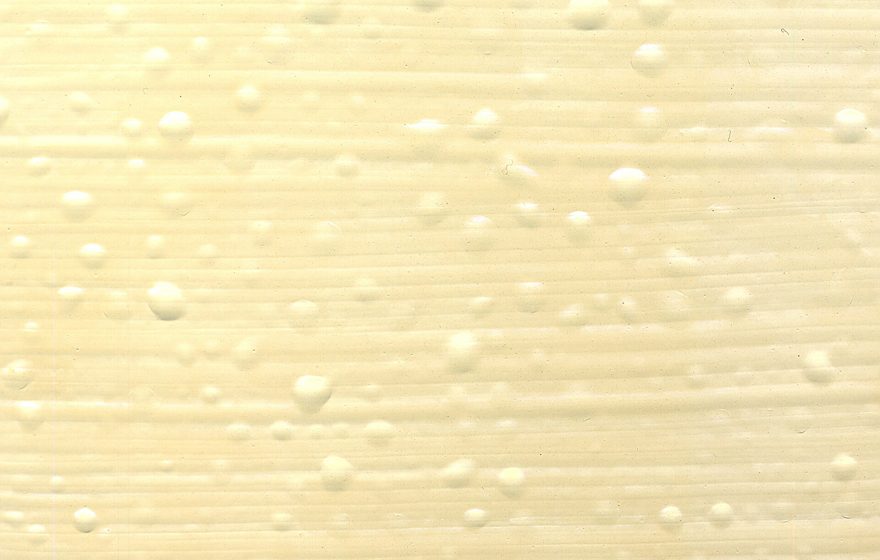
- Pinholes or bubbles formed as solvent vapor escapes through a partly set film.
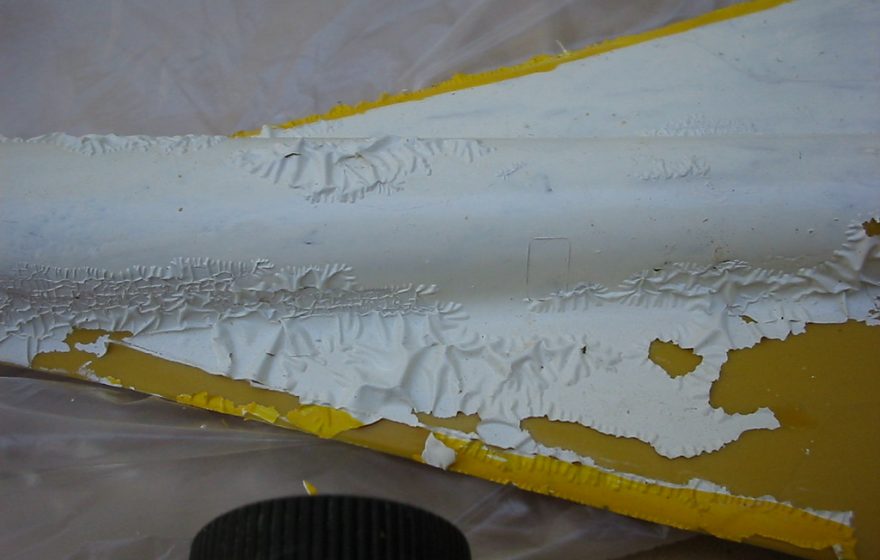
- Wrinkling or lifting when a later coat’s solvents attack an undercured layer.
- Poor chemical or immersion resistance, softening, or early failure in linings.
- Low adhesion between coats, with failure at a soft layer.
Causes
Film thickness
Diffusion time increases sharply with film thickness, so overly thick coats and sags retain much more solvent than films applied in the specified range. Heavy single coats of solvent-borne products are a classic cause.
Recoating too soon
Applying the next coat before the previous one has released enough solvent traps it under a new barrier. Minimum recoat times on product data sheets account for this; see recoat windows.
Temperature and ventilation
Low temperatures slow both evaporation and cure. In enclosed spaces such as tanks, poor air exchange lets solvent vapor build up near the surface, slowing further evaporation. See ventilation for coating work.
Material and environment
- Using a slower thinner than recommended, or too much thinner.
- Direct sun or forced heat that skins the surface while lower layers remain wet.
- Porous primers and concrete that release air and solvent into topcoats.
Diagnosis
| Cause | Clues | Check | Prevention |
|---|---|---|---|
| Excess film thickness | Soft areas match heavy build or sags | DFT survey; cross-section per ASTM D4138 | Control wet film; apply multiple thinner coats |
| Short recoat interval | Soft or failing layer between coats | Daily reports: times and temperatures | Observe minimum recoat times at actual temperature |
| Cold conditions | Softness in shaded or cold areas | Surface temperature history | Heat and maintain temperature through cure |
| Poor ventilation | Solvent odor and softness in enclosed spaces | Ventilation records; vapor readings | Engineered ventilation through cure |
| Wrong or excess thinner | Whole area slow to harden | Mixing records; thinner on site | Use specified thinner within limits |
| Surface skinning | Hard skin over soft layer; blisters on heating | Cut test; heat exposure history | Avoid direct sun or excessive early heat |
Field and laboratory tests
- Hardness checks — thumbnail, pencil hardness (ASTM D3363) or durometer — compared with properly cured reference areas.
- Cut test — cutting with a knife reveals a soft or gummy layer and may release odor.
- Solvent rub tests indicate cure but cannot distinguish retained solvent from undercure alone.
- Laboratory analysis — techniques such as gas chromatography or thermogravimetric analysis can identify and quantify retained solvents, and thermal analysis can show a depressed glass transition temperature.
See testing coating cure for more on field cure methods.
Retained solvent acts as a plasticizer, lowering the film’s glass transition temperature and hardness. A coating can be chemically cured yet still be soft because of solvent it has not released.
Repair
- Establish severity. Map soft areas, blisters and odor, and compare with sound areas.
- Try recovery for mild cases. If the film is intact, extend the cure time with heat within the manufacturer’s limits and continuous ventilation, then retest hardness.
- Remove failed material. Where blisters, wrinkling or intercoat failure are present, remove the affected coats back to sound material, or to the substrate if necessary.
- Reapply correctly. Apply coats within the specified thickness range, observe recoat times, and maintain temperature and ventilation through cure.
- Verify before service. Confirm hardness or cure criteria before immersion or chemical exposure.
Heating a film with trapped solvent too quickly can cause the solvent to boil and blister the coating. Follow the manufacturer’s forced-cure schedule and ramp temperatures gradually.
Prevention
- Measure wet film thickness during application and stay within the data sheet range.
- Observe minimum recoat intervals, lengthening them at low temperatures.
- Provide ventilation that moves air across coated surfaces in enclosed spaces throughout drying and cure.
- Use only the specified thinner and quantity, and avoid adding thinner to compensate for cold.
- Delay service exposure, especially immersion, until the cure criteria are met.
Frequently asked questions
Can high-solids or solvent-free coatings suffer solvent entrapment?
Solvent-free products cannot trap solvent, but thinning them adds solvent. High-solids coatings have less solvent but can still trap it if applied too thick.
Will trapped solvent eventually escape?
Often slowly, and thin films may recover. Thick or heavily overcoated films may retain solvent for a very long time.
Is solvent entrapment the same as undercure?
No, though they often coexist. Undercure is incomplete chemical reaction; solvent entrapment is retained solvent. Both soften the film.
Educational reference. Coating performance varies by formulation. Always follow the manufacturer’s product data sheet, safety data sheet and your project specification.