Ventilation for Coating Work
How dilution and local exhaust ventilation control solvent vapor, spray mist and dust in shops, booths, tanks and containments — and how to plan airflow that protects both health and fire safety.
Key takeaways
- Ventilation is an engineering control that removes or dilutes solvent vapor, spray mist and dust before workers breathe it or it reaches an ignitable concentration.
- Local exhaust captures contaminants at the source; dilution ventilation mixes them with clean air. Most field coating work in enclosed spaces relies on dilution supplemented by respirators.
- Airflow sized only to stay below the lower explosive limit (LEL) is usually far too low to keep exposures below occupational limits.
- Exhaust from low points, avoid short-circuiting, provide make-up air, use equipment rated for flammable atmospheres, and verify with monitoring.
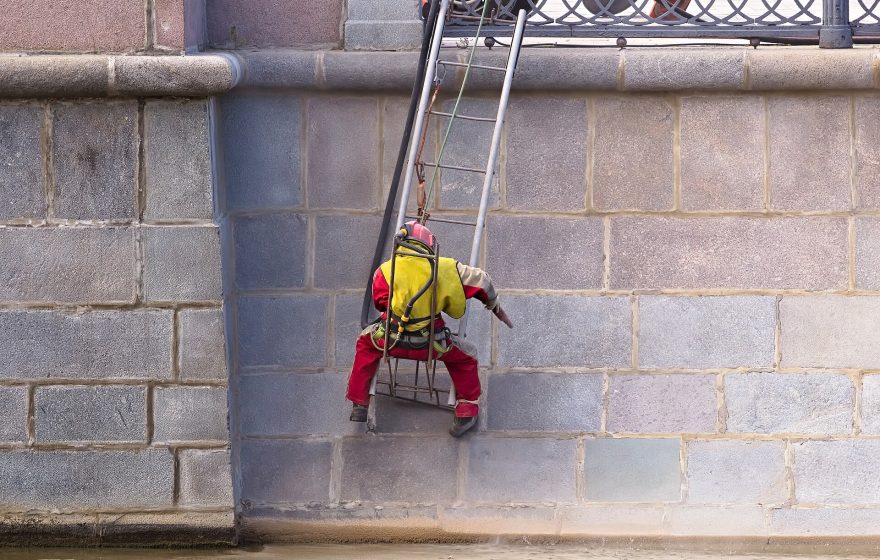
Solvent-borne coatings can release a large share of their volume as vapor during application and cure, and spray application adds mist and overspray. Abrasive blasting and grinding add dust. In open air, wind usually dilutes these contaminants. Inside a tank, hull, booth, containment or building, they accumulate unless air is deliberately moved.
This article explains the principles of ventilation for coating work. Detailed design should be done by competent people using recognized references such as the ACGIH Industrial Ventilation manual, NFPA 33 for spray booths, and the requirements of OSHA, HSE, EU-OSHA or your local authority. Always follow the product SDS and your employer’s safety program.
Why ventilation matters
- Health. Solvent vapors can cause dizziness, headaches and longer-term effects; mists may carry sensitizers such as isocyanates and epoxy resins. See isocyanate safety.
- Fire and explosion. Vapor concentrations between the lower and upper explosive limits can ignite; see fire and explosion hazards.
- Visibility and quality. Clearing overspray improves visibility and reduces dry spray settling on fresh work.
- Cure. Removing solvent vapor from the space helps films release solvent as intended, reducing the risk of solvent entrapment.
Types of ventilation
Local exhaust ventilation
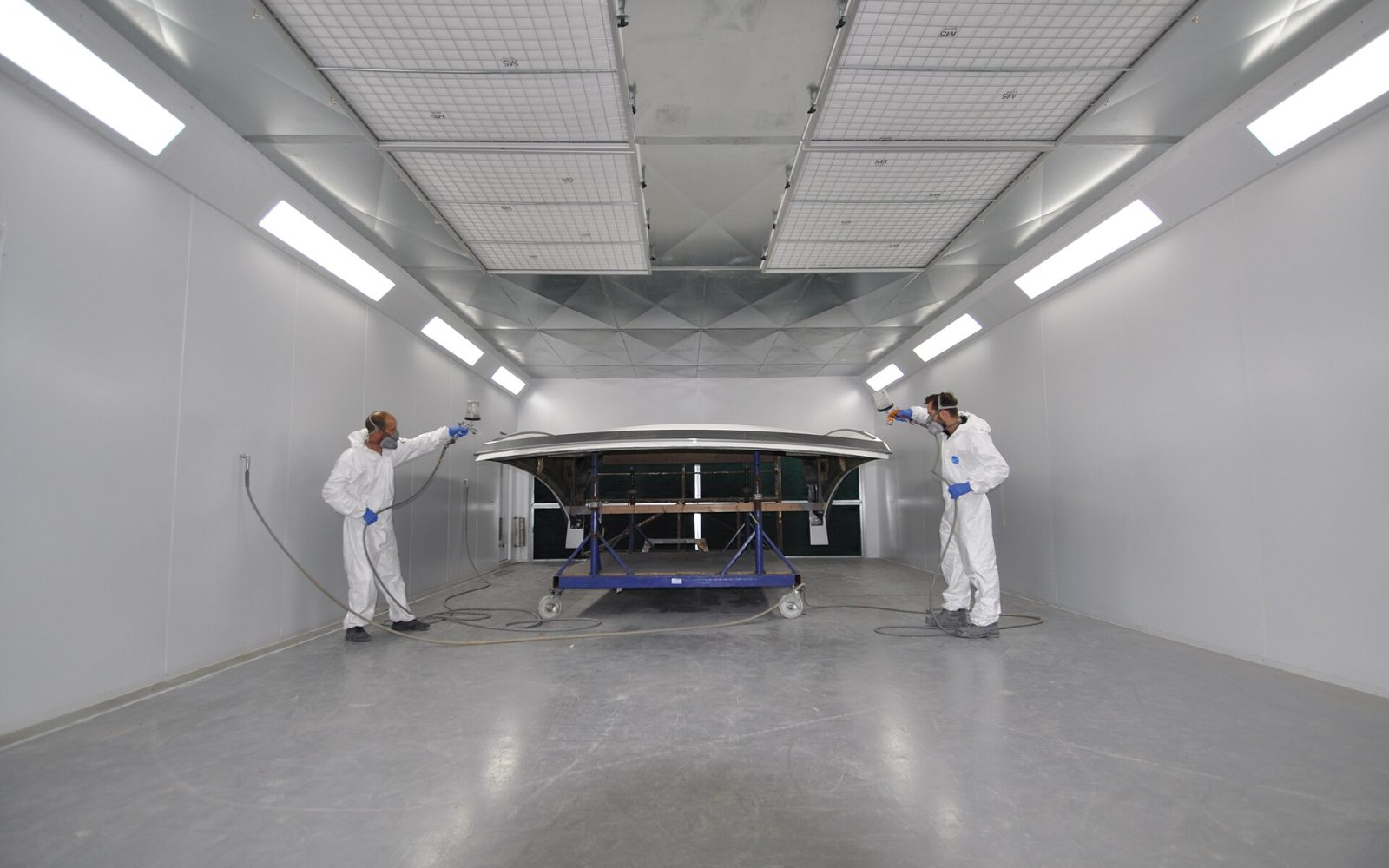
Local exhaust ventilation (LEV) captures contaminants close to where they are generated — a spray booth, a downdraft table, a shrouded grinder with a vacuum, or a capture hood at a mixing station. It is the most effective form of ventilation because it removes contaminants before they spread. Capture velocity falls off very quickly with distance from a hood opening, so the source must be close to the hood.
Dilution (general) ventilation
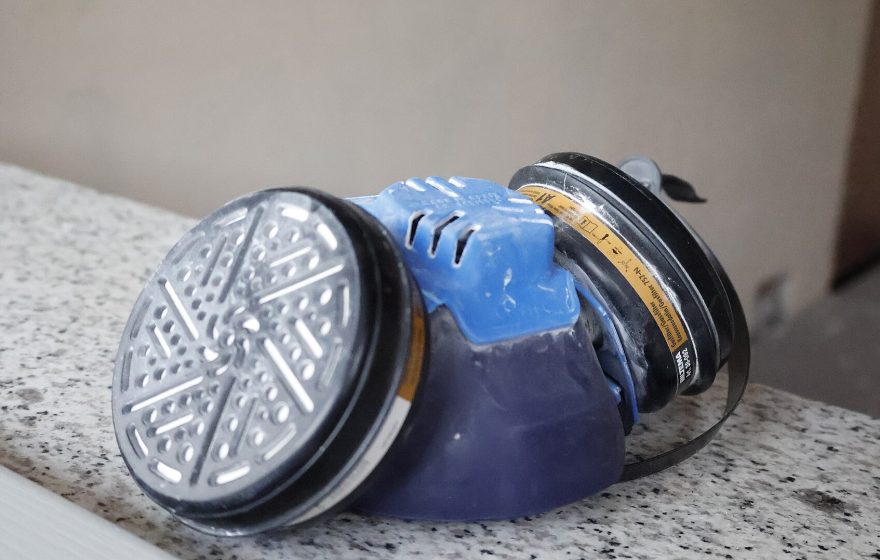
Dilution ventilation brings in clean air and removes contaminated air to lower average concentrations. It is the usual approach in tanks, vessels and building interiors where the source moves with the applicator. Dilution works best for relatively low-toxicity contaminants released at a predictable rate, and it does not prevent high concentrations right at the spray gun — which is why applicators in enclosed spaces usually still need respirators (see respiratory protection).
Supply, exhaust and pressure balance
Exhaust ventilation pulls air out of a space, keeping it under slight negative pressure so contaminants do not leak to surrounding areas. This is generally preferred for coating and blasting enclosures. Supply-only ventilation pushes air in and can drive vapor and dust out of openings into areas where others are working. Many setups use both, with exhaust exceeding supply.
Ventilation by work setting
| Setting | Typical approach | Key concerns |
|---|---|---|
| Shop spray booth | Engineered LEV with filtered exhaust | Airflow maintenance, filter loading, residue fire risk |
| Tank or vessel interior | Exhaust fans and ducting with planned make-up air | Vapor pockets, short-circuiting, rated equipment, entry rules |
| Blast containment | Dust collector maintaining negative pressure | Visibility, dust escape, lead and silica exposure |
| Occupied building interior | Exhaust to outdoors, isolate from HVAC | Odor and vapor migration to occupants |
| Open outdoor structure | Natural air movement | Wind direction, overspray drift, nearby people |
Planning ventilation for enclosed spaces
For tanks, hulls and other enclosed spaces — many of which are permit-required confined spaces under OSHA 29 CFR 1910.146 or equivalent rules (see confined space coating work) — a ventilation plan typically follows these steps:
- Estimate vapor release. Use the application rate and the solvent content of the coating and thinner from the SDS and product data sheet.
- Set targets. Calculate the airflow needed to keep vapor below occupational exposure limits where practical, and in any case well below 10% of the LEL, applying a safety factor for imperfect mixing.
- Select equipment. Choose fans, ducting and dust collectors rated for the airflow and, where flammable vapor may be present, for the hazardous location. Bond and ground ducting and fans.
- Arrange airflow. Draw exhaust from low points and from the far side of the work so clean air sweeps across the applicator toward the exhaust, and avoid placing supply and exhaust openings close together.
- Provide make-up air. An exhaust fan cannot remove air that cannot enter; provide openings or supply fans sized to match.
- Monitor continuously. Use calibrated gas meters for oxygen, flammability and specific toxics at several heights throughout the work.
- Keep running. Maintain ventilation through application and cure until monitoring shows the space is safe, and protect fresh coating from contaminated or condensing air with dehumidification and climate control where needed.
Most solvent vapors are heavier than air and pool in sumps, bottoms and low compartments. A fan blowing across the top of a tank can leave a dangerous layer of vapor below the applicator’s working level. Measure at several heights.
Check airflow with a smoke tube or anemometer after setup, and again whenever ducting is moved. Kinked, crushed or excessively long duct runs can cut fan output dramatically compared with the nameplate rating.
Frequently asked questions
Is opening a manway and placing a fan in it enough?
Rarely. A single fan in one opening often short-circuits, with air entering and leaving at the same place while the rest of the space stays stagnant. Plan inlet and exhaust locations so air sweeps through the whole work area.
Can I use an ordinary box fan?
Not where flammable vapors may be present. Fans and motors in those atmospheres must be rated for the hazardous location, and air-driven or explosion-proof units are commonly used.
Does good ventilation mean I don’t need a respirator?
Not necessarily. Whether respirators are required depends on measured or estimated exposure against the applicable limits. In enclosed spaces and during spraying, respirators are commonly required even with good ventilation.
Educational reference. Coating performance varies by formulation. Always follow the manufacturer’s product data sheet, safety data sheet and your project specification.