Waterborne Epoxy Coatings
Waterborne epoxies deliver much of the adhesion and toughness of epoxy with low odor, low VOC and water cleanup, but they cure differently from solvent-borne products.
Key takeaways
- Waterborne epoxies disperse epoxy resin, curing agent or both in water, sharply reducing VOC and odor.
- Films form by water evaporation and particle coalescence as well as chemical cross-linking, so drying conditions matter.
- Pot life can end without any obvious thickening, so the data sheet’s limit must be followed by the clock.
- They are widely used as concrete primers and sealers, wall coatings and primers in occupied buildings, but are less chemically resistant than the best solvent-free epoxies.
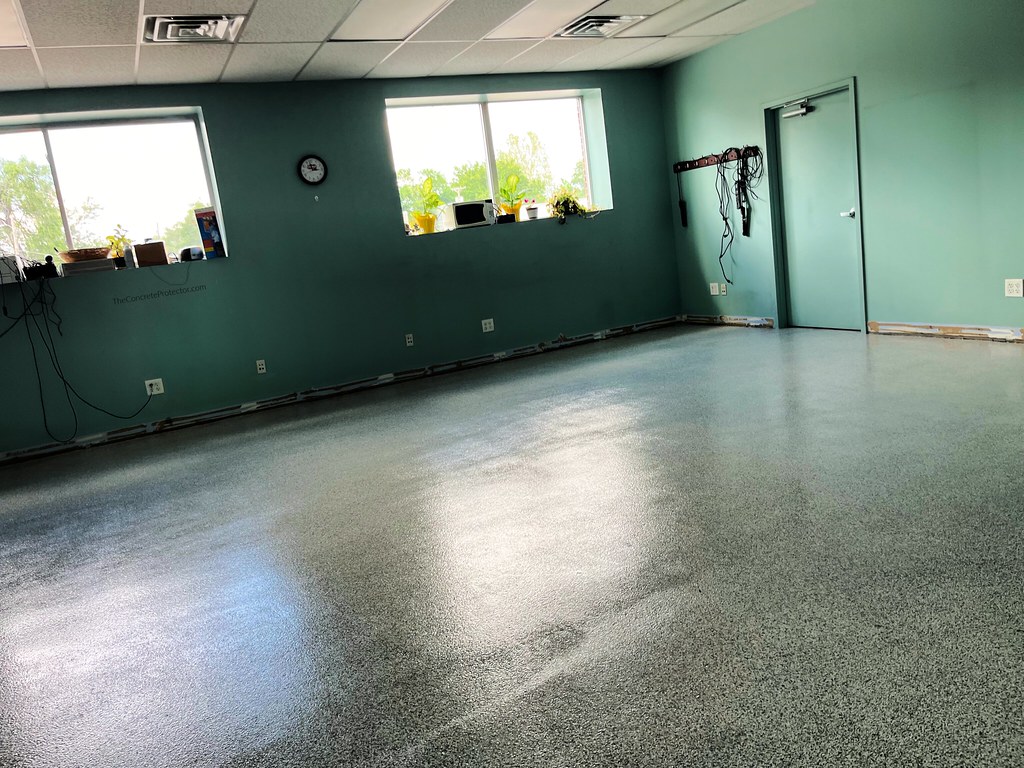
Stricter VOC rules and a growing demand for low-odor work in hospitals, schools, food plants and offices have made waterborne epoxies a mainstream choice. They allow crews to coat walls and floors with building occupants nearby and clean tools with water, while still providing much of the adhesion, hardness and chemical resistance associated with epoxy coatings.
The trade-off is that water is a less forgiving carrier than solvent. It evaporates slowly in humid air, freezes in storage and can promote flash rust on steel. Understanding how these products form a film is the key to using them well.
How waterborne epoxies work
Epoxy resins are not naturally water-soluble. Formulators make them waterborne in two main ways:
- Type I systems use a liquid epoxy resin that is emulsified into water at the time of mixing by a water-reducible amine curing agent, which acts as the emulsifier.
- Type II systems use a pre-made dispersion of higher molecular weight (solid) epoxy resin in water, combined with an amine curing agent. These tend to dry faster to touch and give better early properties.
After application, two processes run together. Water evaporates and the dispersed particles pack together and fuse — the coalescence described in film formation. At the same time, the curing agent diffuses into the resin particles and cross-links them. If water leaves too slowly, or the curing agent cannot reach the resin before the particles fuse, the film can be soft, hazy or poorly cross-linked. For more on hardeners, see epoxy curing agents.
Waterborne versus solvent-borne and solvent-free epoxy
| Property | Waterborne epoxy | Solvent-borne epoxy | 100% solids epoxy |
|---|---|---|---|
| VOC and odor | Very low | Moderate to high | Very low |
| Cleanup | Water (before cure) | Solvent | Solvent |
| Typical DFT per coat | 2–5 mils (50–125 µm) | 4–8 mils (100–200 µm) | 8–30+ mils (200–750+ µm) |
| Sensitivity to humidity while drying | High | Moderate | Low to moderate |
| Chemical resistance | Moderate to good | Good | Good to excellent |
| Freeze sensitivity in storage | Yes | No | No |
The figures are typical; individual products vary considerably. Waterborne epoxies are often chosen not for peak performance but because they are the right fit for the setting and the VOC regulations in force.
Common uses
- Concrete primers and sealers beneath thicker floor systems, where they penetrate and bond well to slightly damp but not wet concrete.
- Light- to medium-duty floor coatings in warehouses, garages and commercial spaces.
- Wall and ceiling coatings in food plants, hospitals, schools and correctional facilities, where washability and low odor matter.
- Primers for steel in shop and light industrial work, including some aerospace and military primer specifications.
- Tie coats and sealers over existing coatings where a solvent-borne product would lift the old film.
Advantages and limitations
Advantages
- Very low VOC and odor; suited to occupied buildings
- Water cleanup and reduced fire hazard
- Good adhesion to concrete, including slightly damp surfaces
- Less likely to lift or wrinkle existing coatings
- Breathable enough to suit some concrete conditions
Limitations
- Drying is slow in cold or humid conditions
- Pot life end may not be visible
- Thin films per coat; more coats for high build
- Risk of flash rust on bare steel
- Freeze-sensitive in storage and transport
Application and cure
Surface preparation follows the same principles as for any epoxy: sound, clean concrete abraded to the profile the system requires, or blast-cleaned steel. On steel, waterborne products can cause flash rust during drying, so manufacturers add inhibitors and often specify limits on humidity and film thickness.
- Condition the material. Store above freezing and bring to the recommended temperature before use.
- Mix as directed. Combine components in the exact ratio; some products require a specific amount of added water.
- Watch the clock. Note mixing time and discard the batch at the end of the stated pot life, even if it still looks usable.
- Apply in the right conditions. Keep temperature and relative humidity within data sheet limits and provide air movement to remove water vapor.
- Allow full dry before recoating. Trapped water under the next coat can cause blistering or softness.
Unlike many solvent-borne epoxies, waterborne epoxies may not thicken noticeably at the end of their pot life. Material applied after that point can look normal but give poor gloss, adhesion and chemical resistance. Treat the stated pot life as a hard limit.
Ventilation still matters. Even with low VOC, the water released during drying must be removed, and in enclosed rooms high humidity can stall the cure. Dehumidification or gentle heating is often used in cool, damp spaces.
Checking the result
A properly cured waterborne epoxy should be hard, uniform in gloss and free of tackiness or milky haze. Haze, low gloss or a soft film usually point to application past pot life, too much added water, low temperature or high humidity during drying. Dry film thickness is checked in the usual way, and on floors a small test area is often prepared first so the owner can approve appearance and slip resistance before full application.
Frequently asked questions
Is waterborne epoxy as strong as solvent-based epoxy?
For many applications it performs well, but solvent-borne and especially 100% solids epoxies generally offer higher build and better chemical resistance. Choose based on the exposure.
Can waterborne epoxy be applied to damp concrete?
Many products tolerate slightly damp concrete, but not standing water or high moisture vapor emission. Test concrete moisture and follow the data sheet limits.
What happens if waterborne epoxy freezes?
Freezing can break the dispersion, making the material unusable. Most manufacturers advise discarding product that has frozen.
Educational reference. Coating performance varies by formulation. Always follow the manufacturer’s product data sheet, safety data sheet and your project specification.