Hiding Power and Contrast Ratio of Coatings
How contrast ratio measures coating hiding over black and white backgrounds, why film build matters, and what an opacity result can and cannot establish.
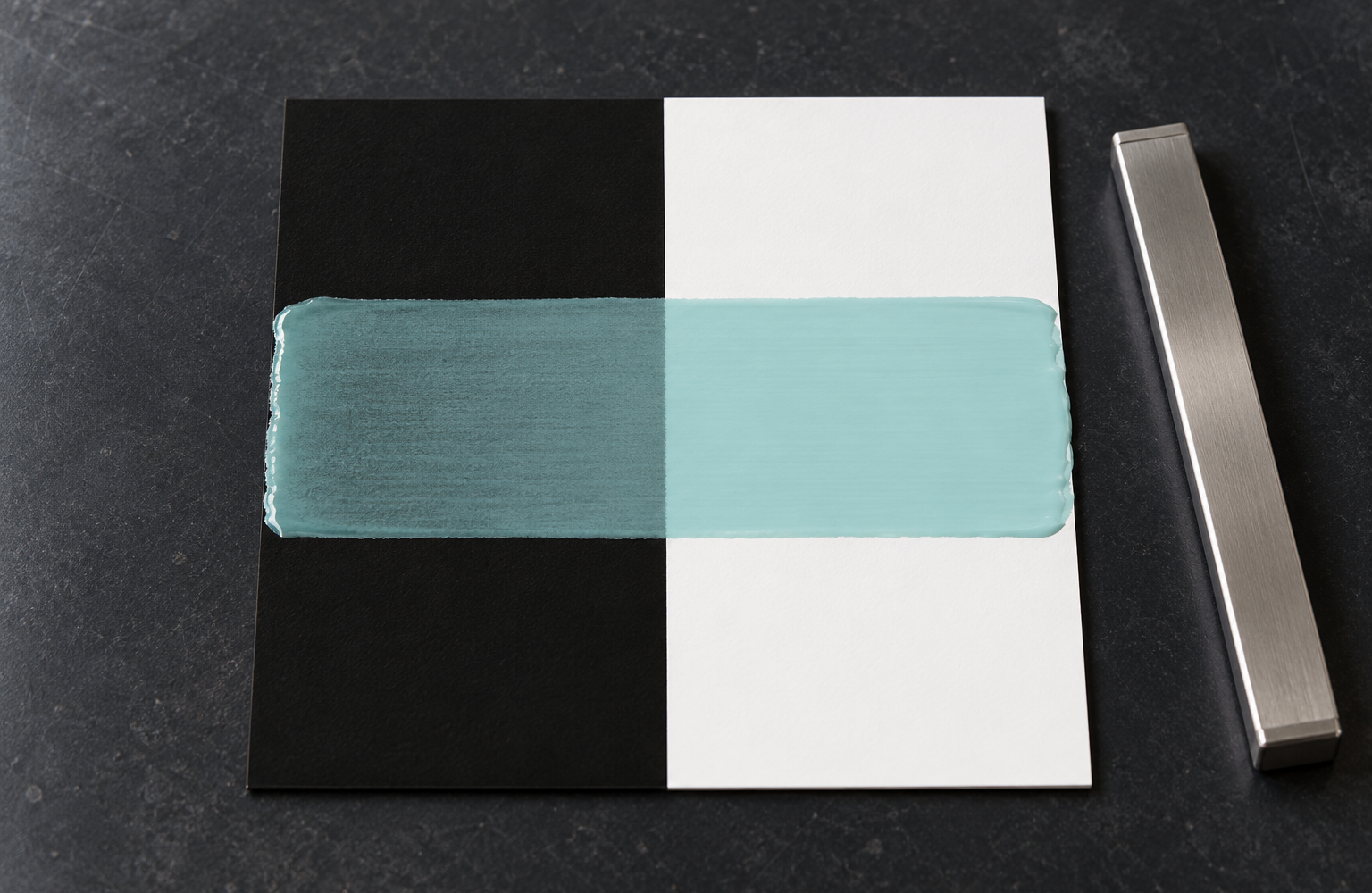
Key takeaways
- Hiding describes how effectively a coating obscures the background beneath it.
- Contrast ratio compares light reflected from equivalent films over black and white backgrounds.
- A useful result identifies the film thickness or spreading rate and the measurement conditions.
- An opacity result addresses an optical property; protective performance needs its own evidence.
Definition and measurement principle
Hiding power concerns a coating’s ability to obscure the substrate. One way to evaluate it is to measure the same coating over contrasting backgrounds. In a contrast-ratio measurement, the luminous reflectance over the black area is divided by that over the white area. The ratio is dimensionless; multiplying it by 100 expresses the result as a percentage. BYK-Gardner’s coating measurement guide describes this principle.
Contrast ratio = Yblack / Ywhite
Here, the two Y values describe the coated black and white areas under the specified measurement conditions. They are not readings of the bare card. As the ratio approaches one, the difference between the two backgrounds has less influence on the measured appearance of that film.
A simple arithmetic example
Suppose an illustrative pair of coated-area readings is 78 over black and 80 over white, on the same reflectance scale. The calculation is 78 ÷ 80 = 0.975, or 97.5%. These numbers are invented solely to demonstrate the arithmetic; they are not a test result or an acceptance target.
The reported percentage should travel with its context. “97.5% at the stated spreading rate under the stated method” contains substantially more information than “97.5% opacity.” A specification must supply its own applicable criterion and method.
Film build and spreading rate belong with the result
A comparison should establish whether the coatings were evaluated at a fixed film thickness, a fixed spreading rate or a defined hiding endpoint. These arrangements answer different questions. A drawdown bar’s nominal gap should not be substituted for an independently established film thickness or spreading rate without the method’s basis.
Leneta’s release-chart guidance illustrates the distinction: it determines dry film mass over a known area and uses coating properties to calculate spreading rate. Its metal-panel guidance describes contrast-ratio measurements at identified film thicknesses. Retaining the application basis prevents an optical comparison from concealing a difference in material applied.
Relevant methods have defined scopes
ASTM D2805-11(2023) is an instrumental reflectometry method for hiding power. Its published scope covers air-drying coatings with Y tristimulus values above 15%, with modification contemplated for baking finishes. The method’s scope should be checked before treating it as a universal test for every color or coating.
ISO 6504-3:2019 addresses hiding power for paints used on masonry, concrete and interiors. Its public abstract describes white and light-colored films with Y or Y10 values above 25, using black-and-white charts or transparent foil backed by black and white panels. ISO lists this edition as confirmed in 2025. Cite the method and edition actually used in a report; the two standard numbers do not establish that results are interchangeable.
What a useful report retains
A practical review record identifies the product, color and batch; substrate or chart; application basis; drying or conditioning; measurement geometry and settings; individual coated-area readings; calculated ratio; repeat observations; and any deviation from the selected method. These are interpretation prompts rather than a replacement for its reporting requirements.
Background consistency matters. BYK-Gardner notes the importance of consistent chart color and gloss in opacity comparisons. Retain the chart type with the result rather than assuming any black-and-white card produces an equivalent measurement.
Interpretation limits
Hiding is one aspect of appearance. It does not report adhesion strength, cure state, corrosion resistance or the continuity of a protective film. An apparently well-hidden background should not replace the specified thickness and quality checks for a protective coating.
Color matching and specular gloss also ask different optical questions. The companion Gloss & Color Measurement entry covers those measurements. Keep the quantities distinct when evaluating a finish: a good color match, a chosen gloss level and satisfactory hiding each need an appropriate comparison.
Public technical references checked October 27, 2026.
For a structured review of specimen preparation, methods and reported outcomes, use How to Compare Coating Test Reports.
Educational reference. Coating performance varies by formulation. Always follow the manufacturer’s product data sheet, safety data sheet and your project specification.