Blast Containment & Enclosures
How tarps, scaffolding, negative-pressure ventilation and dust collection keep abrasive blasting debris contained — protecting workers, neighbors and the environment.
Key takeaways
- Containment encloses a blasting operation so spent abrasive, paint chips and dust are captured instead of reaching soil, water, air and nearby people.
- SSPC-Guide 6 groups containment into classes from Class 1 (most stringent) to Class 4 (least), based on enclosure materials, joints, entryways and ventilation.
- For hazardous debris such as lead paint, the enclosure is usually kept under negative pressure, with exhaust air passed through a dust collector.
- Good containment also improves the job inside: better visibility, cleaner steel and an envelope that can be heated or dehumidified.
Abrasive blasting produces large volumes of airborne dust and spent media. On an open field in a remote area that may be tolerable, but on a bridge over a river, a tank beside a school or a structure coated with lead-based paint, uncontrolled debris is a serious environmental and health problem. Containment is the set of physical barriers, ventilation and recovery equipment that keeps that debris where it can be collected.
The level of containment is chosen to match the hazard. Removing intact modern coatings from a shop-fabricated tank may need little more than ground tarps, while removing lead paint from a highway bridge may demand an airtight, ventilated enclosure that rivals a temporary building.
Why containment is required
- Hazardous paint. Older coatings may contain lead, chromium, cadmium or other heavy metals. Disturbing them is regulated, and debris may be classed as hazardous waste. See lead paint removal.
- Worker and public exposure. Dust from blasting can contain respirable crystalline silica and metal particulates that must be controlled under occupational rules.
- Environmental permits. Air, water and waste regulators may require visible-emission limits, ambient monitoring and recovery of all debris.
- Neighbors and property. Drifting dust damages vehicles, buildings and goodwill.
- Job quality. An enclosure shelters the work from wind and rain and lets the crew control temperature and humidity.
SSPC-Guide 6 containment classes
SSPC-Guide 6 is the principal North American reference for containing surface-preparation debris. It describes four classes, with a suffix letter indicating the removal method (for example “A” for abrasive blasting). Specifications usually name a class and then add project-specific performance criteria such as emission limits and monitoring.
| Class | Enclosure walls | Joints and entryways | Ventilation |
|---|---|---|---|
| Class 1 | Rigid or flexible, impermeable | Fully sealed; airlock or resealable entries | Negative pressure with filtered exhaust |
| Class 2 | Rigid or flexible, impermeable | Sealed or overlapped | Mechanical ventilation, less stringent |
| Class 3 | Flexible, often permeable screens | Overlapped | Usually natural airflow |
| Class 4 | Flexible, permeable | Partial; open seams allowed | Natural airflow |
The table summarizes the general idea; the guide itself contains the detailed component descriptions, and each project specification sets its own acceptance criteria. Always work from the current edition and the contract documents.
Enclosure components
Support structure
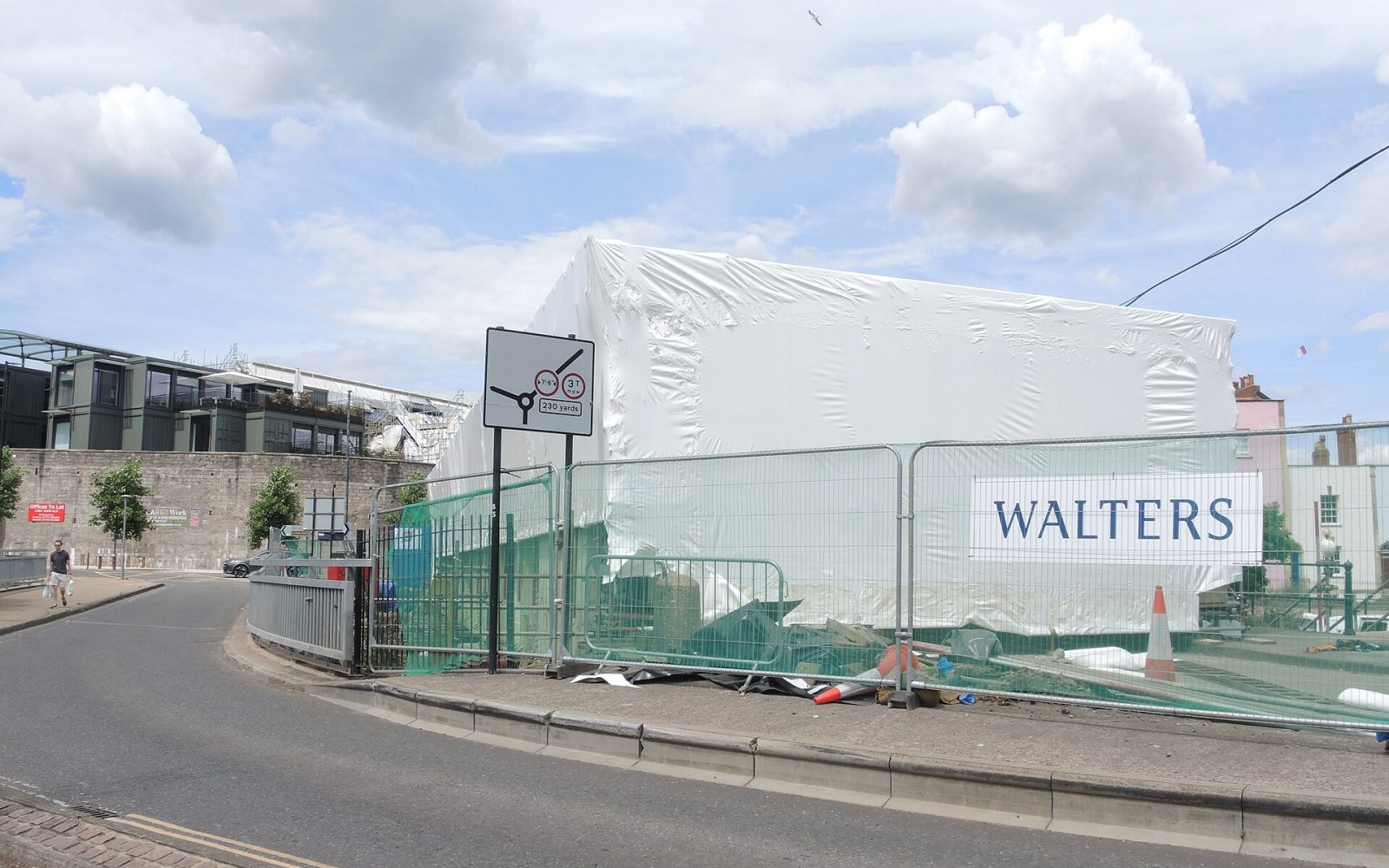
Containments are hung from the structure being blasted, from purpose-built scaffolding, or from suspended platforms on bridges. Because tarped enclosures act like sails, wind loading must be considered in the design; engineered drawings are commonly required for large or elevated containments.
Walls, floors and ceilings
Impermeable materials include reinforced plastic tarps, shrink-wrap film and rigid panels such as plywood or metal sheeting. Permeable screens let air pass while catching larger particles. Floors must withstand abrasive impact and foot traffic, so they are often rigid decking or heavy tarps over plywood.
Entryways and seams
Seams are overlapped, taped or clamped. Higher-class containments use airlocks or overlapping flap doors so that opening the entry does not release dust.
Negative pressure and dust collection
For Class 1 work, fans draw more air out of the enclosure than leaks in, so any leak pulls clean air in rather than letting dust escape. The exhaust passes through a dust collector, typically a cartridge or bag-house unit, before discharge.
Airflow is designed both for containment and for visibility. Cross-draft velocities on the order of 100 ft/min (0.5 m/s) for horizontal flow and about 60 ft/min (0.3 m/s) for downdraft flow are widely cited targets; the specification governs. Negative pressure is commonly verified by observing inward-bowing tarps or with a differential-pressure gauge.
An enclosure that traps dust also traps solvent vapor once painting begins. Ventilation must be re-evaluated for flammable vapors and worker exposure during coating application — see ventilation for coating work.
Setting up a containment
- Review the requirements. Confirm the specified class, emission limits, monitoring, waste handling and permit conditions.
- Engineer the structure. Design supports, scaffolding and tie-offs for dead load, abrasive load and wind.
- Install ground protection. Lay tarps or decking beneath the work and around equipment so spills and fines are captured.
- Erect walls and seal seams. Hang the enclosure, overlap and seal joints, and install entryways.
- Commission ventilation. Start the dust collector, check airflow and confirm negative pressure before blasting begins.
- Monitor during work. Watch for visible emissions, tears and blown seams, and carry out any required air or soil monitoring.
- Clean up and dismantle. Vacuum all debris, inspect the area, and remove the containment in a way that does not release residual dust.
Choosing a containment approach
Advantages
- Meets environmental and occupational requirements for hazardous debris
- Protects neighbors, waterways and property
- Shelters work from weather and allows climate control
- Captures abrasive for recycling where recyclable media is used
Limitations
- Adds significant cost and schedule time for design and erection
- Can create a confined space with heat, noise and limited egress
- Enclosed air can concentrate dust and vapors if ventilation is undersized
- Wind, weight and traffic clearances may restrict where it can be built
Alternatives can reduce the containment burden. Wet abrasive blasting suppresses dust, vacuum blasting captures debris at the nozzle, and power tools with shrouds and vacuum attachments generate little airborne dust. These methods still produce waste that must be collected and characterized, and debris handling is covered in coating waste and disposal.
Inside the enclosure, workers still need protection. Containment controls emissions to the outside; it does not replace respirators and exposure controls for the blasters. See crystalline silica and abrasive blasting and follow OSHA, local regulations and the employer’s safety program.
Frequently asked questions
Is containment only needed for lead paint?
No. Lead is the most common driver, but permits, nearby waterways, neighbors, silica exposure and owner requirements can all call for containment even when the old coating contains no hazardous metals.
What does “negative pressure” mean in a containment?
It means the air pressure inside the enclosure is slightly lower than outside, because exhaust fans remove more air than enters. Leaks then draw air inward rather than releasing dust.
Can the containment be used during painting too?
Yes, and it is often an advantage because it allows heating and dehumidification. Ventilation must be reassessed for solvent vapors, and overspray must still be controlled.
Who designs the containment?
Usually the contractor, working to the class and criteria in the specification. Large or elevated systems commonly require drawings stamped by a qualified engineer.
Educational reference. Coating performance varies by formulation. Always follow the manufacturer’s product data sheet, safety data sheet and your project specification.