Lead Paint Removal
Removing lead-based paint turns routine surface preparation into regulated hazardous work. This guide covers testing, method selection, containment, worker protection and waste.
Key takeaways
- Lead-based paint remains on many older bridges, tanks, industrial structures and buildings; disturbing it creates lead dust and debris that are hazardous to workers and the public.
- Confirm lead content by testing before any work, then decide between full removal, spot repair, overcoating or replacement.
- Removal methods range from contained abrasive blasting and vacuum blasting to HEPA-shrouded power tools, chemical strippers and waterjetting, each with different dust, waste and cost profiles.
- In the US, OSHA 29 CFR 1926.62 governs worker protection in construction; waste is typically tested by TCLP to determine whether it is hazardous. Follow all applicable federal, state and local regulations.
Lead pigments such as red lead and white lead were used for generations because they inhibited corrosion and made durable paints. Many structures built before the late 1970s, and some industrial assets painted later, still carry them. Lead paint removal is ordinary surface preparation carried out under extraordinary controls: every chip, particle and rinse becomes a potential exposure and a regulated waste.
This article covers the surface-preparation side of the job. For health effects, exposure symptoms and medical surveillance, see lead paint hazards.
Testing and assessment
Never assume old paint is lead-free, or that a lead-containing coating is only on the bottom coat. Common ways to confirm lead content include:
- Paint chip sampling with laboratory analysis, which gives lead concentration through all layers.
- X-ray fluorescence (XRF) with a portable analyzer, a non-destructive screening method used widely on buildings and structures.
- Chemical spot test kits, sometimes used in housing work where recognized by the relevant regulator, but less informative for industrial coatings.
Assessment should also check for other hazardous metals such as chromium, cadmium and arsenic, which affect the same controls. Condition surveys (see coating condition assessment) help decide whether removal is actually necessary.
Remove, repair or overcoat?
Full removal eliminates the lead permanently but is the most expensive option. Alternatives include:
- Overcoating sound existing paint with a compatible system (see overcoating existing coatings), which limits disturbance to cleaning and spot preparation.
- Spot repair of failed areas only, combined with overcoating.
- Encapsulation or enclosure, mostly used in buildings.
- Replacement of components, where economical.
Overcoating defers rather than eliminates the lead problem, and it only works when the existing paint has adequate adhesion and the new system will not lift it. Many owners use overcoating to manage lead until structural rehabilitation or full repainting is planned.
Removal methods
| Method | Typical use | Containment and waste | Notes |
|---|---|---|---|
| Abrasive blasting (contained) | Full removal on bridges, tanks, structures | Full enclosure under negative pressure; large debris volume unless abrasive is recycled | Fastest; achieves SP 10 or SP 5 cleanliness and profile |
| Vacuum blasting | Spot work, sensitive locations | Blast head captures abrasive and debris at the surface | Slower; lower containment needs |
| HEPA-shrouded power tools | Spot repair, edges, smaller areas | Shroud plus HEPA vacuum; lighter enclosure | Can reach SSPC-SP 3 or SP 11 |
| Chemical stripping | Detailed, historic or thin-section items | Paste and paint residues collected as waste | Low dust; slow; follow-up cleaning needed |
| Waterjetting | Removal without abrasive | Water and paint debris must be captured and filtered | No profile created; flash rust control needed |
See chemical paint stripping for stripper types. In residential and child-occupied buildings in the US, the EPA Renovation, Repair and Painting (RRP) rule restricts practices such as open-flame burning, high-temperature heat guns and power sanding or blasting without HEPA exhaust controls.
Containment
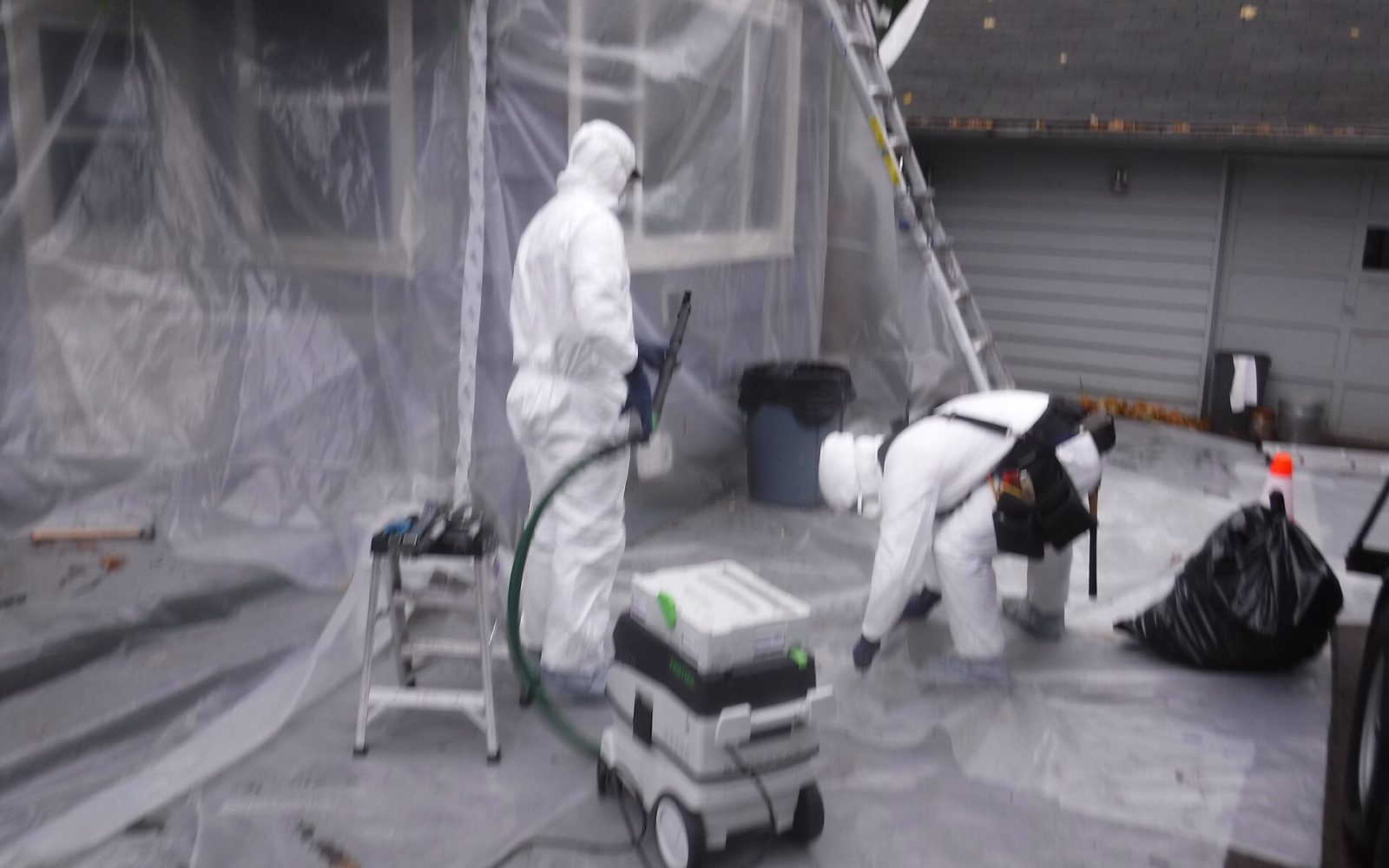
SSPC Guide 6 classifies containment systems for surface preparation debris by the method used and by enclosure features: how permeable the walls are, whether joints are sealed, whether the enclosure is under negative air pressure and how exhaust is filtered. Abrasive blasting of lead paint typically requires the most stringent classes, while power-tool and chemical methods can often use lighter systems (see blast containment and enclosures).
Projects commonly add ambient air monitoring around the site, soil sampling before and after the work, and daily visual checks for emissions, so the contractor can show that lead stayed inside the work area.
Containment protects the public and the environment, but it concentrates exposure inside the enclosure. Lead levels inside a blasting containment can be very high. Respiratory protection, protective clothing, hygiene facilities and decontamination are essential, as directed by the employer’s compliance program.
Worker protection
In US construction, OSHA 29 CFR 1926.62 sets a permissible exposure limit of 50 µg/m³ as an 8-hour time-weighted average and an action level of 30 µg/m³. It requires exposure assessment, a written compliance program, engineering and work-practice controls, respiratory protection, protective clothing, hygiene facilities, training, and blood lead and medical surveillance where triggered. Respirators must be selected and used under OSHA 29 CFR 1910.134 (see respiratory protection). Other countries have equivalent regulations; HSE in the UK, for example, regulates lead at work. Follow the regulations that apply where you work, the SDS for products used, and your employer’s safety program.
Owners often require contractors to hold a recognized qualification for hazardous paint removal, such as SSPC-QP 2.
Waste management
Spent abrasive, paint chips, filters, used protective clothing and wastewater may all be regulated. In the US, waste is commonly evaluated with the Toxicity Characteristic Leaching Procedure (TCLP); waste leaching lead above 5.0 mg/L is a characteristic hazardous waste under RCRA. SSPC Guide 7 addresses disposal of lead-contaminated surface preparation debris. Keep waste streams separate, store them in labelled, closed containers, and use licensed transporters and facilities (see coating waste and disposal).
- Plan. Test the paint, choose the strategy and method, and write the containment, monitoring, worker-protection and waste plans.
- Set up. Erect containment, ground covers, hygiene and decontamination facilities.
- Remove. Prepare the surface to the specified standard within the containment.
- Clean up. HEPA-vacuum surfaces and the enclosure; collect all debris.
- Verify. Inspect cleanliness and profile; complete air, soil and waste testing as required.
- Coat. Prime before rust-back, then remove containment only after final cleanup is accepted.
Recyclable steel abrasive can sharply reduce the volume of hazardous waste from lead blasting, because only the separated paint fines and dust need disposal. Weigh its higher upfront equipment cost against disposal savings.
Frequently asked questions
Can I sand lead paint if I wear a mask?
Dry sanding creates fine lead dust and is restricted or prohibited in many situations. Follow applicable regulations and use wet methods or HEPA-shrouded tools with appropriate respiratory protection.
Is overcoating lead paint allowed?
Generally yes, if the existing coating is sound and compatible with the new system. It still leaves lead in place for future work, so record its presence.
Do I need special training to remove lead paint?
In most jurisdictions, yes. OSHA requires training for workers exposed above set levels, and renovation work in housing is subject to separate certification rules.
Educational reference. Coating performance varies by formulation. Always follow the manufacturer’s product data sheet, safety data sheet and your project specification.