Fall Protection for Industrial Painters
How painters and blasters on bridges, tanks, towers and scaffolds prevent falls — guardrails, aerial lifts, personal fall arrest systems, rescue planning and coating-specific hazards.
Key takeaways
- Industrial painting is largely work at height — on bridges, tanks, towers, ships and building facades — and falls are a leading cause of serious injury and death in construction.
- Prefer eliminating the hazard or using passive protection such as guardrails and platforms before relying on personal fall arrest.
- In the US, construction fall protection generally applies at 6 ft (1.8 m), general industry at 4 ft (1.2 m) and scaffolds at 10 ft (3 m).
- Coating work adds specific risks: slippery surfaces, hoses that snag lanyards, restricted vision in blast hoods and solvent or abrasive damage to harnesses.
Few coating jobs happen at ground level. Painters and blasters routinely work from scaffolds, aerial lifts, suspended platforms, rigging under bridge decks, ladders and the roofs and shells of tanks. Falls from these positions can be fatal even from modest heights, and the nature of coating work — wet, slippery, noisy, dusty and often inside containment — makes them more likely.
This article summarizes general principles and well-known US requirements. Fall protection must be planned by competent people for the specific job; follow your employer’s program, equipment manufacturers’ instructions and the regulations where you work.
Regulations and trigger heights
In the United States, OSHA sets different requirements depending on the type of work and the equipment used. Other jurisdictions differ: in Great Britain, for example, the Work at Height Regulations 2005 apply to work at any height where a fall could cause injury.
| Situation (US) | Rule | Fall protection generally required at |
|---|---|---|
| Construction work (unprotected sides, edges, holes) | 29 CFR 1926 Subpart M | 6 ft (1.8 m) |
| Scaffolds in construction | 29 CFR 1926 Subpart L | 10 ft (3 m) |
| Aerial lifts (boom-supported) | 29 CFR 1926.453 | Body harness and lanyard attached to the boom or basket |
| Ladders in construction | 29 CFR 1926 Subpart X | Requirements for ladder type, setup and use |
| General industry walking-working surfaces | 29 CFR 1910 Subpart D | 4 ft (1.2 m) |
Maintenance painting of an existing structure may fall under construction or general industry rules depending on the scope, so confirm which applies. OSHA also requires training on fall hazards and the systems used, given by a competent person.
The hierarchy of fall protection
- Eliminate the hazard. Shop-coat steel before erection, lower components to the ground, or use extension poles from grade.
- Passive protection. Guardrails, toe boards, hole covers, work platforms and safety nets protect everyone without relying on individual action.
- Fall restraint. A harness and short lanyard or line that physically prevents the worker from reaching the edge.
- Fall arrest. A personal fall arrest system that stops a fall after it starts.
- Administrative controls. Warning lines, safety monitors and controlled access zones, used only where permitted and appropriate.
Personal fall arrest systems
A personal fall arrest system (PFAS) is often described by its components:
- Anchorage. OSHA construction rules require anchorages for fall arrest to support 5,000 lb (22.2 kN) per attached worker, or be designed, installed and used as part of a complete system with a safety factor of at least two under the supervision of a qualified person.
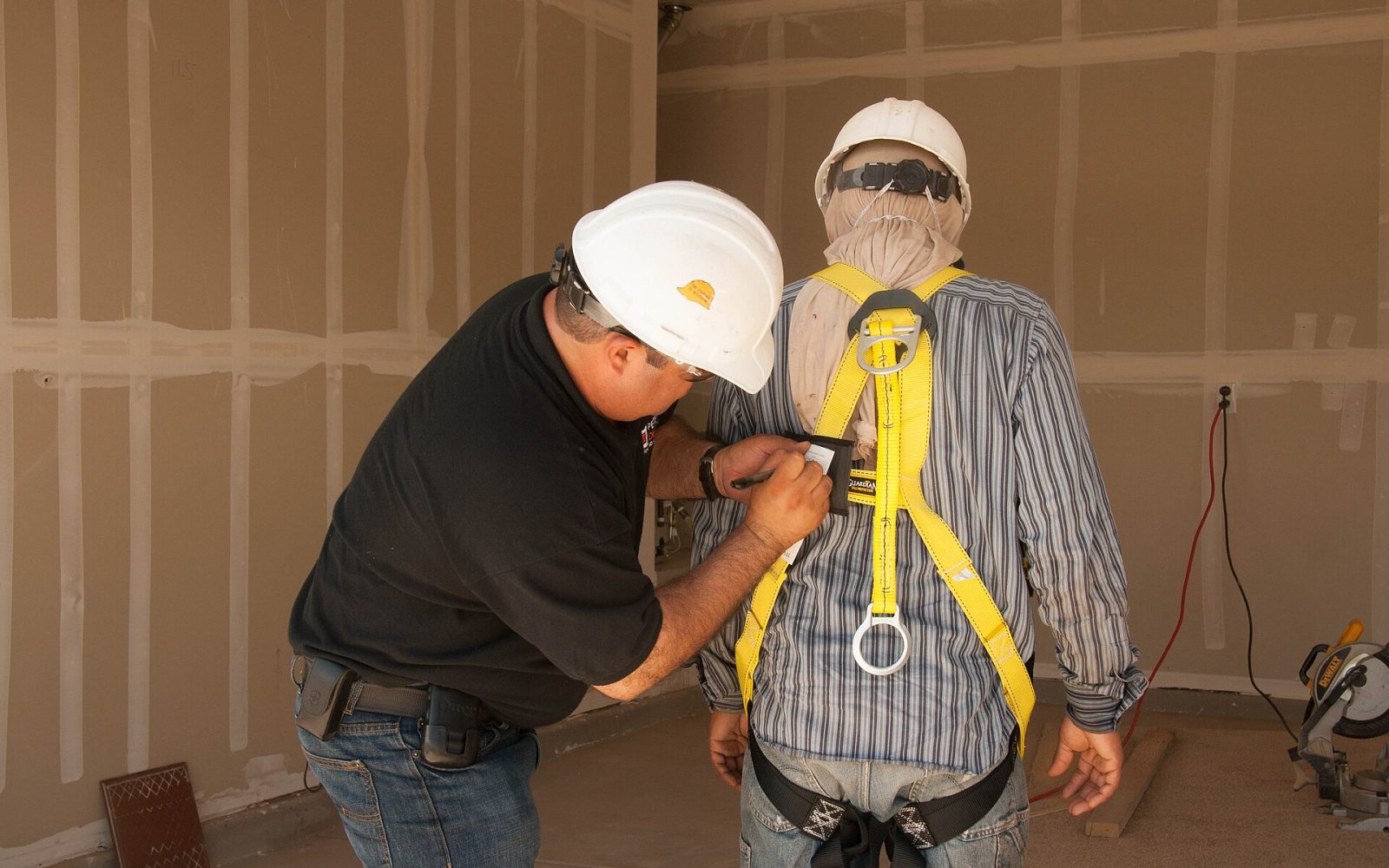
- Body harness. A full-body harness distributes arrest forces; body belts are not acceptable for fall arrest.
- Connectors. Shock-absorbing lanyards, self-retracting lifelines (SRLs), rope grabs and locking snap hooks or carabiners compatible with the anchor.
- Clearance. The total fall distance — free fall, deceleration, harness stretch and the worker’s height below the D-ring, plus a safety margin — must be less than the distance to the nearest obstruction.
OSHA construction criteria also limit maximum arresting force on a worker using a harness to 1,800 lb (8 kN) and free fall to 6 ft (1.8 m) in most cases. Manufacturers’ instructions specify compatible components and clearance requirements.
Hazards specific to coating work
- Slippery surfaces. Wet coatings, overspray, spent abrasive and condensation make steel and decking treacherous. Clean walking surfaces regularly and consider slip-resistant footwear.
- Hoses and leads. Spray hoses, blast hoses and air lines can snag lanyards and SRLs, pull workers off balance or drag them toward an edge. Route them away from fall protection lines.
- Restricted senses. Blast hoods, respirators and hearing protection limit vision and hearing, making edges harder to see.
- Equipment damage. Solvents, coatings and abrasive can degrade or hide damage to webbing, stitching and hardware. Inspect before each use, clean only as the manufacturer allows, and remove damaged equipment from service.
- Anchors on coated steel. Paint and corrosion can hide section loss or cracks. Anchorages on old structures should be evaluated by a qualified person.
- Containment. Tarps and enclosure walls on bridge projects are not guardrails; enclosures also complicate rescue. See blast containment.
- Tanks and vessels. Roof edges, shell openings and interior scaffolds combine fall and confined-space hazards; see confined space coating work and storage tank linings.
A worker hanging in a harness after a fall can develop suspension intolerance, a potentially life-threatening condition, within a relatively short time. Every fall arrest plan must include a way to rescue the worker promptly — not just a phone number for emergency services.
Planning and rescue
- Survey the work. Identify every elevated position, edge, opening and access route, including those used by inspectors.
- Select systems. Choose platforms, scaffolds, lifts and anchorage systems that suit the structure and the coating method.
- Calculate clearance. Confirm there is enough clearance below each tie-off point for the connector being used.
- Write a rescue plan. Specify equipment, trained rescuers and how a suspended worker will be reached quickly.
- Train and inspect. Train workers on the systems and hazards, and inspect equipment before every use.
- Review at the pre-job meeting. Cover fall protection at the pre-job conference and daily safety briefings.
Protect harnesses and lanyards from overspray with covers recommended by the manufacturer, and keep spare harnesses on site so a contaminated or damaged one can be taken out of service immediately.
Frequently asked questions
Can I tie off to a guardrail or a pipe?
Only if a qualified person has determined that it can serve as an anchorage meeting the applicable strength requirements. Many guardrails, pipes and handrails are not designed for fall arrest loads.
Do I need fall protection in a scissor lift?
Scissor lifts are generally treated as mobile scaffolds with guardrails as the primary protection. Some employers and manufacturers also require restraint; follow the manufacturer’s manual and your program.
How often should harnesses be inspected?
By the user before each use, and periodically by a competent person as the manufacturer and your program require. Remove any harness that has arrested a fall from service.
Educational reference. Coating performance varies by formulation. Always follow the manufacturer’s product data sheet, safety data sheet and your project specification.