Hot-Dip Galvanizing
Hot-dip galvanizing immerses fabricated steel in molten zinc to form metallurgically bonded zinc-iron layers that protect by barrier and sacrificial action, often for decades with little maintenance.
Key takeaways
- Hot-dip galvanizing (HDG) dips cleaned steel into molten zinc, forming a series of zinc-iron alloy layers topped by relatively pure zinc.
- The coating protects steel by barrier action and by sacrificial (galvanic) protection at scratches and cut edges.
- Coating thickness depends mainly on steel thickness and chemistry, especially silicon and phosphorus content, more than on dip time.
- Parts must be designed for galvanizing, with vent and drain holes and sizes that fit the kettle.
Galvanizing has protected steel for well over a century and remains one of the most widely specified corrosion-protection methods for structural steel, transmission towers, light poles, guardrail, fasteners and reinforcing bar. Unlike paint, which adheres to the surface, a galvanized coating reacts with the steel itself, producing a metallurgical bond.
The process is done in a factory, not in the field, which gives consistent quality control but introduces size and design constraints. When additional life or color is required, galvanized steel is often painted to form a duplex system.
How the galvanizing process works
- Degreasing. A hot caustic or acidic cleaning solution removes oil, grease and soil. Paint, weld slag and heavy markings must be removed separately, often by blasting.
- Rinsing. Water rinses prevent carryover between tanks.
- Pickling. Dilute hydrochloric or sulfuric acid removes mill scale and rust.
- Fluxing. A zinc ammonium chloride flux removes final oxides and protects the steel until dipping.
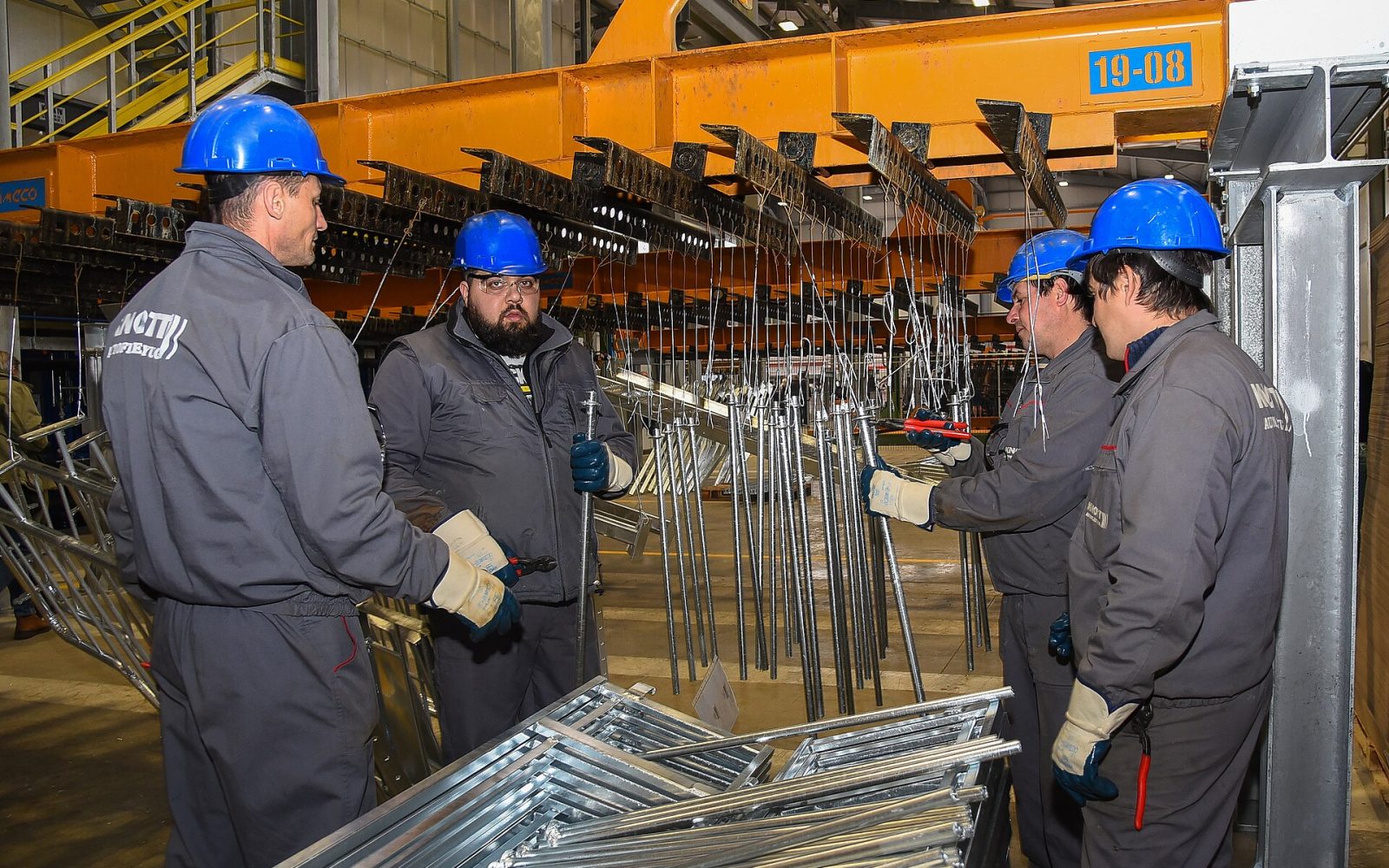
- Galvanizing. The part is immersed in molten zinc at about 840–850 °F (449–454 °C) until it reaches bath temperature and the reaction is complete.
- Cooling and finishing. Parts are withdrawn, excess zinc is drained or removed, and items may be water-quenched or air-cooled.
- Inspection. Coating thickness, appearance and adhesion are checked against the applicable standard.
Because the chemical cleaning steps cannot remove paint, asphalt or welding slag, these contaminants cause bare spots and must be addressed before parts arrive at the galvanizer.
Coating structure and protection
The coating that forms is not a simple zinc layer. Zinc and iron diffuse into each other to create intermetallic layers, usually described as the gamma, delta and zeta layers, topped by a relatively pure zinc eta layer. The alloy layers are harder than the base steel, giving galvanizing good abrasion and impact resistance.
Zinc protects steel in two ways. First, it is a barrier that corrodes far more slowly than steel in most atmospheres, forming a stable zinc carbonate patina over time. Second, zinc is anodic to steel, so at scratches, cut edges and small damaged areas it corrodes preferentially and protects the exposed steel, the same principle described in Galvanic Corrosion.
Effect of steel chemistry
Silicon and phosphorus in the steel strongly affect how fast the zinc-iron reaction proceeds. Certain reactive steels produce thicker, duller gray coatings that may be more brittle, while other steels produce thinner, bright coatings. Discuss steel chemistry with the galvanizer when appearance or thickness matters.
Standards and coating thickness
| Standard | Scope |
|---|---|
| ASTM A123/A123M | Zinc coatings on fabricated iron and steel products, including structural shapes, plate and pipe |
| ASTM A153/A153M | Zinc coatings on iron and steel hardware, such as fasteners and small castings, typically centrifuged |
| ASTM A767/A767M | Zinc-coated (galvanized) steel bars for concrete reinforcement |
| ASTM A780/A780M | Repair of damaged and uncoated areas of hot-dip galvanized coatings |
| ISO 1461 | International standard for hot-dip galvanized coatings on fabricated iron and steel articles |
Minimum thickness requirements generally increase with steel thickness. For typical structural members, minimum average coating thicknesses commonly fall in the range of roughly 3–4 mils (75–100 µm) or more; check the table in the governing standard. Thickness is normally measured with magnetic gauges; see Dry Film Thickness Measurement.
Designing for galvanizing
Good design avoids trapped air, explosions and poor coverage. Hollow sections and enclosed spaces need vent and drain holes so that cleaning solutions and zinc can flow in and out and air or steam can escape; sealed hollow parts can rupture violently in the kettle. Overlapping surfaces trap pickling acid and cause weeping and staining.
- Size: the part must fit the galvanizer’s kettle, sometimes with progressive (double) dipping for long members.
- Distortion: thin, asymmetrical or heavily welded assemblies can warp at bath temperature.
- Mixed thicknesses: combining very thick and very thin sections can cause uneven heating and coating.
- Threads and moving parts: may need masking, re-tapping or post-galvanize assembly.
Contact the galvanizer during detailing, not after fabrication. Vent hole sizes and locations, kettle dimensions and steel chemistry are far easier to fix on drawings than on finished steel.
Service life, advantages and limitations
Service life to first maintenance depends mainly on coating thickness and environment. Zinc corrodes slowly in rural and many urban atmospheres and faster in industrial, marine and wet environments; the ISO 12944 corrosivity categories help estimate this. Zinc performs best in a pH range of roughly 6–12 and is attacked rapidly by strong acids and strong alkalis.
Advantages
- Metallurgical bond and tough, abrasion-resistant alloy layers
- Coats inside and outside surfaces, corners and edges uniformly
- Sacrificial protection at damage
- Factory-controlled process, independent of field weather
- Long, low-maintenance life in many atmospheres
Limitations
- Limited by kettle size and part design
- Possible distortion of thin or complex fabrications
- Appearance varies with steel chemistry
- Not suitable for strongly acidic or alkaline exposure
- Painting requires specific surface preparation
Paint applied directly to fresh galvanizing without proper preparation often peels. See Preparing Galvanized Steel for Coating before specifying a duplex system.
Frequently asked questions
How is damaged galvanizing repaired?
ASTM A780 describes repair using zinc-rich paints, zinc-based solders or sprayed zinc metallizing, with requirements for surface preparation and thickness.
What is white rust?
White rust is a bulky zinc corrosion product that forms when freshly galvanized surfaces stay wet without good air circulation, such as in tightly stacked bundles. Proper storage and ventilation help prevent it.
Is galvanizing better than painting?
It depends on size, environment, appearance needs and life-cycle cost. Galvanizing often has lower lifetime cost for steel that fits a kettle; a duplex system can extend life further.
Can galvanized steel be welded?
Yes, but zinc must usually be removed from the weld zone, fumes must be controlled, and the area recoated afterward.
Educational reference. Coating performance varies by formulation. Always follow the manufacturer’s product data sheet, safety data sheet and your project specification.