Impact & Flexibility Testing
How falling-weight impact, mandrel bend, T-bend, cupping and elongation tests show whether a coating can survive knocks, bending and substrate movement without cracking or losing adhesion.
Key takeaways
- Impact tests drop a weighted indenter onto a coated panel and record the highest energy the film withstands without cracking or losing adhesion.
- Flexibility tests bend coated panels over mandrels or folds of decreasing radius and record the tightest bend the coating survives.
- Elongation tests on free films measure how far a coating can stretch — critical for elastomers and coatings over moving substrates.
- All of these are comparative laboratory tests. Results depend heavily on substrate, film thickness, cure and temperature, so compare only like with like.
Coatings get knocked by tools, debris and handling equipment, and they have to move with substrates that bend, expand and contract. A film that is hard and chemically resistant but brittle can crack under a single impact or a cold-weather flex, opening a path to corrosion. Impact and flexibility tests measure how well a coating tolerates rapid deformation and bending — properties that complement abrasion and hardness testing.
Impact resistance testing
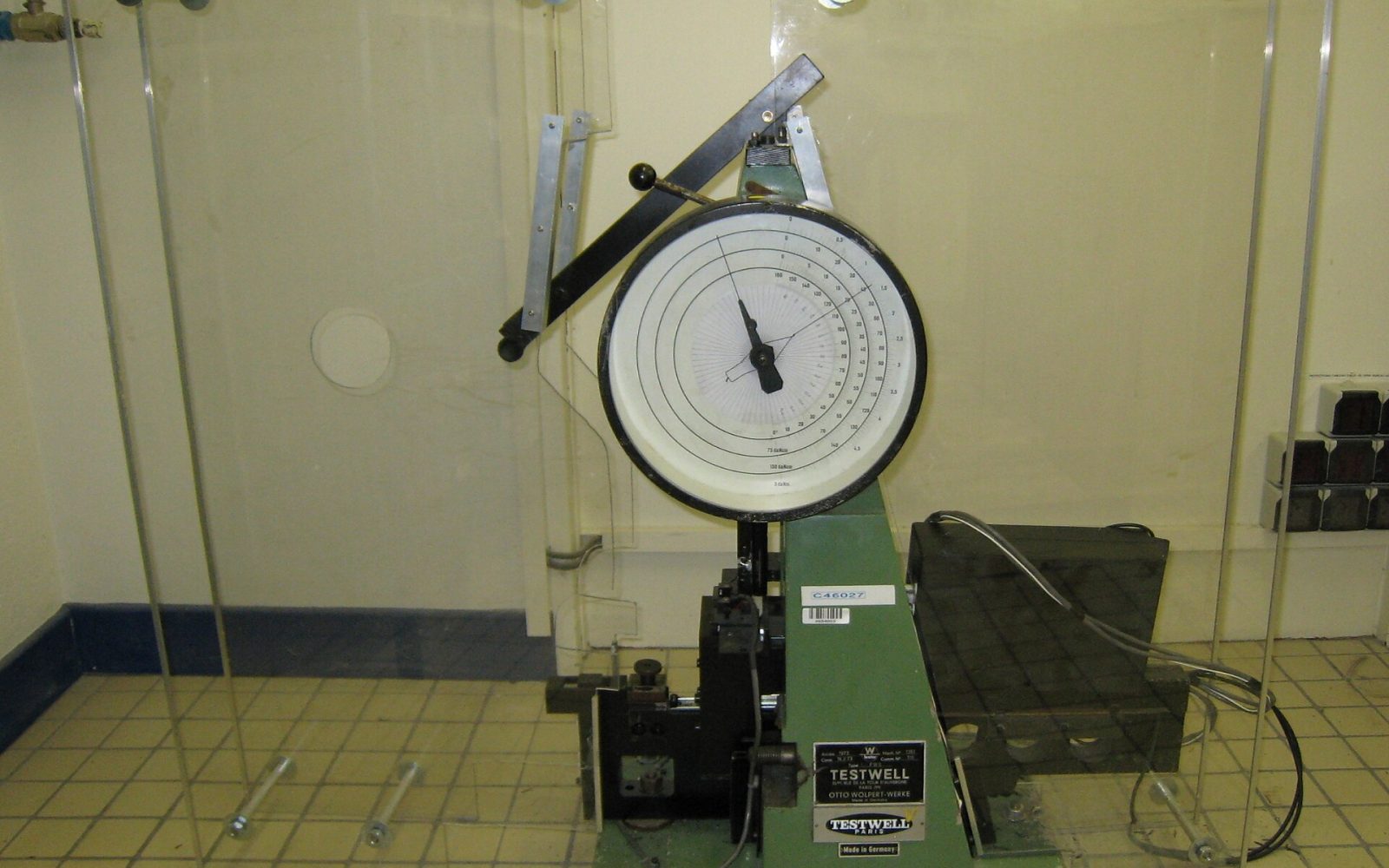
The most widely used methods are ASTM D2794, which covers resistance of organic coatings to the effects of rapid deformation (impact), and the ISO 6272 series of falling-weight tests.
A weight slides down a guide tube and strikes a hemispherical indenter resting on a coated panel. Impact may be intrusion (direct), striking the coated face, or extrusion (reverse), striking the back so the coating is stretched over the dome. The operator increases drop height in steps until the coating cracks or detaches, then reports the highest energy without failure — in inch-pounds or joules.
Failure can be hard to see on small cracks. Common aids include magnification, a copper sulfate solution that plates copper onto exposed steel, or a low-voltage pinhole detector over the deformed area.
Reverse impact is usually more severe than direct impact because the coating is stretched in tension. Data sheets that list both give a better picture of a coating’s toughness.
Flexibility and bend tests
Mandrel bend
ASTM D522 covers mandrel bend tests of attached organic coatings using either a conical mandrel or a set of cylindrical mandrels. ISO 6860 (conical) and ISO 1519 (cylindrical) are the international equivalents. Coated sheet-metal panels are bent around the mandrel, and the smallest diameter that causes no cracking or loss of adhesion is recorded. With a conical mandrel, one bend covers a range of diameters and the crack length shows the limit.
T-bend
ASTM D4145 covers the flexibility of prepainted sheet, a key test in coil coating. The coated strip is folded back on itself, 180°, around increasing numbers of thicknesses of the same sheet (0T, 1T, 2T and so on). The lowest T rating with no cracking — and, separately, no tape pick-off — is reported. Lower numbers mean better flexibility.
Cupping
ISO 1520 (often called the Erichsen cupping test) pushes a hemispherical punch into the back of a coated panel to slowly draw a dome. The depth at which the coating cracks or detaches is reported in millimetres. It simulates forming of coated metal parts.
Pipe bend tests
For fusion-bonded epoxy and other pipeline coatings, product standards specify bending coated strips cut from pipe, often at low temperature, to a set angle per pipe diameter length. The test reflects field bending of coated line pipe.
| Test | Standard(s) | Simulates | Reported as |
|---|---|---|---|
| Falling weight impact | ASTM D2794; ISO 6272 | Knocks, dropped tools, debris | Max energy without failure (in·lb or J) |
| Mandrel bend | ASTM D522; ISO 1519; ISO 6860 | Bending of thin sheet | Smallest diameter passed |
| T-bend | ASTM D4145 | Forming of prepainted sheet | Lowest T rating passed |
| Cupping | ISO 1520 | Stretch-forming | Depth at failure (mm) |
| Free-film tensile | ASTM D2370; ASTM D412 | Substrate movement, crack bridging | Elongation (%) and tensile strength |
Elongation and tensile properties
Attached-film tests are limited by the substrate. To measure how far a coating itself can stretch, laboratories cast free films, cut them into specimens and pull them in a tensile tester. ASTM D2370 covers tensile properties of organic coatings; ASTM D412 is widely used for elastomeric materials such as polyurea and polyurethane. Results include tensile strength, elongation at break and sometimes modulus.
Elongation ranges from a few percent for rigid, highly crosslinked epoxies to several hundred percent for elastomers. High elongation is valuable for crack bridging over concrete, roofs and waterproofing, but it usually comes with lower hardness and chemical resistance — a trade-off linked to crosslink density.
Factors that affect results
- Film thickness. Thicker films generally crack more easily in bend tests and absorb impact differently. Test at the specified dry film thickness.
- Substrate and pretreatment. Panel thickness, metal type and surface preparation affect both impact and bend results.
- Cure and age. Coatings often become harder and less flexible as cure continues and as they age or weather.
- Temperature. Most coatings become more brittle in the cold, especially below their glass transition temperature. Low-temperature tests reveal this.
- Adhesion. A well-bonded film may crack where a poorly bonded one would stretch and lift, so record whether failure is cracking, loss of adhesion or both.
For coatings that will see low temperatures or thermal cycling, ask for impact and flexibility data at service temperature, not just at room temperature. A coating that passes at 73 °F (23 °C) can crack well before the bend limit at freezing.
Using the results
Impact and flexibility results are most useful for comparing candidate systems under identical conditions, for batch quality control, and for diagnosing cracking failures such as checking and cracking. They do not predict field life on their own. Follow the product data sheet for the manufacturer’s tested values, and make sure any specification requirement names the method, substrate, film thickness, temperature and pass criteria.
Frequently asked questions
What is the difference between direct and reverse impact?
Direct (intrusion) impact strikes the coated face; reverse (extrusion) impact strikes the back so the coating is stretched over the deformation. Reverse impact is usually the harsher test.
Can impact tests be done on concrete floors?
Standard methods are designed for coated metal panels. Floor coating manufacturers sometimes report impact data on coated concrete or steel, but results are not directly comparable between substrates.
Does a higher elongation always mean a better coating?
No. High elongation helps on moving substrates, but it usually comes with lower hardness and chemical resistance. Choose the balance the service needs.
Educational reference. Coating performance varies by formulation. Always follow the manufacturer’s product data sheet, safety data sheet and your project specification.