Coil Coating
How steel and aluminum strip is cleaned, pretreated, roller-coated and baked at high speed before it is formed into roofing, cladding, appliances and other products.
Key takeaways
- Coil coating applies paint to flat metal strip on a continuous line before the metal is cut and formed into products.
- Lines clean, pretreat, prime, topcoat and bake the strip in one pass, usually with precision reverse roller coaters.
- Coatings must withstand forming after cure, so flexibility and adhesion are as important as weathering resistance.
- Prepainted metal is very consistent, but cut edges and field damage need attention because the coating cannot be reapplied the same way on site.
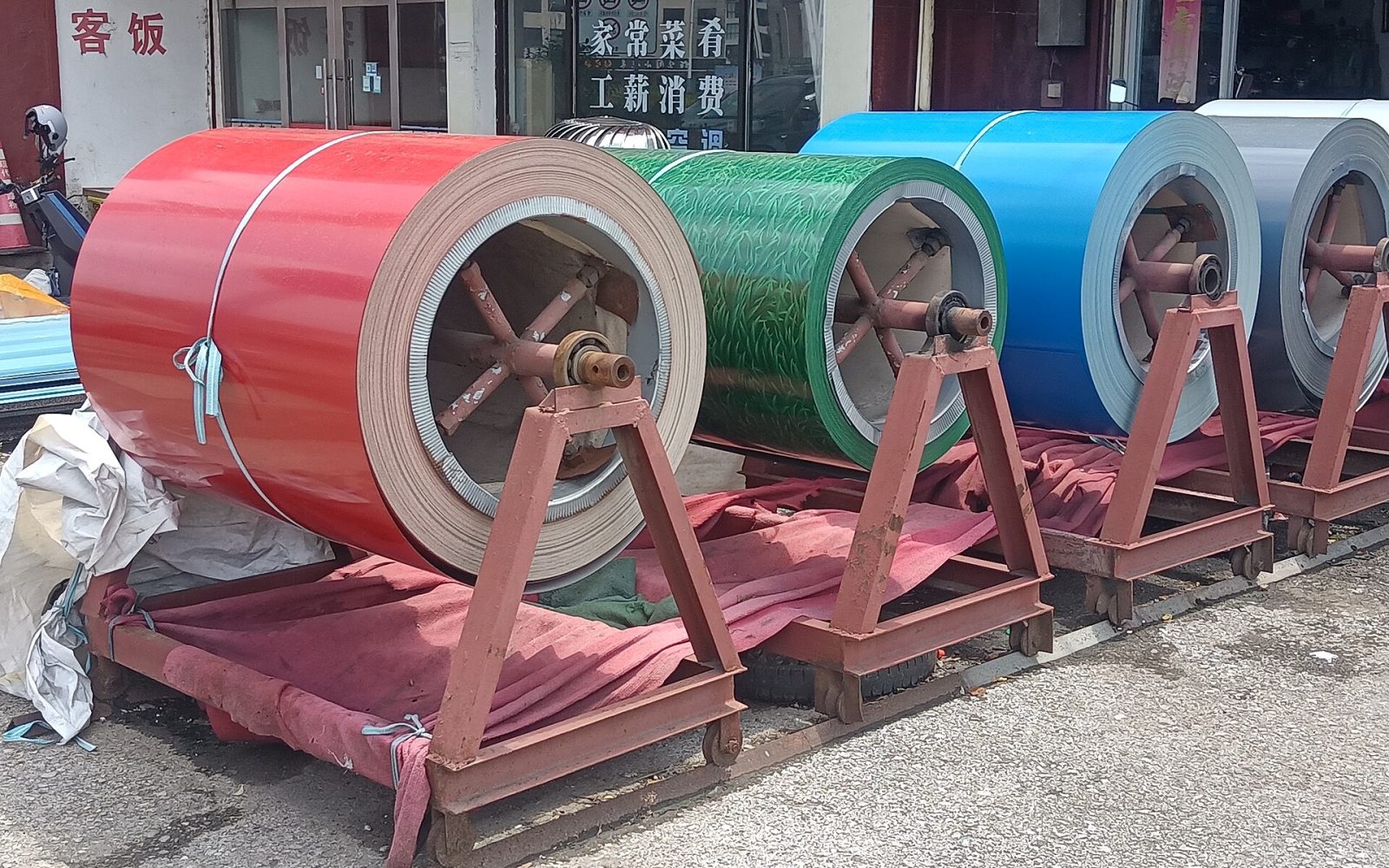
Much of the colored metal seen on buildings — roofing, wall cladding, garage doors, gutters — and on appliances, HVAC cabinets and many other products was painted as flat strip before it was ever formed. This process, coil coating (also called prepainting), coats the metal at high speed under tightly controlled factory conditions. Fabricators then roll-form, bend, stamp or cut the prepainted sheet into finished parts.
Compared with painting finished parts, coil coating offers very uniform film thickness, efficient material use and fully cured finishes with no field application. Its main constraint is that the cured coating must survive the forming operations that follow.
How a coil coating line works
- Uncoil and join. Coils of bare or metallic-coated strip are unwound and stitched end-to-end so the line runs continuously; accumulators store strip so the process section keeps moving during coil changes.
- Clean. Alkaline cleaning, brushing and rinsing remove oils and soils from rolling and handling.
- Pretreat. A conversion coating or dried-in-place pretreatment is applied to improve adhesion and underfilm corrosion resistance. Chrome-free pretreatments have largely replaced chromate systems in many regions.
- Prime. A thin primer is roller-coated onto one or both sides and cured in a short, high-temperature oven.
- Topcoat and backer. The finish coat is applied to the exposed side and a backer coat to the reverse side, then cured in a second oven.
- Cool, inspect and recoil. The strip is quenched, inspected, sometimes laminated with a strippable protective film, and rewound for shipment.
Roller application and cure
Most coil lines use reverse roller coating. A pickup roll lifts coating from a pan, a metering roll sets the amount on the applicator roll, and the applicator roll — turning opposite to the strip direction — wipes the coating onto the moving metal. Film thickness is controlled by roll gaps, roll speed ratios and coating viscosity, which allows thin, very uniform films on wide strip.
Curing takes place in long convection or induction ovens. Rather than a fixed time and temperature, cure is specified as a peak metal temperature (PMT) — the highest temperature the strip reaches — over a short dwell. PMTs commonly fall in the range of about 400–480 °F (approximately 200–250 °C), with dwell times measured in seconds rather than minutes; the exact values come from the coating supplier.
Because cure happens in seconds, small changes in line speed, oven settings or strip gauge can under- or over-cure the film. Lines monitor PMT with temperature-indicating devices and verify cure with solvent rub tests.
Coating systems for coil
| Topcoat type | Typical film build | Character | Typical uses |
|---|---|---|---|
| Polyester | ~0.7–1 mil (18–25 µm) | Economical, good flexibility, moderate weathering | Residential roofing, appliances, interiors |
| Silicone-modified polyester (SMP) | ~0.7–1 mil (18–25 µm) | Improved gloss and color retention | Commercial and agricultural buildings |
| PVDF fluoropolymer | ~0.7–1 mil (18–25 µm) over primer | Excellent color and chalk resistance | Architectural cladding, premium roofing |
| Polyurethane / polyamide-modified | Varies | Good formability and abrasion resistance | Roofing in harsh climates, doors |
| Plastisol (PVC) | Thick, often ~4–8 mils (100–200 µm) | Tough, textured, high build | Cladding and roofing in some markets |
Primers are typically epoxy or polyester, applied at around 0.2–0.3 mil (5–8 µm). Values vary by supplier and specification. The substrate is usually hot-dip galvanized or aluminum-zinc alloy-coated steel, or aluminum; in North America prepainted metallic-coated steel sheet is commonly specified to ASTM A755/A755M, and in Europe EN 10169 covers continuously organic-coated steel flat products.
Testing prepainted metal
Because the product is formed after painting, coil coatings are tested for both durability and formability. Common checks include:
- Film thickness by magnetic or eddy-current gauges or destructive methods (see dry film thickness measurement)
- Solvent resistance by MEK double rubs, commonly per ASTM D5402, to confirm cure
- Flexibility by T-bend testing per ASTM D4145, reported as the tightest bend without cracking or loss of adhesion
- Impact and adhesion by reverse impact and tape tests (see impact and flexibility testing)
- Gloss, color and weathering by instrument measurements and exposure testing (see gloss and color measurement)
Advantages and limitations
Advantages
- Very uniform film thickness and appearance
- High material efficiency and controlled emissions in a factory
- Fully cured finish delivered to the job site
- Eliminates field painting of panels and components
Limitations
- Cut edges are bare metal and rely on the metallic coating
- Thin films are vulnerable to scratches during handling and installation
- Color and coating changes need minimum order quantities
- Repainting in service requires a compatible field system
Touch-up paint on prepainted panels often weathers differently from the factory finish and may look worse over time than the scratch. Use it sparingly and only with the panel supplier’s matched product; replace badly damaged panels instead.
Frequently asked questions
Why do coil coatings use such thin films?
Thin films cure quickly at line speed and flex without cracking during roll-forming. Durability comes from the metallic coating, pretreatment, primer and high-performance topcoat working together.
What is the difference between PVDF and SMP finishes?
PVDF fluoropolymer finishes generally offer better long-term color and gloss retention and are used for premium architectural work. SMP is a lower-cost option with good performance for many building applications.
Can old coil-coated roofing be repainted?
Yes, with suitable cleaning, preparation and a field coating designed for prepainted metal (see overcoating existing coatings and roof coatings). Weathered PVDF can be difficult to adhere to, so follow the field coating manufacturer’s instructions.
Educational reference. Coating performance varies by formulation. Always follow the manufacturer’s product data sheet, safety data sheet and your project specification.