Spray-On Truck Bed Liners
Thick, bonded elastomer coatings that armor pickup beds against impact, abrasion and rust — how they differ, how they are applied and what makes them last.
Key takeaways
- Spray-on bed liners are thick elastomeric coatings — usually polyurea, polyurethane or hybrids — bonded directly to the truck bed.
- High-pressure, heated plural-component equipment produces the fastest-curing, toughest liners; low-pressure and roll-on products cure more slowly and are typically thinner.
- Adhesion depends on preparation: scuffing or blasting, thorough cleaning, masking and priming any bare metal.
- Many aromatic liner materials darken or chalk in sunlight unless they are UV-stabilized or topcoated with an aliphatic coat.
- Isocyanate exposure during spraying requires proper ventilation and respiratory protection.
A spray-on truck bed liner is a protective elastomeric coating applied directly to a pickup bed to resist impact, abrasion, denting, cargo shifting and corrosion. Unlike a molded plastic drop-in liner, it is bonded to the bed and conforms to every rib and contour, leaving no gap for water and grit to collect.
The same technology is used well beyond pickups: trailer decks, utility bodies, off-road vehicle tubs, rocker panels, boat decks, dock edges, equipment housings and even entire vehicle exteriors are coated with bed-liner-type materials.
Liner chemistries
Most professional liners are two-component reactive elastomers based on isocyanate chemistry:
- Pure polyurea — isocyanate reacting with amine-terminated resins. Gels in seconds and is tack-free in well under a minute in many formulations, giving very high productivity and good tolerance of cool or humid conditions. See polyurea coatings.
- Hybrid polyurea/polyurethane — blends of amine and polyol resins. Slightly slower and often more economical, with properties between the two families.
- Polyurethane — isocyanate reacting with polyols. Slower cure, more moisture-sensitive during application, and widely used in low-pressure systems. See polyurethane coatings.
Most liner base materials use aromatic isocyanates for cost and toughness. Aromatic materials typically darken and lose gloss in sunlight. Manufacturers address this with UV-stabilized formulations or, more effectively, an aliphatic polyurethane or polyaspartic topcoat. See chalking and fading.
Comparing liner options
| Type | Typical thickness | Cure / handling | Notes |
|---|---|---|---|
| High-pressure polyurea or hybrid | Commonly ~60–125 mils (1.5–3 mm) in the bed | Seconds to minutes to tack-free; light service often within hours | Toughest option; requires heated plural-component rig and trained applicator |
| Low-pressure polyurethane | Commonly ~40–80 mils (1–2 mm) | Minutes to hours; longer before full service | Lower equipment cost; slower build; more sensitive to humidity |
| DIY roll-on or aerosol kits | Often a few to ~20 mils (0.1–0.5 mm) | Hours to days | Mostly cosmetic and light-duty; durability varies widely |
| Drop-in plastic liner | Molded polyethylene shell | Immediate | Removable; can trap water and grit and rub paint beneath it |
| Rubber bed mat | Loose mat | Immediate | Protects floor only; good cargo grip |
Thickness and cure figures are typical ranges only; individual product data sheets vary significantly.
Advantages and limitations of spray-on liners
Advantages
- Bonded and seamless, so no water or debris trapped underneath
- Excellent impact and abrasion resistance
- Good cargo grip from textured finish
- Seals bare-metal scratches and seams against corrosion
- Reduces noise and vibration
- Can be colored to match or contrast the vehicle
Limitations
- Effectively permanent — removal is difficult and labor-intensive
- Quality depends heavily on prep and applicator skill
- Aromatic materials fade or chalk without UV protection
- Textured surface makes sliding heavy cargo harder
- Adds weight compared with an uncoated bed
- Requires professional equipment and isocyanate safety controls
How a spray-on liner is applied
- Inspect and clean. Remove the tailgate hardware, tie-downs and any drop-in liner. Wash the bed and remove wax, silicone and grease with a suitable cleaner or solvent wipe.
- Mask. Tape off the bed rails, cab, lights, wiring, drain holes and threaded fasteners. A crisp tape line along the rails is the most visible quality marker.
- Abrade. Scuff all painted surfaces thoroughly by sanding or abrasive blasting so no gloss remains; rusted areas are cleaned to sound metal. Common practice uses coarse abrasive to create a mechanical key.
- Clean again. Blow off and solvent-wipe to remove sanding dust and fingerprints.
- Prime. Apply the manufacturer’s adhesion promoter or primer to bare steel, aluminum and plastic or composite surfaces. Aluminum and composite beds generally need a specific primer.
- Spray. Apply the liner in multiple passes to build even thickness, with extra attention to corners, ribs and the bulkhead; adjust gun distance and pressure for the desired texture.
- Topcoat (optional). Apply an aliphatic UV-resistant topcoat within the recoat window if specified.
- Demask and cure. Remove masking while edges are clean, reinstall hardware, and observe the manufacturer’s time before loading.
Most bed liner adhesion complaints are preparation failures rather than material failures. If the liner peels cleanly and the back is smooth and glossy, the paint underneath was not abraded enough or was contaminated. See delamination and adhesion failure.
Equipment and safety
Professional polyurea and hybrid liners are applied with heated, high-pressure proportioners that meter the two components — usually at a 1:1 volume ratio — heat them, and mix them by impingement in the spray gun. Typical setups run fluid pressures in the low thousands of psi and preheat the components to roughly 140–170 °F (60–77 °C), but settings should follow the material data sheet. Hose heating, drum temperature and ratio accuracy directly affect texture and properties; off-ratio material can be soft, brittle or tacky.
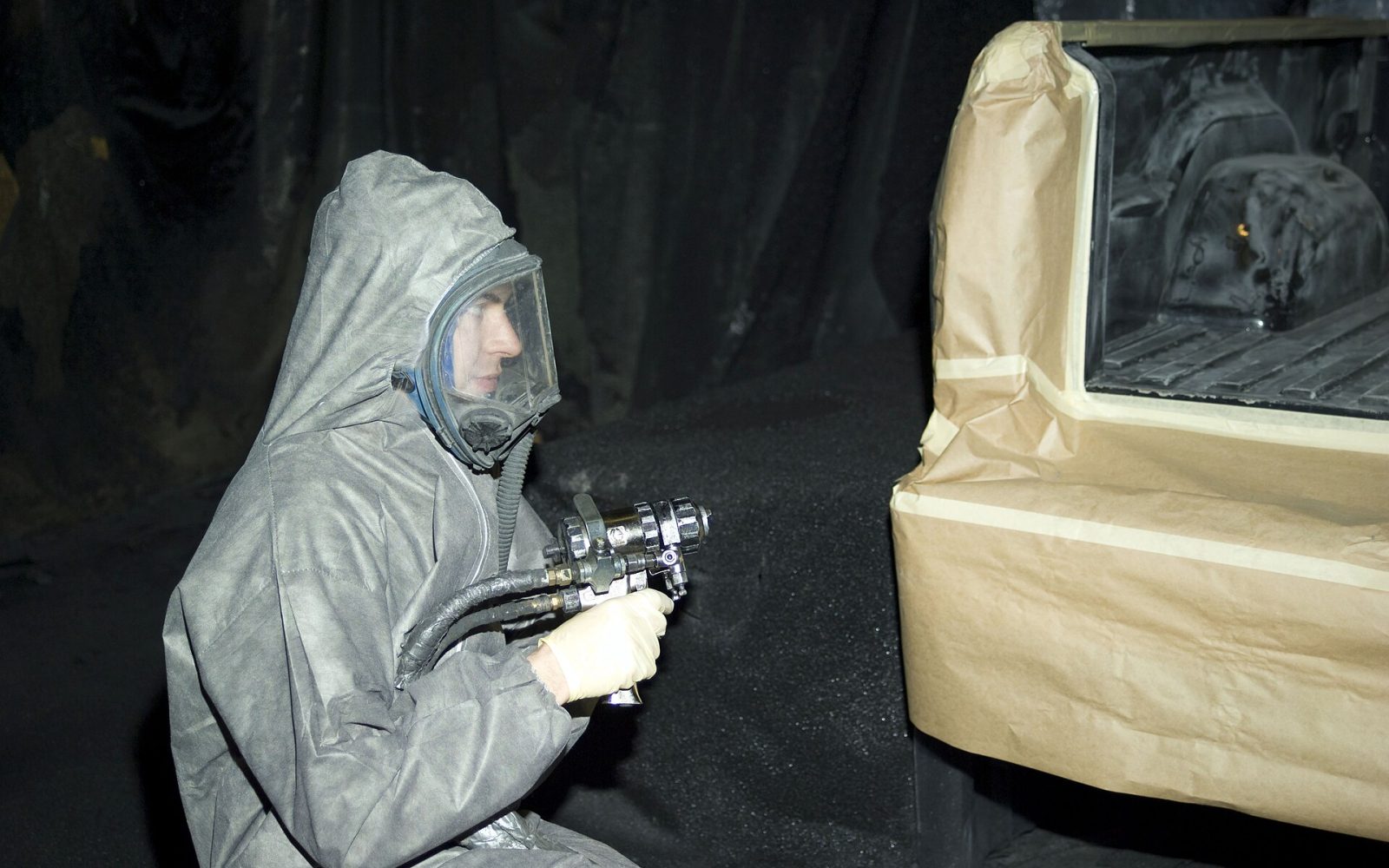
Isocyanates are respiratory and skin sensitizers. Spraying is done in ventilated booths, with supplied-air respiratory protection commonly recommended or required for spray work, along with chemical-resistant gloves, coveralls and eye protection. Low-pressure products still contain isocyanates and need appropriate controls.
“Non-isocyanate” marketing on some DIY products does not mean every liner product is free of hazards. Read the safety data sheet for every component before use.
Durability, maintenance and repair
A well-applied high-pressure liner can last for the working life of many trucks. Common issues include fading of aromatic materials, edge lifting where masking lines were not properly abraded, and gouges from sharp loads. Damage is repaired by cleaning, abrading the area and a margin around it, priming exposed metal and re-spraying or applying a repair kit compatible with the original material. Routine care is simple: wash with mild detergent and avoid strong solvents. For abrasion comparisons between products, manufacturers often report Taber abrasion results — see abrasion and hardness testing.
Frequently asked questions
Is spray-on better than a drop-in liner?
For most heavy users, yes: a bonded liner does not trap water or abrade the paint underneath and conforms to the bed. A drop-in is removable and inexpensive, which suits owners who may want to restore a bare bed later.
Will a bed liner prevent rust?
A well-bonded liner seals the bed’s painted surface from moisture and impact damage. It cannot stop corrosion already active beneath it, so existing rust should be removed and primed before lining.
Can the whole truck be coated in bed liner?
Yes, full-exterior liner coatings are common on off-road and work vehicles. A UV-stable or topcoated system is recommended to avoid fading, and the vehicle gains some weight.
How long before I can load the bed?
Fast-set polyureas often allow light use within hours, while slower polyurethane and DIY products can take a day or more. Full properties may take several days to develop; follow the product’s instructions.
Educational reference. Coating performance varies by formulation. Always follow the manufacturer’s product data sheet, safety data sheet and your project specification.