Marine & Offshore Coatings
How ships, platforms and harbor structures are protected from seawater, salt air and fouling — zone by zone, from topsides to the seabed.
Key takeaways
- Marine and offshore structures are coated zone by zone — atmospheric, splash, tidal and submerged — because each zone corrodes differently.
- The splash zone is usually the most aggressive area and receives the thickest, toughest systems or thermal-sprayed metal.
- Underwater hulls combine an anticorrosive epoxy system with an antifouling or fouling-release topcoat, and must be compatible with cathodic protection.
- ISO 12944 (including Part 9 for offshore) and, for ship ballast tanks, the IMO Performance Standard for Protective Coatings (PSPC) are the key frameworks.
- Soluble salt contamination and edge coverage are the most common hidden causes of premature failure.
Marine and offshore coatings protect ships, offshore platforms, wind turbine foundations, jetties, harbor structures and subsea equipment from one of the most corrosive environments on earth. Seawater is a highly conductive electrolyte, marine air carries chlorides far inland, and structures face wave impact, abrasion, ultraviolet light and biological fouling — often for decades between full maintenance opportunities.
Because access is difficult and expensive, especially offshore, marine coating specifications place a premium on getting the system right the first time: thorough surface preparation, controlled application and robust inspection.
Exposure zones and why they matter
A single offshore jacket or ship’s hull passes through several distinct corrosion environments. Understanding them is the basis of every marine specification. For background on why chlorides and wet–dry cycling accelerate attack, see corrosion science basics.
- Atmospheric zone — topsides, superstructures and decks exposed to salt-laden air, UV and condensation. ISO 12944-2 classifies these as C5 (very high) or CX (extreme) for offshore conditions.
- Splash zone — wetted by waves and spray, alternately wet and dry, well oxygenated and subject to wave slam and floating debris. Corrosion rates of bare steel are typically highest here, and cathodic protection is ineffective because the steel is not continuously immersed.
- Tidal zone — immersed and exposed with the tide; partially protected by cathodic protection at high water.
- Submerged zone — continuously immersed in seawater (ISO 12944-2 category Im2, or Im4 where cathodic protection is applied). Coatings work together with sacrificial anodes or impressed-current systems.
- Buried/mudline zone — piles and pipelines in seabed sediments, where sulfate-reducing bacteria can contribute to corrosion.
The ISO 12944 corrosivity categories article explains the classification in detail.
Typical coating systems by zone
| Area | Typical system | Indicative total DFT |
|---|---|---|
| Topsides / superstructure | Zinc-rich or epoxy primer, epoxy intermediate, aliphatic polyurethane topcoat | About 280–350 µm (11–14 mils) |
| Splash zone | Glass-flake epoxy or polyester, high-build surface-tolerant epoxy, or thermal-sprayed aluminum (TSA) with sealer | Often 500–1,000+ µm (20–40+ mils) for organic systems |
| Underwater hull | Anticorrosive epoxy, tie coat, antifouling or fouling-release topcoat | Anticorrosive commonly 250–400 µm, plus antifouling layers |
| Ballast tanks | Light-colored epoxy, two spray coats plus stripe coats (IMO PSPC) | 320 µm nominal (≈12.6 mils), 90/10 rule |
| Weather decks | Epoxy with broadcast or filled non-skid aggregate, sometimes polyurethane topcoat | Varies with texture and traffic |
| Cargo tanks | Phenolic epoxy, novolac epoxy or inorganic zinc silicate, chosen against the cargo list | Per manufacturer’s cargo resistance guide |
These figures are indicative; actual thicknesses come from the specification and the product data sheets. ISO 12944-5 lists example systems and durability ranges, and the offshore industry widely uses NORSOK M-501 for platform coating systems and qualification.
Primers and barrier systems
Atmospheric systems frequently start with a zinc-rich primer, which provides galvanic protection at scratches and edges. Immersed systems usually avoid zinc-rich primers in favor of thick barrier epoxies, since zinc can be consumed rapidly in immersion. Lamellar pigments such as micaceous iron oxide, aluminum flake or glass flake lengthen the diffusion path for water and ions through the film.
Antifouling and fouling-release coatings
Marine growth — slime, weed and hard fouling such as barnacles — increases hull drag, fuel consumption and emissions within weeks to months in warm waters. Hull topcoats are designed to control it in one of two ways:
- Biocidal antifoulings release biocides (most commonly copper compounds, often with co-biocides) at a controlled rate. Self-polishing copolymer (SPC) types hydrolyze or ion-exchange at the surface so the film erodes smoothly and exposes fresh biocide; controlled depletion polymer (CDP or ablative) types use rosin-based binders; hybrids combine both. Antifoulings are typically specified for the planned interval between drydockings.
- Fouling-release coatings, usually silicone- or fluoropolymer-modified, contain no biocides by design. Their very low surface energy keeps organisms from bonding strongly, and fouling is shed when the vessel moves above a certain speed. They suit vessels with high activity and consistent speeds.
Tributyltin (TBT) antifoulings were phased out under the IMO International Convention on the Control of Harmful Anti-fouling Systems on Ships (AFS Convention), and the convention was later amended to restrict cybutryne. Regional rules on biocides also apply, so product approval status should be checked for the flag and trading area.
Fouling-release silicones must be applied over a specific tie coat, and silicone overspray or contamination can cause severe adhesion problems for other coatings nearby. Application is usually carefully sequenced and masked.
Coatings and cathodic protection
Submerged steel is almost always protected by a combination of coating and cathodic protection (CP). The coating dramatically reduces the bare-steel area the CP system has to protect, while CP protects the inevitable defects and damage in the coating. The two must be compatible: excessive CP potentials generate hydroxide and hydrogen at coating defects, which can cause cathodic disbondment — loss of adhesion spreading from holidays. Immersion systems are therefore tested for cathodic disbondment resistance (for example ISO 15711 or ASTM G8), and ISO 12944-9 includes this in its qualification regime for offshore systems.
Surface preparation, application and inspection
- Remove salts and contaminants. Fresh-water wash, degrease, and test for soluble salts. Many marine specifications set a chloride limit; the IMO PSPC, for example, specifies a maximum equivalent to 50 mg/m² NaCl. See soluble salt contamination.
- Blast clean. Abrasive blast to ISO 8501-1 Sa 2½ (equivalent to SSPC-SP 10/NACE No. 2) or as specified, typically with an angular profile of roughly 50–100 µm (2–4 mils) checked per ASTM D4417, adjusted to the system.
- Check conditions. Steel temperature at least 3 °C (5 °F) above the dew point, with relative humidity within the product’s limits — difficult to achieve outdoors in marine climates, so dehumidification is common in tanks and enclosed blocks.
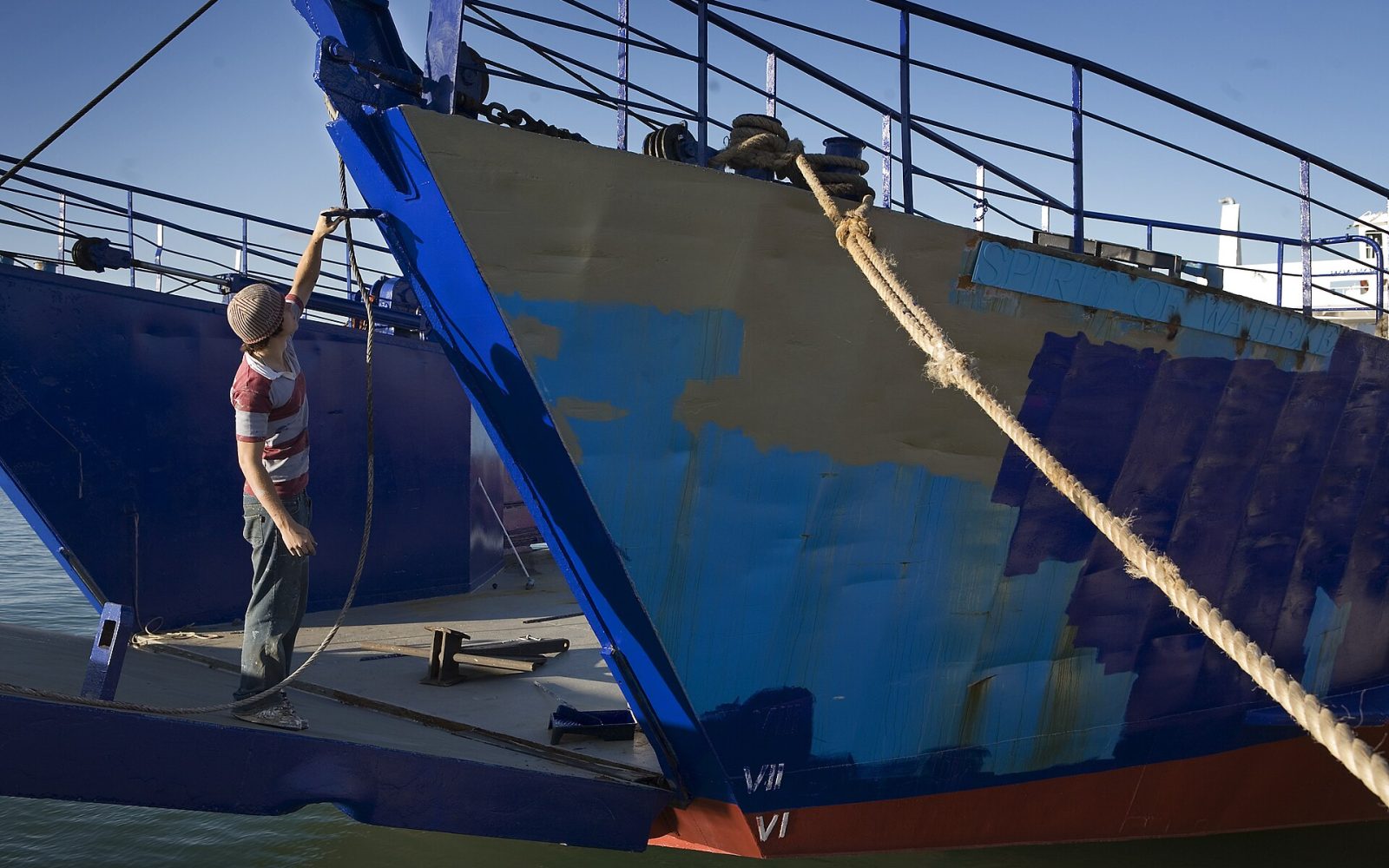
- Stripe coat. Brush or roll stripe coats on edges, welds, cutouts and back-sides of stiffeners, where spray films are thin. Edges are often ground to a radius beforehand.
- Apply full coats. Spray each coat to the specified wet film thickness, measuring as work proceeds and respecting minimum and maximum overcoating intervals.
- Inspect. Measure DFT per SSPC-PA 2 or ISO 19840, check for defects, record environmental data and document the work for class or owner acceptance.
Salts left on steel cannot be removed once overcoated. Even a correctly specified, well-applied system can blister and fail early in immersion if the steel was blasted while still contaminated with chlorides.
Maintenance and repair
Ships are typically drydocked on a planned cycle, commonly around five years for many merchant vessels, with intermediate in-water surveys. During drydocking, underwater hulls are high-pressure washed, damaged areas spot-blasted or water-jetted, and anticorrosive and antifouling coats reinstated. Offshore structures cannot be drydocked, so maintenance relies on rope access, scaffolding or habitats, and surface-tolerant products that can be applied over power-tool cleaned or water-jetted steel. Because access cost often dwarfs material cost, owners increasingly specify higher initial thickness and premium systems for hard-to-reach areas.
Frequently asked questions
Why is the splash zone so difficult to protect?
It combines constant wetting and drying, high oxygen availability, salt concentration, wave impact and debris abrasion, yet it is not continuously immersed, so cathodic protection cannot reach it reliably. Thick, tough barrier coatings or thermal-sprayed aluminum are commonly used.
What does the IMO PSPC require?
For dedicated seawater ballast tanks on ships within its scope, it sets requirements including blast cleaning to Sa 2½, a soluble salt limit, an epoxy-based system with stripe coats, a nominal total DFT of 320 µm under the 90/10 rule, and documented inspection, with a target useful life of 15 years.
Are copper antifoulings still allowed?
Copper-based antifoulings are widely used, but regulations vary by country and region, and some jurisdictions restrict copper in specific waters. Always check current approvals for the area of operation.
Can marine coatings be applied in cold or humid weather?
Only within the product’s stated limits. Low-temperature curing epoxies exist, but the dew point margin and humidity limits still apply, which is why enclosed spaces are often dehumidified and heated during coating work.
Educational reference. Coating performance varies by formulation. Always follow the manufacturer’s product data sheet, safety data sheet and your project specification.