Accelerated Weathering (QUV & Xenon Arc)
How fluorescent UV and xenon arc cabinets speed up sunlight, heat and moisture damage to coatings — lamps, cycles, standards, what gets measured, and the limits of correlation with real exposure.
Key takeaways
- Accelerated weathering cabinets intensify the three main drivers of coating degradation — ultraviolet light, heat and moisture — to compress years of exposure into weeks or months.
- Fluorescent UV devices (often called QUV-type testers) focus on short-wavelength UV and condensation; xenon arc devices reproduce the full sunlight spectrum more closely.
- Lamp type, irradiance, temperature and moisture cycle must be fixed by the standard and specification; results from different cycles are not comparable.
- Accelerated hours do not convert reliably to years outdoors. Use results to rank coatings and confirm with outdoor exposure where it matters.
Sunlight is the main enemy of coating appearance. Ultraviolet radiation breaks chemical bonds in binders, leading to gloss loss, color change, chalking and fading and eventually cracking. Heat speeds those reactions, and moisture — rain, dew and humidity — washes away degraded material and adds stress through swelling and drying.
Outdoor exposure takes years to produce meaningful results. Accelerated weathering tests let manufacturers develop formulations and let specifiers compare topcoats within a practical time frame.
How accelerated weathering works
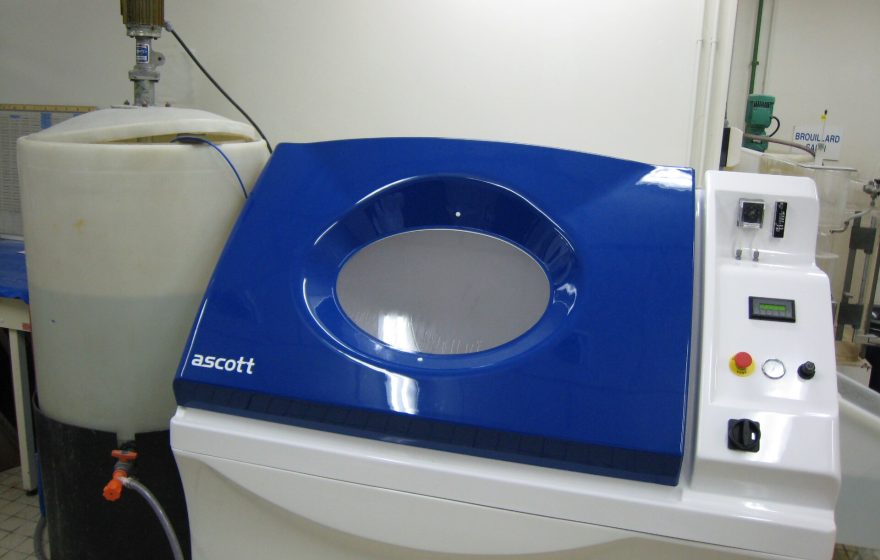
Test panels are mounted in a cabinet and exposed to a repeating cycle of light, heat and moisture. The cabinet controls:
- Light source and spectrum — which wavelengths reach the sample, and how intense they are (irradiance), usually controlled at a set wavelength or band.
- Temperature — measured with a black panel or black standard thermometer, representing a dark sample in sunlight.
- Moisture — condensation, water spray or humidity, applied in timed cycles.
- Dark periods — allowing reactions and moisture uptake that happen at night outdoors.
Panels are removed at intervals to measure gloss, color and condition, building a curve of degradation over time.
Fluorescent UV (QUV-type) testing
Fluorescent UV cabinets use rows of fluorescent lamps that emit mainly in the ultraviolet. ASTM G154 covers the general operation of fluorescent UV devices, ASTM D4587 covers fluorescent UV–condensation exposures of paints and related coatings, and ISO 16474-3 is the international equivalent for paints and varnishes.
- UVA-340 lamps simulate the short-wavelength end of sunlight reasonably well and are the usual choice for comparing coatings.
- UVB-313 lamps emit shorter wavelengths than reach the ground in sunlight. They give faster, harsher results that can produce degradation not seen outdoors, so they are mainly used for quality control and quick screening.
Moisture is usually applied as condensation: the panels form the wall of the chamber, and warm water vapour condenses on their cooler faces. One widely used cycle alternates 8 hours of UV at 60 °C (140 °F) with 4 hours of condensation at 50 °C (122 °F), though many other cycles exist.
Xenon arc testing
Filtered xenon arc lamps reproduce the full spectrum of sunlight — ultraviolet, visible and infrared — more closely than fluorescent lamps. ASTM G155 covers xenon arc apparatus, ISO 16474-2 covers xenon arc exposure of paints and varnishes, and ASTM D7869 defines a xenon arc cycle with enhanced light and water exposure for transportation coatings. The automotive industry also uses SAE J2527.
Optical filters tailor the spectrum to direct sunlight or sunlight through window glass. Water spray, humidity control and dark cycles add moisture stress. Because visible light is included, xenon arc is generally preferred for color-sensitive work, where pigments can fade under visible as well as UV light.
| Feature | Fluorescent UV | Xenon arc |
|---|---|---|
| Spectrum | Mainly UV | Full sunlight (UV, visible, IR) |
| Moisture | Usually condensation; some add spray | Water spray, humidity control |
| Key standards | ASTM G154, D4587; ISO 16474-3 | ASTM G155, D7869; ISO 16474-2 |
| Strengths | Lower cost, fast, simple to run | Best spectral match; color and fading |
| Limitations | Poor for visible-light fading; UVB can over-accelerate | Higher cost and maintenance |
What is measured
Panels are evaluated against unexposed controls at each interval. Common measurements include:
- Gloss retention at 20° or 60°, as a percentage of initial gloss — see gloss and color measurement.
- Color change as ΔE and its components, especially Δb* for yellowing.
- Chalking, rated with tape or fabric methods such as ASTM D4214.
- Cracking, checking, blistering and erosion, rated visually against standard scales.
Always run a reference coating with known outdoor performance in the same test. Ranking new products against a benchmark is far more meaningful than reporting hours to failure on their own.
Correlation and limitations
There is no universal factor that converts hours in a cabinet to years outdoors. Real climates vary in sunlight, temperature, moisture and pollution, and different coatings respond differently to the shortcuts accelerated tests take. Unrealistically short wavelengths, very high temperatures or missing moisture can produce failure modes that never occur in service — or miss ones that do.
For that reason, accelerated tests are best used for:
- Ranking candidate coatings against each other and against a proven reference.
- Quality control of production batches.
- Screening formulation changes before longer outdoor exposure.
Outdoor exposure at benchmark sites — hot, humid subtropical sites such as South Florida and hot, dry desert sites such as Arizona — remains the reference, guided by standards such as ASTM G7. Concentrated outdoor methods using sun-tracking mirrors (ASTM G90) sit between the two.
Accelerated weathering tests UV durability, not corrosion protection. Corrosion performance needs salt spray and cyclic corrosion testing; cyclic schemes such as the one in ISO 12944-9 combine UV, condensation and salt fog for that reason.
Using results in coating selection
Weathering data are most relevant for exterior topcoats, where appearance retention drives repaint cycles. Aliphatic polyurethanes, polysiloxanes and fluoropolymers are typically chosen for UV-exposed topcoats, while aromatic epoxies chalk relatively quickly in sunlight. When comparing data sheets, check the test method, lamp, cycle and duration before comparing gloss retention figures.
Frequently asked questions
How many years outdoors does 1,000 hours of QUV equal?
There is no reliable conversion. The relationship depends on the coating, the cycle and the climate. Use accelerated hours to compare coatings, not to predict service life.
Is xenon arc better than fluorescent UV?
Xenon arc matches sunlight more closely and is better for color and visible-light fading. Fluorescent UV is cheaper and faster and works well for ranking UV durability. Many programs use both.
Why are panels tested against a reference coating?
Because cabinet results vary between machines and over time, a reference with known outdoor performance makes the comparison meaningful.
Educational reference. Coating performance varies by formulation. Always follow the manufacturer’s product data sheet, safety data sheet and your project specification.