Key ASTM Standards for Coatings
A practical map of the ASTM test methods that coating specs cite most often — for surface prep, film thickness, adhesion, holidays, cure and corrosion testing.
Key takeaways
- ASTM International publishes most of the test methods used to measure coatings, substrates and application conditions; committee D01 covers paint and related coatings.
- A handful of methods — for adhesion, film thickness, surface profile, holidays and corrosion testing — appear in almost every industrial specification.
- ASTM methods describe how to test; the specification or product data sheet sets the acceptance criteria.
- Standards are revised periodically, and the year suffix identifies the edition, so confirm which version governs your contract.
ASTM International, originally the American Society for Testing and Materials, develops consensus standards through technical committees made up of producers, users, laboratories and consultants. For coatings, the most important is Committee D01 on Paint and Related Coatings, Materials, and Applications. Other committees contribute methods for corrosion testing, concrete, roofing and rubber hardness.
This article is a practical map of the ASTM standards that coating specifiers, inspectors and applicators encounter most often. It explains what each one does, not how to run it in detail; follow the links for full treatments.
How ASTM standards are structured
Each document has a letter-and-number designation followed by a year, for example D4541-22. The letter indicates the general subject area (D for miscellaneous materials including paint, G for corrosion and weathering, F for end-use products and some floor methods). Standards are classified by type:
- Test method — a defined procedure that produces a result, such as a pull-off value.
- Practice — a set of instructions for an operation that does not itself produce a result, such as exposing panels in a cabinet.
- Guide — options and information without a mandatory course of action.
- Specification and terminology — requirements for a material, and agreed definitions (ASTM D16 defines paint terms).
An ASTM method rarely tells you what result is acceptable. “Test adhesion per ASTM D4541” is incomplete unless the specification also states the minimum value, the instrument type and what failure modes are acceptable.
Surface preparation and condition
These methods verify that the substrate and the environment are ready for coating:
- ASTM D4417 — field measurement of blast-cleaned steel surface profile by comparator, depth micrometer or replica tape. See surface profile measurement.
- ASTM D7127 — surface roughness of blast-cleaned metal using a portable stylus instrument.
- ASTM D4285 — a blotter test for oil and water in compressed air.
- ASTM D4940 — conductimetric analysis of water-soluble ionic contamination in blast abrasives.
- ASTM D4263 — the plastic sheet test for moisture in concrete, a qualitative check.
- ASTM F1869 and ASTM F2170 — calcium chloride moisture vapor emission and in-situ relative humidity testing of concrete slabs. See concrete moisture testing.
Film thickness
Thickness is the most frequently measured coating property:
- ASTM D4414 — wet film thickness by notch gauge.
- ASTM D7091 — nondestructive dry film thickness with magnetic and eddy-current gauges over metals. Acceptance of the measurements is commonly governed by SSPC-PA 2.
- ASTM D6132 — nondestructive measurement with ultrasonic gauges, useful over concrete and other nonmetallic substrates.
- ASTM D4138 — destructive measurement by cross-sectioning, which can show individual coat thicknesses.
See dry film thickness measurement for instruments, calibration and sampling.
Adhesion, continuity and mechanical tests
| Standard | What it measures | Typical use |
|---|---|---|
| ASTM D4541 | Pull-off adhesion, portable testers (metals) | Qualification, QC, failure analysis |
| ASTM D7234 | Pull-off adhesion on concrete | Floor and lining systems |
| ASTM D3359 | Tape adhesion, X-cut or cross-cut | Thinner films, quick field check |
| ASTM D6677 | Knife adhesion | Field evaluation of existing coatings |
| ASTM D5162 | Holiday detection on metal substrates | Linings and immersion coatings |
| ASTM D4787 | Continuity of coatings on concrete | Containment and tank linings |
| ASTM D4060 | Taber abrasion resistance | Floors, wear surfaces |
| ASTM D2794 | Impact (rapid deformation) | Product comparison |
| ASTM D522 | Mandrel bend flexibility | Product comparison |
| ASTM D3363 | Pencil hardness | Cure and hardness checks |
| ASTM D2240 | Durometer (Shore) hardness | Elastomers, polyurea |
For detail, see adhesion testing and holiday testing.
Cure, corrosion and weathering
Cure and drying
ASTM D1640 defines drying stages (set-to-touch, dry-hard, dry-through) at room temperature. ASTM D4752 is the MEK solvent rub test for inorganic zinc-rich primers, and ASTM D5402 covers solvent rubs on organic coatings.
Corrosion and weathering
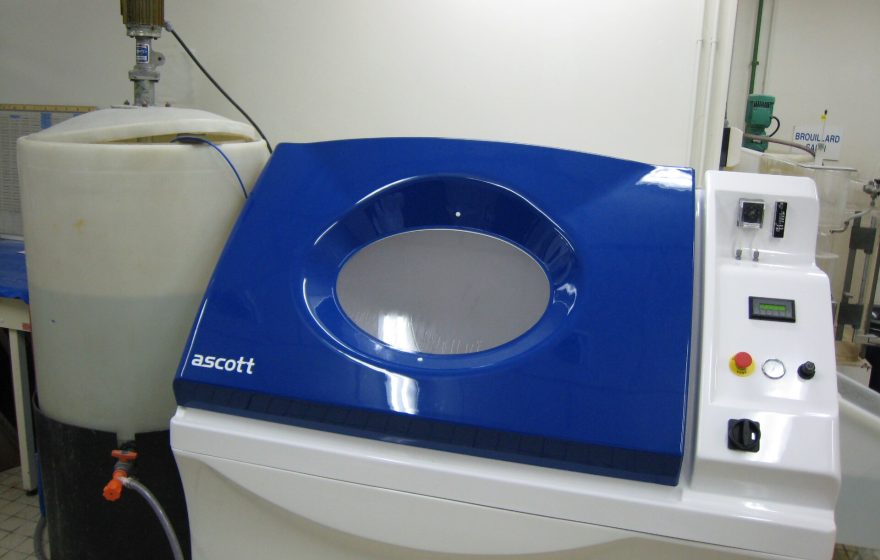
ASTM B117 is the long-established neutral salt spray (fog) practice. ASTM D5894 alternates salt fog/dry cycles with UV/condensation exposure and is generally considered more representative for many atmospheric coatings. ASTM G154 (fluorescent UV) and ASTM G155 (xenon arc) cover laboratory light exposure. Results are commonly rated with ASTM D714 (blistering), ASTM D610 (rusting) and ASTM D1654 (scribe creep).
Appearance and liquid properties
ASTM D523 (specular gloss), ASTM D2244 (color difference), ASTM D1475 (density), ASTM D2369 (volatile content) and ASTM D2697 (volume solids) support quality control and product comparison.
Using ASTM standards in specifications
- Cite the right document type. Use a test method where you need a measurable result and set the acceptance criteria separately.
- Name options explicitly. Many methods include several procedures (D3359 Method A or B; D4417 Method A, B or C). State which one applies.
- Address the edition. State a year or declare that the current edition at bid date applies.
- Match the inspector’s equipment. Make sure the specified method is practical in the field and the instruments are available and calibrated.
- Pair with AMPP and ISO documents. Most specifications combine ASTM methods with the AMPP/SSPC and ISO standards described in AMPP, SSPC & NACE explained.
Laboratory test results quoted on product data sheets are only comparable when the method, edition, panel preparation, film thickness and exposure duration are the same. Ask for full test reports before comparing products.
The standards index lists further methods referenced across Coatingpedia.
Frequently asked questions
Where can I get the full text of an ASTM standard?
Directly from ASTM International or authorized resellers, individually or by subscription. Standards are copyrighted, so specifications should reference them rather than reproduce them.
What does the year after the number mean?
It is the year of adoption or last revision. A number in parentheses indicates reapproval without change; a superscript epsilon indicates an editorial change.
Is a salt spray rating a prediction of service life?
No. Accelerated tests are useful for ranking and quality control, but correlation with field life varies by coating type and environment.
Do ASTM and ISO methods give the same results?
Not necessarily. Equivalent-sounding methods can differ in procedure and reporting, so specify one and do not substitute without agreement.
Educational reference. Coating performance varies by formulation. Always follow the manufacturer’s product data sheet, safety data sheet and your project specification.