Automotive Refinish Coatings
The primers, basecoats and clearcoats body shops use to repair and repaint vehicles — and how they match factory color, gloss and durability without a factory oven.
Key takeaways
- Refinish coatings repair or repaint vehicles after manufacture, using air-dry or low-bake chemistry because a finished car cannot go through an OEM oven.
- The standard modern system is a primer stack under a pigmented basecoat and a two-component (2K) polyurethane clearcoat.
- Color matching relies on formula databases, spectrophotometers, spray-out cards and blending into adjacent panels.
- VOC and hazardous air pollutant rules have pushed shops toward waterborne basecoats, high-solids clears and high-transfer-efficiency spray guns.
- 2K primers and clears contain isocyanates, so supplied-air respiratory protection and ventilated booths are standard practice.
Automotive refinish coatings are the paint systems used in collision repair, restoration, fleet repainting and custom work. They must reproduce the color, gloss and durability of the factory finish described in automotive OEM paint systems, but they have to do it on an assembled vehicle with rubber, plastics, wiring and glass that cannot tolerate the high oven temperatures used on the assembly line. Refinish chemistry is therefore built around ambient cure or low-temperature forced drying in a spray booth.
The refinish system layer by layer
A typical repair builds a stack of thin, specialized layers. Total film thickness is usually comparable to the factory finish, roughly 4–6 mils (100–150 µm) over bare substrate, though heavy primer build in filled areas can exceed this.
| Layer | Common chemistry | Function |
|---|---|---|
| Body filler / putty | Polyester | Fills dents and low spots before priming |
| Corrosion primer | Epoxy primer or acid-etch (wash) primer | Adhesion and corrosion protection on bare steel, aluminum or galvanized metal |
| Primer-surfacer (filler) | 2K urethane or epoxy | Builds film to be block-sanded flat |
| Sealer | 2K urethane or epoxy, often tintable | Uniform color holdout, isolates sanding scratches and old finishes |
| Basecoat | Waterborne or solvent-borne acrylic/polyester | Color and effect (metallic, pearl) |
| Clearcoat | 2K acrylic polyurethane | Gloss, UV and chemical resistance, scratch resistance |
Older single-stage enamels and urethanes, which combine color and gloss in one coat, are still used for solid colors on commercial vehicles, equipment and budget repaints. Lacquers have largely disappeared because of their very high solvent content.
Surface preparation and substrates
Refinish adhesion problems almost always trace back to preparation. Shops typically wash with soap and water, then clean with a dedicated wax-and-grease remover before and after sanding. Old finishes are scuffed with abrasive pads or sanded with progressively finer grits; bare metal is sanded or blasted and primed promptly.
- Steel and galvanized panels need a corrosion-inhibiting primer on any exposed metal.
- Aluminum panels require dedicated tools and abrasives to avoid cross-contamination with steel particles, which can cause galvanic corrosion — see coating aluminum.
- Plastic bumpers and trim often need an adhesion promoter and a flex additive or flexible primer, and must be cleaned with plastic-safe products.
Silicone-containing polishes, tire dressings and some interior protectants are a classic cause of fisheyes. Keep them out of the paint shop and clean thoroughly before every coat. See fisheyes and cratering for diagnosis.
Application and curing
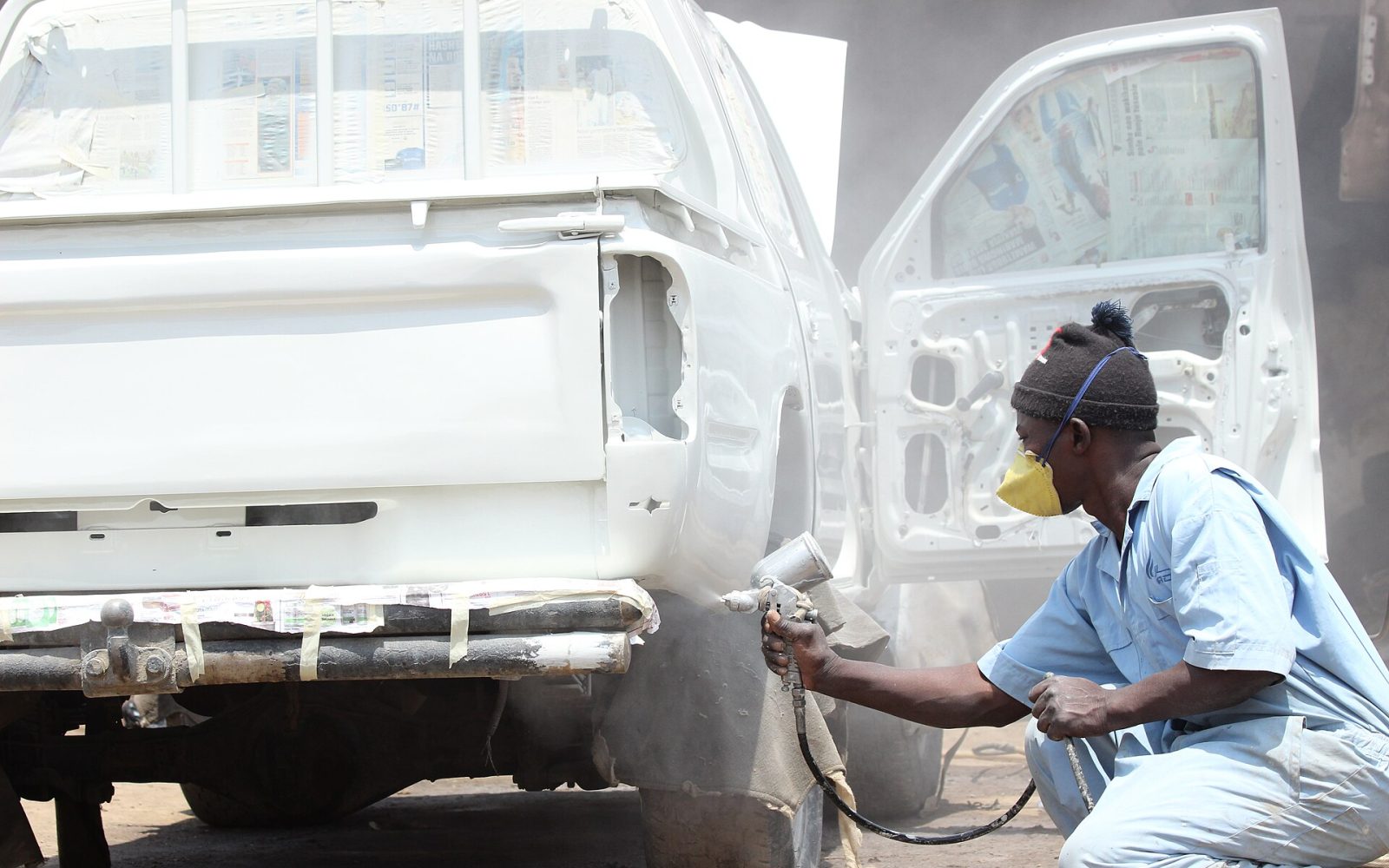
Refinish coatings are sprayed in a downdraft or semi-downdraft booth that controls airflow, temperature and dust. High-volume low-pressure (HVLP) and other high-transfer-efficiency guns are standard; see HVLP and conventional air spray for equipment details.
- Mix accurately. Measure components by the ratio on the technical data sheet, using mixing cups, scales or a computerized mixing system. Activator and reducer choice depends on temperature and panel size.
- Apply basecoat. Spray medium coats to hiding, followed by a lighter control or drop coat on metallics to even out flake orientation. Allow the specified flash time between coats.
- Apply clearcoat. Typically two wet coats, observing flash time to avoid solvent popping and sags.
- Cure. Most shops use a booth bake cycle, commonly around 140 °F (60 °C) metal temperature for roughly 20–40 minutes, while short-wave infrared lamps speed spot repairs. Air-dry cure is possible but slower.
- Finish. Once cured, minor dust nibs and orange peel are wet-sanded and polished to match surrounding texture.
Color matching and blending
Factory colors vary slightly between plants, production years and even individual vehicles, and they also change with weathering. A paint code alone is therefore a starting point, not a guarantee.
- Variant formulas. Paint suppliers publish multiple variants of popular colors, often with physical chip decks.
- Spectrophotometers. Handheld multi-angle instruments read the vehicle and suggest the closest formula and adjustments — see gloss and color measurement.
- Spray-out cards. Spraying a test card with the same technique and film build confirms the match before painting the car.
- Blending. Basecoat is faded into adjacent panels so the eye cannot detect any small difference, then the entire panel or panels are clearcoated.
Always check a spray-out card under several light sources — daylight, shop lighting and a color-corrected lamp. Metallic and pearl colors can match head-on yet look different at a steep angle, which is why technique on the control coat matters as much as formula.
Regulations, VOCs and safety
Refinish shops are among the most regulated users of coatings. In the United States, the EPA’s area-source rule for paint stripping and miscellaneous surface coating (40 CFR Part 63, Subpart HHHHHH, often called “6H”) sets requirements for spray booths, filtration, high-efficiency spray guns, gun cleaning and painter training where coatings contain certain metal hazardous air pollutants. Many states and air districts, notably in California, also set VOC limits by coating category, which is the main reason waterborne basecoats became standard. See VOCs and coating regulations.
Two-component primers and clearcoats are cured with polyisocyanate activators. Spray mist and vapor can cause respiratory sensitization, so shops commonly use supplied-air respirators during spraying, along with gloves, coveralls and eye protection. Follow the safety data sheet, the employer’s respiratory protection program under OSHA 29 CFR 1910.134 and local regulations; see isocyanate safety.
Frequently asked questions
Why is clearcoat applied over basecoat?
Basecoats are formulated for color and effect and have little gloss or weather resistance on their own. The clearcoat supplies gloss, UV protection and resistance to chemicals, scratches and environmental fallout.
Is waterborne basecoat as durable as solvent-borne?
Yes, when used as part of a complete system. Durability comes mainly from the clearcoat, and waterborne basecoats are now widely used in regulated markets.
How long before a refinished car can be washed or waxed?
Hand washing is usually acceptable soon after the bake cycle, but most suppliers advise waiting several weeks before waxing or sealing so the clearcoat can finish curing. Follow the paint maker’s guidance.
Why does a repaired panel look different from the next one?
Common causes are formula variance, film thickness, spray technique affecting metallic orientation, and aging of the original paint. Blending into adjacent panels minimizes the difference.
Educational reference. Coating performance varies by formulation. Always follow the manufacturer’s product data sheet, safety data sheet and your project specification.