Cathodic Protection
Cathodic protection turns an entire buried or submerged structure into a cathode so it stops corroding. Paired with a good coating, it is the backbone of pipeline, tank and hull protection.
Key takeaways
- Cathodic protection (CP) supplies electrons to a metal structure so that its whole surface becomes cathodic and corrosion is suppressed.
- Galvanic (sacrificial) anode systems use active metals such as magnesium, zinc and aluminum alloys; impressed current systems use a DC power source and durable anodes.
- CP only works where an electrolyte is present — soil, water or concrete — not in the atmosphere.
- Coatings and CP are complementary: the coating carries most of the load, and CP protects the inevitable holidays.
Corrosion occurs because some areas of a metal surface act as anodes and lose metal while others act as cathodes. Cathodic protection eliminates the anodes by pushing enough current onto the structure that every part of it behaves as a cathode. It is one of the few corrosion-control methods that can effectively stop corrosion of buried and submerged steel, and it is commonly required by regulation on pipelines carrying hazardous liquids and gas.
How cathodic protection works
In a corrosion cell, electrons flow from anodic sites to cathodic sites through the metal while ions move through the electrolyte. If an external source supplies electrons to the structure, the potential of the steel shifts in the negative (cathodic) direction. Once it is polarized far enough, the anodic reaction — iron dissolving — is reduced to a negligible rate. The underlying electrochemistry is covered in corrosion science basics.
The current must reach the steel through the electrolyte, which is why CP protects buried and immersed surfaces but cannot protect steel exposed to air. It also explains why internal tank and pipe surfaces only receive protection where they are wetted.
Galvanic anode systems
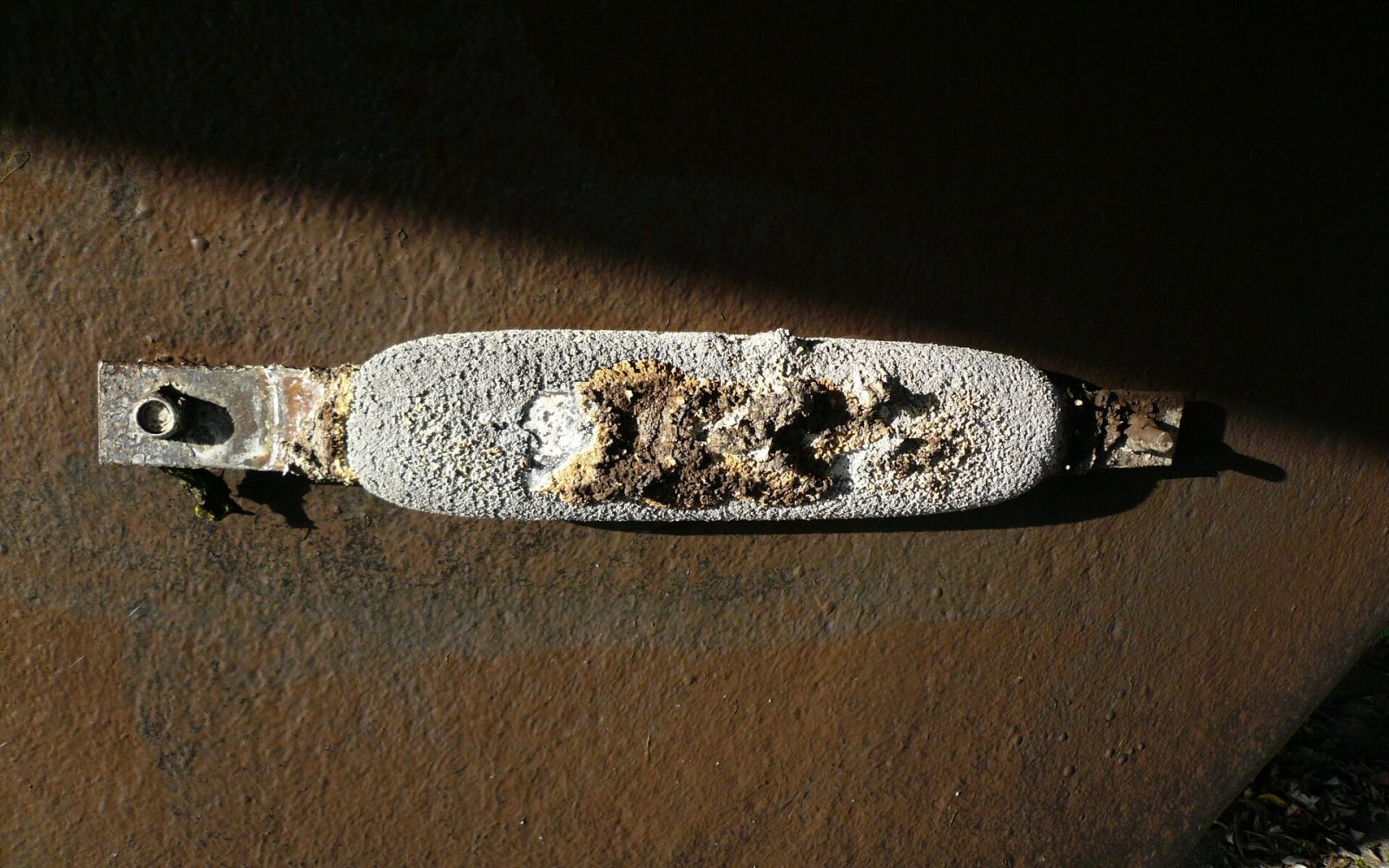
Galvanic, or sacrificial, systems apply the principles of galvanic corrosion deliberately. A more active metal connected to the steel corrodes preferentially and supplies protective current with no external power.
- Magnesium has the most negative potential and is common in higher-resistivity soils.
- Zinc is used in seawater, low-resistivity soils and some brackish water.
- Aluminum alloys, activated with small additions such as indium, are widely used offshore and on ship hulls.
Galvanic anodes are simple and self-regulating, but their driving voltage and current output are limited. They suit well-coated structures, small or isolated sections, and seawater, where low resistivity lets current flow easily.
Impressed current systems
Impressed current cathodic protection (ICCP) uses a DC power source, typically a transformer-rectifier, to drive current from anodes into the electrolyte and onto the structure. Because the voltage can be adjusted, one system can protect long pipelines, large tank farms or poorly coated structures.
ICCP anodes are designed to discharge current with slow consumption: mixed-metal oxide coated titanium, high-silicon cast iron and graphite are common. They are installed in groundbeds, deep wells, distributed strings or, on ships, in insulated hull mounts.
| Factor | Galvanic anodes | Impressed current |
|---|---|---|
| Power source | None (anode potential) | External DC supply |
| Driving voltage | Low, fixed | Adjustable, can be high |
| Current capacity | Limited per anode | Large |
| Best for | Well-coated or small structures, seawater | Large or poorly coated structures, high-resistivity soils |
| Interference risk | Low | Higher; can affect nearby structures |
| Maintenance | Periodic surveys, anode replacement | Rectifier checks, surveys, anode bed upkeep |
| Overprotection risk | Low | Possible if poorly adjusted |
Why coatings and CP work together
CP current demand is roughly proportional to the bare steel area it must protect. A bare pipeline would need enormous current; a well-coated one needs only a small fraction of it, because current flows only to holidays and damaged areas. The coating does most of the work, and CP takes care of defects no coating program can fully avoid.
This partnership puts demands on the coating. Buried and immersed coatings used with CP — such as fusion-bonded epoxy and many other pipeline coatings — should have:
- High electrical resistance to keep current demand low.
- Resistance to cathodic disbondment, because the cathodic reaction produces hydroxide ions at holidays. The resulting alkalinity and, at high potentials, hydrogen can lift the coating around defects. See cathodic disbondment.
- Alkali resistance, which rules out oil-based and alkyd coatings prone to saponification.
- A non-shielding failure mode, so that if the coating disbonds, CP current can still reach the steel underneath.
A coating that disbonds but remains electrically insulating can shield the steel beneath it from CP current. Water trapped under the disbonded film can then corrode the pipe even though survey readings look acceptable.
Protection criteria and overprotection
Whether a structure is adequately protected is judged by potential measurements against a reference electrode, such as copper/copper sulfate in soil or silver/silver chloride in seawater. Widely used criteria for steel, found in standards such as NACE SP0169 for buried and submerged piping, include a polarized potential of −850 mV or more negative versus copper/copper sulfate, or a minimum of 100 mV of cathodic polarization. Measurements must account for the voltage error (IR drop) introduced by current flowing through the soil.
More negative is not always better. Excessively negative potentials increase hydrogen generation, which accelerates cathodic disbondment and can cause hydrogen embrittlement in high-strength steels. Specifications therefore often cap the polarized potential for coated structures; follow the project specification and the coating manufacturer’s guidance.
Monitoring and maintenance
CP systems need regular attention to stay effective:
- Potential surveys. Readings at test stations, and periodically along the full route with close-interval surveys, confirm protection levels.
- Rectifier inspections. Output voltage and current are checked and recorded to catch failures early.
- Interference testing. Stray currents from nearby CP systems or DC transit can cause accelerated corrosion where current leaves a structure.
- Coating assessment. Rising current demand often signals coating deterioration, which can be located with above-ground survey techniques.
Rebar in concrete, the interiors of water tanks and the external bottoms of above-ground storage tanks are other common applications.
Frequently asked questions
Can cathodic protection replace coatings?
Technically it can protect bare steel, but the current required is usually impractical and costly. Coatings dramatically reduce current demand, which is why the two are almost always used together.
Does CP protect steel above the waterline?
No. CP current needs a continuous electrolyte, so splash zones and atmospheric surfaces depend on coatings, often of heavier specification.
How long do sacrificial anodes last?
It depends on anode mass, material, current output and environment. Designs commonly target a set life, and anodes are inspected and replaced as they are consumed.
Educational reference. Coating performance varies by formulation. Always follow the manufacturer’s product data sheet, safety data sheet and your project specification.