Coating Aluminum
Why aluminum's natural oxide resists paint, and how conversion coatings, anodizing, abrading and the right primers produce durable finishes on architectural, marine and industrial aluminum.
Key takeaways
- Aluminum protects itself with a thin natural oxide film, but that film is a weak, inconsistent base for paint unless it is cleaned and pretreated.
- Durable adhesion depends on pretreatment: conversion coatings and anodizing in the factory, or abrading and specialized primers in the field.
- Filiform corrosion and galvanic corrosion are the characteristic failure modes of coated aluminum.
- Copper-based antifouling paints and direct contact with copper or steel should be avoided on aluminum.
Aluminum is coated on everything from window frames and curtain walls to boats, truck bodies, aircraft and process equipment. It is light, strong and reasonably corrosion resistant on its own, so coatings are often applied for appearance, color and long-term protection in harsh environments rather than to stop general corrosion.
Because aluminum’s surface chemistry differs fundamentally from steel’s, good results depend on specific cleaning, pretreatment and primer choices.
The aluminum surface
Freshly exposed aluminum reacts almost instantly with air to form a thin, transparent aluminum oxide layer. This passive film gives aluminum its corrosion resistance in many environments. For coating, however, it presents problems:
- The natural oxide is thin and can be loosely bound or contaminated with rolling oils and lubricants.
- Mill-finish surfaces are smooth, offering little mechanical key.
- The oxide is amphoteric — it dissolves in both strong acids and strong alkalis — so harsh cleaners and some cementitious contact can attack it.
- Different alloy series behave differently; high-copper alloys are less corrosion resistant, while magnesium- and magnesium–silicon alloys are common in marine and architectural uses.
Pretreatment replaces or modifies the natural oxide with a more uniform, adherent and corrosion-inhibiting layer.
Pretreatment options
| Pretreatment | Where used | What it does | Notes |
|---|---|---|---|
| Chromate conversion coating | Aerospace, legacy architectural | Excellent adhesion and corrosion inhibition | Hexavalent chromium is heavily restricted; use is declining |
| Trivalent chromium and chrome-free conversion coatings | Architectural, automotive, general industry | Zirconium-, titanium- or trivalent-chrome-based films improve adhesion | Now widely used in place of hexavalent chromates |
| Anodizing | Architectural, aerospace, consumer | Electrochemically grown, thicker oxide layer | Can be left clear or colored, or used as a paint base |
| Wash (etch) primers | Field and shop repairs | Etches the surface and deposits an adhesion layer | Thin film; must be topcoated within its window |
| Abrasive sweep blasting | Marine, industrial, field work | Removes oxide and creates a profile | Use non-metallic abrasive; prime promptly |
| Mechanical abrading | Small areas, repairs | Scuff sanding with non-metallic abrasive pads or paper | Least robust; relies heavily on the primer |
Factory-applied systems almost always use multi-stage cleaning and conversion treatment lines before painting or powder coating. Field work relies on abrading and on primers designed for non-ferrous metals.
Field preparation steps
- Clean. Remove oil, grease, salts and dirt with a suitable cleaner that is safe for aluminum, then rinse with fresh water.
- Remove corrosion products. Take off white powdery aluminum oxide and any loose old coating.
- Roughen. Sweep blast with clean, non-metallic abrasive such as aluminum oxide or garnet, or abrade by hand, to produce the profile the primer requires.
- Prime quickly. Apply the primer while the surface is fresh — often within a few hours — before a new oxide layer and contamination build up.
- Build the system. Apply intermediate and topcoats per the manufacturer’s data sheet.
Abrasive choice is discussed in abrasive media selection.
Never use steel shot, steel grit or carbon steel wire brushes on aluminum. Embedded iron particles corrode and can set up galvanic cells that pit the aluminum beneath the coating.
Common coating systems
Architectural aluminum
Window frames, curtain walls and panels are typically finished in the factory with powder coatings or liquid fluoropolymer coatings over a conversion coating. Performance standards such as AAMA 2603, 2604 and 2605 define progressively higher levels of weathering performance for these finishes.
Marine aluminum
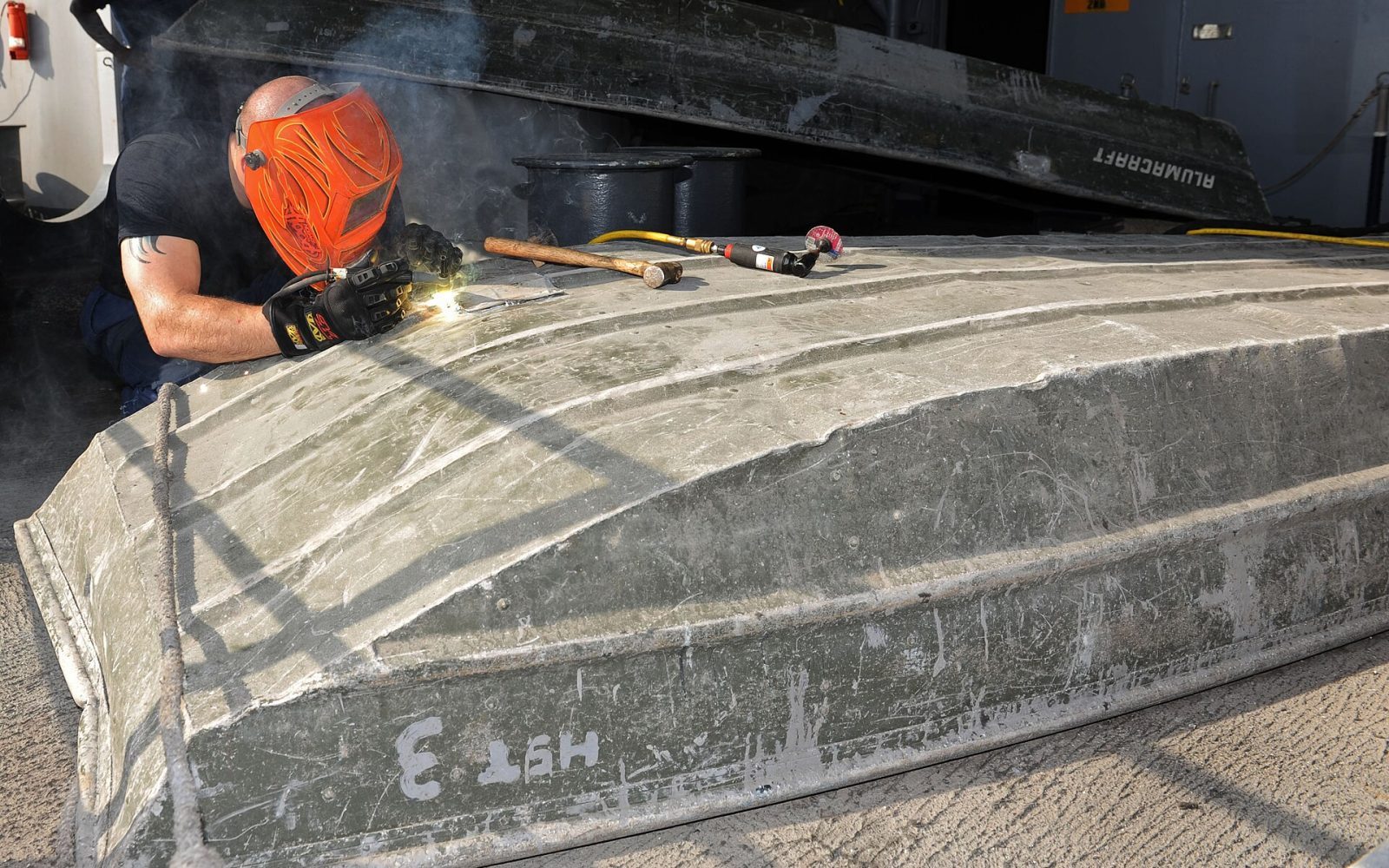
Boat hulls and superstructures generally use epoxy primers and barrier coats, with polyurethane topcoats above the waterline. Below the waterline, antifouling must be specifically formulated for aluminum; see antifouling coatings.
Aerospace
Aircraft structures use tightly controlled pretreatment, corrosion-inhibiting primers and polyurethane topcoats, covered in aerospace coatings.
Industrial equipment
Tanks, enclosures and trailers commonly use epoxy primers with polyurethane or acrylic topcoats.
Copper-based antifouling paints in direct or near contact with aluminum hulls can cause severe galvanic corrosion. Use antifouling products the manufacturer explicitly approves for aluminum.
Characteristic failure modes
Filiform corrosion
Thread-like corrosion filaments that grow beneath the paint film, typically starting at cut edges, scratches or fastener holes in humid, salt-laden conditions. Good pretreatment is the main defense.
Galvanic corrosion
Aluminum is anodic to steel, stainless steel and copper. Where they meet in the presence of moisture, aluminum corrodes preferentially. Isolate dissimilar metals with insulating washers, sealants and coatings — see galvanic corrosion.
Adhesion loss
Peeling from smooth, contaminated or unpretreated surfaces is the most common failure in field painting.
Practical tips
- Confirm the alloy and temper where possible; it affects pretreatment choice.
- Use primers specifically labeled for aluminum or non-ferrous metals.
- Avoid strongly alkaline cleaners that etch aluminum unevenly.
- Seal cut edges and fastener holes thoroughly.
- Keep the substrate within the product’s temperature limits; aluminum heats and cools quickly in sunlight and shade.
Run a cross-cut or pull-off adhesion test on a small trial area before committing to a large field repaint. It quickly reveals whether cleaning and pretreatment are adequate.
Frequently asked questions
Do I need a special primer for aluminum?
Yes. Use a primer formulated for aluminum or non-ferrous metals, such as an epoxy or etch primer, over a properly cleaned and abraded surface.
Can anodized aluminum be painted?
It can, but sealed anodized surfaces are smooth and hard. They need cleaning and abrading, and the coating must be compatible with the anodic layer.
What is filiform corrosion?
Worm-like corrosion tracks that spread beneath paint films on aluminum, usually from edges or defects. Proper pretreatment and edge sealing minimize it.
Why is my paint peeling off aluminum?
Usually because the surface was not cleaned of oils or the natural oxide was not abraded or pretreated before priming.
Educational reference. Coating performance varies by formulation. Always follow the manufacturer’s product data sheet, safety data sheet and your project specification.