Aerospace Coatings
Lightweight, qualified coating systems that protect aircraft aluminum, composites and high-strength steel from corrosion, fluids, erosion and extreme temperature swings.
Key takeaways
- Aircraft exterior coatings are thin, light systems — typically a conversion coating or anodize, an epoxy primer and a polyurethane topcoat.
- Coatings must resist hydraulic fluids, jet fuel, de-icing chemicals, UV at altitude, rain erosion and repeated flexing of the airframe.
- Hexavalent chromium has long been the backbone of aerospace corrosion protection; the industry is steadily qualifying chromate-free alternatives.
- Every material and process is controlled by qualified specifications, and substitutions require formal approval.
Aerospace coatings protect commercial airliners, business jets, helicopters, military aircraft, spacecraft and their components. The environment is unusual: an aircraft can climb from a hot, humid coastal runway to −50 °C (−58 °F) at cruise within minutes, absorbing intense UV, flexing with each pressurization cycle and getting splashed with aggressive fluids on the ground. Because every kilogram of paint costs fuel over the aircraft’s life, film thickness is kept to a minimum.
The result is a family of highly engineered, rigorously qualified systems where performance, weight and traceability matter as much as appearance.
Substrates and pretreatment
Most airframes are built from high-strength aluminum alloys, which are prone to pitting, intergranular and exfoliation corrosion — see coating aluminum and pitting and crevice corrosion. Before painting, aluminum is cleaned, deoxidized and given a chemical conversion coating or anodized layer to improve adhesion and corrosion resistance.
- Chemical conversion coatings for aluminum are covered in the United States by MIL-DTL-5541; traditional chromate types are being replaced by trivalent chromium and other non-chromate chemistries.
- Anodizing, specified under MIL-A-8625 and similar documents, builds a thicker oxide layer on parts and is often sealed.
- Composites such as carbon-fiber laminates are sanded rather than chemically treated, and may need surfacers to fill pinholes and lightning-strike protection layers beneath the paint.
- High-strength steels in landing gear and fasteners are often protected by sacrificial plating; processes must avoid hydrogen embrittlement.
Exterior paint systems
A typical exterior system consists of a corrosion-inhibiting epoxy primer under a polyurethane topcoat. The combination provides adhesion, flexibility and fluid resistance with a total dry film often in the range of about 2–5 mils (50–125 µm), much thinner than industrial steel systems.
| Layer | Typical chemistry | Example specification | Role |
|---|---|---|---|
| Conversion coat / anodize | Chromate, trivalent chrome or non-chrome | MIL-DTL-5541, MIL-A-8625 | Adhesion, corrosion inhibition |
| Primer (solvent-borne) | Epoxy-polyamide, corrosion-inhibiting | MIL-PRF-23377 | Corrosion protection |
| Primer (waterborne) | Waterborne epoxy | MIL-PRF-85582 | Lower-VOC corrosion protection |
| Topcoat | Aliphatic polyurethane | MIL-PRF-85285 | Weathering, color, fluid resistance |
| Clearcoat (optional) | Polyurethane | OEM or operator specification | Gloss and protection of livery graphics |
Commercial airlines often use basecoat/clearcoat systems for complex liveries, similar in concept to automotive finishes, while military aircraft favor low-gloss, low-reflectance topcoats. Some systems use self-priming topcoats that combine corrosion protection and finish in one layer. For more on the resin families, see epoxy coatings and polyurethane coatings.
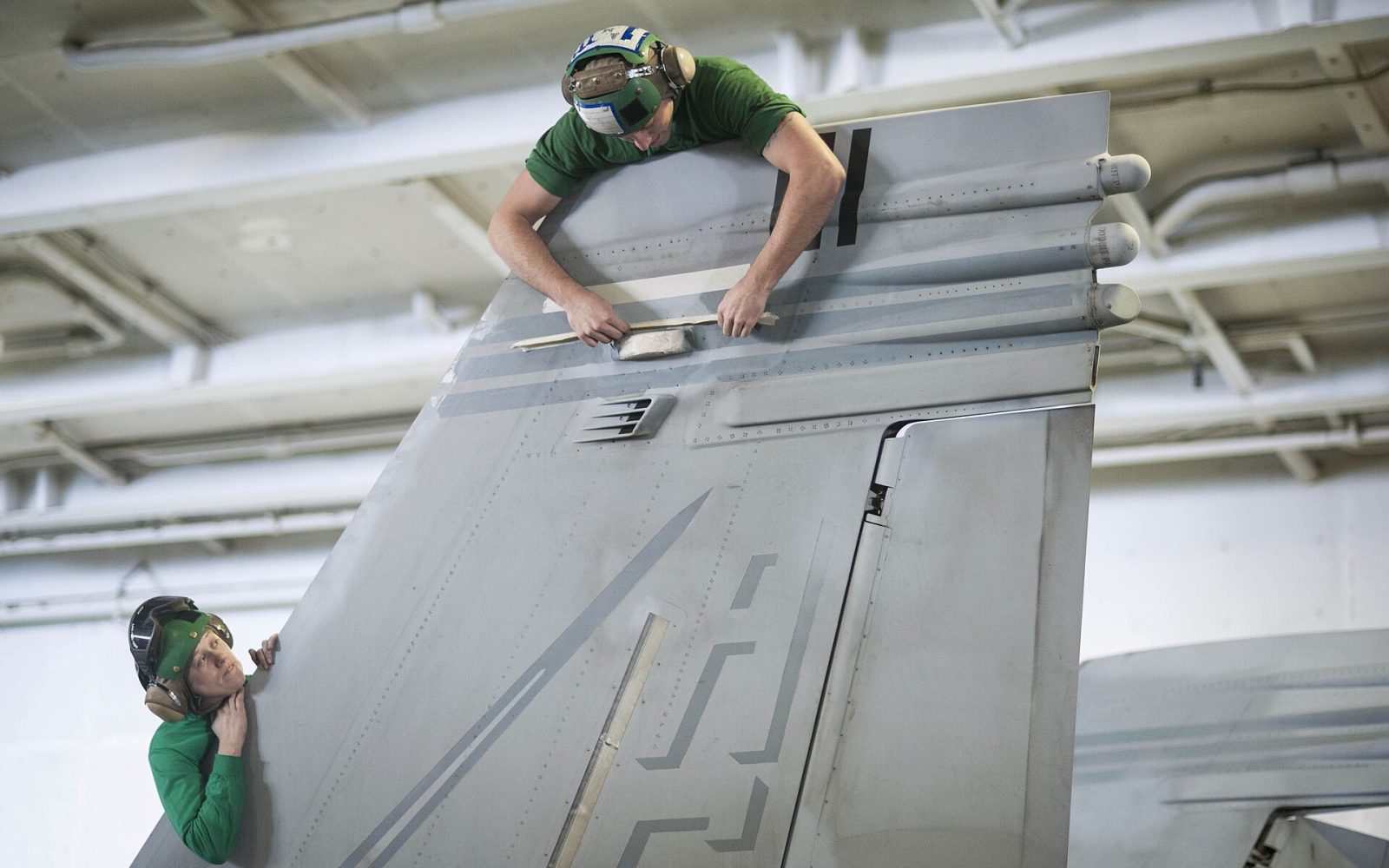
Whole aircraft are usually painted in large, climate-controlled hangars using HVLP and electrostatic spray, with temperature and humidity held within narrow limits because both primers and polyurethane topcoats are sensitive to moisture during cure. Inspectors verify cleanliness with water-break tests, check adhesion on witness panels and measure film thickness with eddy-current gauges suitable for non-ferrous metals. Masking of sensors, windows, antennas and markings is extensive and often takes as long as the painting itself.
The transition from hexavalent chromium
Strontium and other chromate pigments in primers, and chromate conversion coatings, have provided outstanding “self-healing” corrosion inhibition for decades. Hexavalent chromium is, however, a recognized carcinogen. Regulation such as the EU REACH authorization process and occupational exposure limits in many countries have pushed manufacturers and operators toward chromate-free primers and pretreatments.
Replacing chromates is not a simple drop-in: alternatives must be proven through long qualification programs, salt spray and filiform corrosion testing, and service evaluation. Many aircraft still carry chromate systems in the most corrosion-prone areas while non-chromate systems are adopted elsewhere.
Sanding, blasting or stripping old aerospace coatings can release hexavalent chromium, cadmium or other hazardous dusts. Work must follow the safety data sheet, employer exposure controls, respiratory protection programs and local regulations.
Specialty aerospace coatings
- Rain and sand erosion coatings for leading edges, radomes and rotor blades, usually tough elastomeric polyurethanes, sometimes with erosion-resistant tapes or metal sheaths.
- Fuel tank coatings that resist jet fuel and help prevent microbial corrosion in integral wing tanks.
- Thermal barrier coatings on turbine engine hot-section parts, typically ceramic layers applied by plasma spray or electron-beam processes — related to thermal spray technology.
- Conductive and static-dissipative coatings on composites and radomes to manage lightning strike and static charge.
- Interior coatings that must meet flammability requirements for cabin materials, such as those in 14 CFR 25.853.
Maintenance, depainting and environment
Commercial aircraft are typically repainted several times during their service lives, both for corrosion inspection and for livery changes. Stripping must remove paint without damaging thin aluminum skins, composite surfaces or sealants. Methods include chemical strippers (where methylene chloride has largely given way to benzyl alcohol and other formulations), plastic media blasting, and increasingly laser ablation. Selective stripping that removes topcoat while leaving primer intact reduces both downtime and waste.
In the United States, the EPA’s Aerospace Manufacturing and Rework Facilities NESHAP (40 CFR Part 63, Subpart GG) limits hazardous air pollutant content of primers, topcoats and strippers and sets work-practice requirements, alongside state VOC rules — see VOCs and coating regulations.
In aerospace, the approved process sheet is the specification. Mix ratios, induction times, environmental windows and film thickness limits are typically tighter than in industrial work, and records must be traceable to batch numbers for each aircraft.
Frequently asked questions
How much does paint weigh on an airliner?
It varies widely with aircraft size and livery, but for large airliners the paint can weigh several hundred kilograms. This is why aerospace systems are kept thin and why some operators use bare-metal or minimal liveries.
Why are aircraft primers often yellow or green?
The traditional colors came from chromate pigments. Many non-chromate primers are deliberately tinted for visual coverage checks, so color alone does not indicate chemistry.
Can industrial coatings be used on aircraft?
No. Aircraft coatings must be qualified to aerospace specifications and approved by the airframe manufacturer or authority; substituting unqualified products can compromise airworthiness.
Educational reference. Coating performance varies by formulation. Always follow the manufacturer’s product data sheet, safety data sheet and your project specification.