Coating Ductile & Cast Iron
How graphite, casting skins, annealing oxide and porosity change the way cast and ductile iron are prepared and coated — from water pipe and valves to machinery castings.
Key takeaways
- Ductile and cast iron are not just “thick steel”: their graphite content, casting skin, porosity and annealing oxide change how they should be prepared and coated.
- Ductile iron pipe and fittings should not simply be blasted to a near-white steel standard; industry guidance (NAPF 500-03) defines preparation grades written specifically for ductile iron.
- Porous castings can outgas through fresh coatings, causing pinholes and bubbles — warm-substrate application, mist coats and penetrating primers help.
- Factory asphaltic seal coats on pipe are often incompatible with high-performance coatings and usually must be removed or confirmed compatible first.
Cast iron and ductile iron are used for water and wastewater pipe and fittings, valves, pump casings, manhole frames, machine bases, historic architectural ironwork and countless industrial components. Both are iron–carbon alloys with far more carbon than steel, present largely as graphite. In gray cast iron the graphite forms flakes; in ductile (nodular) iron it forms spheroids, which gives ductile iron its toughness.
From a coating standpoint, that microstructure — together with the way the parts are cast and heat-treated — makes iron behave differently from carbon steel. Coatings fail when crews treat a valve body or a ductile iron pipe exactly like a steel plate.
How cast and ductile iron differ from steel
| Feature | Gray cast iron | Ductile iron | Coating implication |
|---|---|---|---|
| Graphite form | Flakes | Spheroids (nodules) | Exposed graphite can reduce adhesion and is cathodic to iron |
| Surface skin | Sand-cast skin, sand inclusions | Annealing oxide on pipe; cast skin on fittings | Skin and scale condition dictate prep |
| Porosity | Common | Present, varies with casting | Outgassing, pinholes, trapped contaminants |
| Brittleness | Brittle | Tough, ductile | Avoid impact damage to gray iron during prep |
| Typical corrosion | Graphitic corrosion | General and pitting corrosion | Corroded castings may look intact but be weakened |
Graphitic corrosion — selective leaching of iron that leaves a soft graphite matrix — is particularly important on old gray iron. A pipe or casting can retain its shape while losing much of its strength, so condition assessment should precede any coating rehabilitation.
Ductile iron pipe and fittings
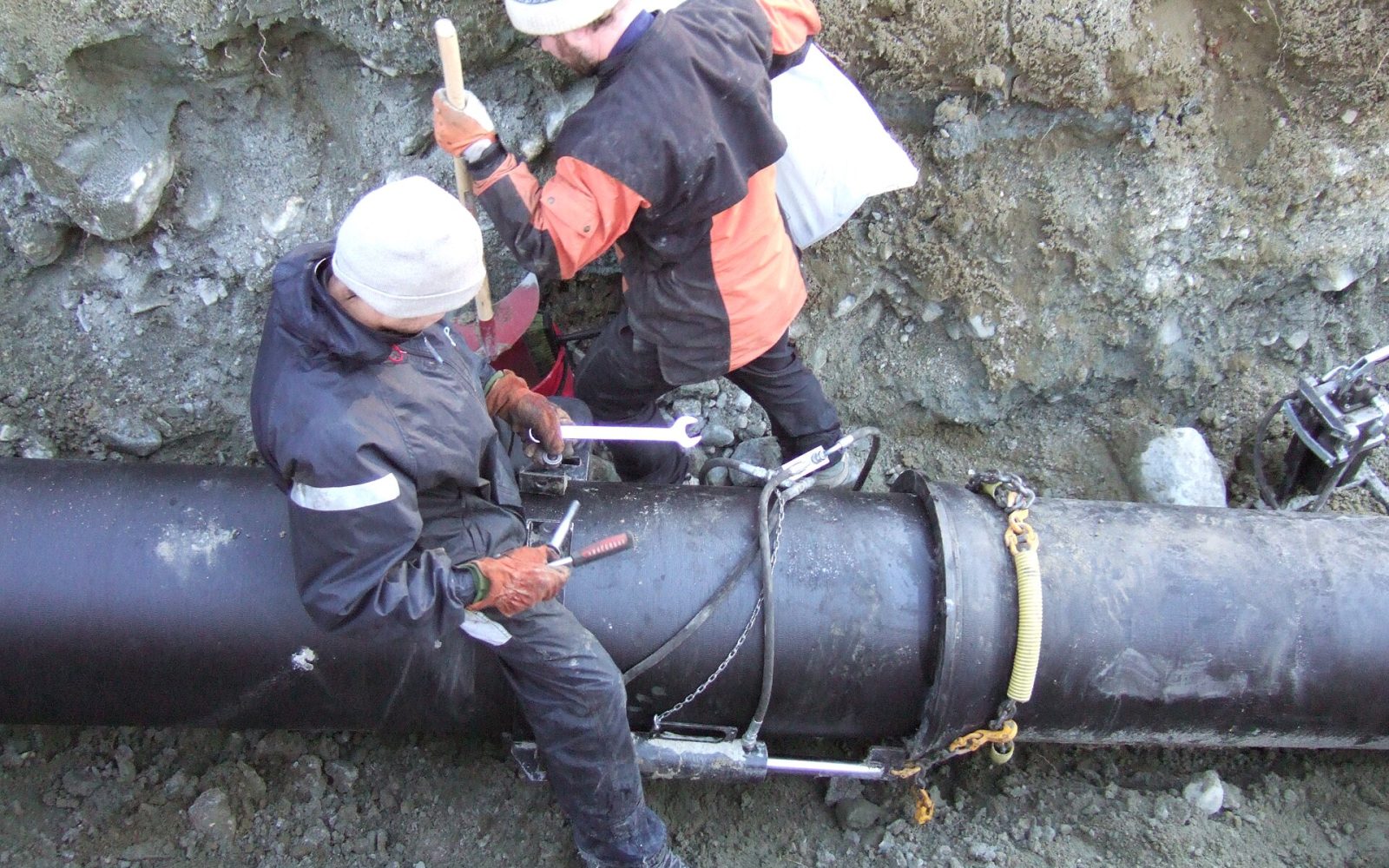
Ductile iron pipe is annealed during manufacture, which forms an annealing oxide layer on the surface. Pipe is typically supplied with a thin asphaltic shop coat outside and, for water service, a cement-mortar lining inside (AWWA C104). Fittings and valves are often supplied with fusion-bonded or liquid epoxy coatings (AWWA C116 covers protective fusion-bonded epoxy coatings for the interior and exterior surfaces of ductile and gray iron fittings).
When a specification calls for special external coatings or internal linings — for example in wastewater service, where cement mortar can be attacked by hydrogen sulfide-generated acids — preparation guidance in NAPF 500-03, published by the National Association of Pipe Fabricators, is widely referenced. It defines abrasive-blast and power-tool preparation grades for ductile iron pipe and fittings, recognizing that blasting through the annealing oxide to a steel-style near-white finish is generally neither necessary nor desirable.
Over-blasting ductile iron pipe in pursuit of a uniform bright finish can open surface porosity and expose more graphite, potentially increasing outgassing. Follow the preparation grade called for in the specification and the coating manufacturer’s recommendations rather than defaulting to steel standards.
Asphaltic shop coats
Standard asphaltic seal coats can bleed through and prevent adhesion of epoxies, polyurethanes and polyurea. Pipe destined for high-performance coating should either be ordered bare (or with a compatible primer) or have the asphaltic coating fully removed. Check compatibility before overcoating any existing shop coat.
Surface preparation
- Identify the material and coating. Confirm whether the part is gray or ductile iron, and what shop coat or lining is present.
- Degrease. Castings often carry machining oils, cutting fluids and rust preventives. Remove them by solvent cleaning or detergent washing before blasting so the abrasive does not drive oil into pores.
- Remove casting defects. Grind fins, sand inclusions and sharp edges; fill or treat significant voids with a compatible filler.
- Blast or power-tool clean. Achieve the specified preparation grade and profile using suitable abrasive. On gray iron, avoid heavy impact on thin or brittle sections.
- Clean and inspect. Remove dust and spent abrasive, inspect for contamination bleeding from pores, and coat promptly before flash rusting.
Some shops bake or heat castings before coating to drive out entrapped oil and moisture — a process sometimes called “burn-off” or preheating — particularly for porous parts that will receive thick linings or fusion-bonded epoxy.
Managing outgassing and porosity
Air, moisture and volatile contaminants trapped in casting porosity expand as the part warms, bubbling through the wet film and leaving craters or pinholes. Measures that help:
- Apply coatings when the casting is cooling, not warming — for example late afternoon outdoors, or after preheating in a shop.
- Use a thinned mist coat or penetrating primer to seal pores before full-build coats, where the data sheet allows.
- Choose systems the manufacturer recommends for porous castings; very fast-setting coatings can trap bubbles before they release.
- Holiday-test linings for immersion service to locate pinholes before commissioning.
If bubbles appear in only some areas, mark them. Repeated outgassing in the same spots usually indicates localized porosity or oil saturation in the casting, which may need local heating or extra cleaning before recoating.
Typical coating systems
- Water pipe, fittings and valves — fusion-bonded or liquid epoxies, with potable-water products certified for drinking water contact where required.
- Wastewater pipe and structures — amine-cured or novolac epoxy linings, polyurethane or polyurea linings, or ceramic-filled epoxy, chosen for acid and abrasion resistance.
- Buried pipe exteriors — asphaltic coatings combined with polyethylene encasement (AWWA C105) are common practice in many regions; high-performance external coatings are used where specified.
- Machinery castings and pump casings — epoxy primers with epoxy or polyurethane topcoats, or ceramic-filled epoxies on wetted surfaces subject to erosion.
- Historic architectural ironwork — often alkyd or epoxy systems over carefully cleaned iron, with attention to lead-containing old paint.
Inspection and quality control
Inspection follows the same principles as steel — profile, cleanliness, DFT and adhesion — but expect more variation in film thickness over rough cast surfaces. Pay special attention to edges, bells and spigots, flange faces and gasket seats, which may need masking or must be left uncoated according to the specification.
Frequently asked questions
Can I blast ductile iron pipe to SSPC-SP 10?
It is generally not recommended. Ductile iron has its own preparation guidance (NAPF 500-03); specify the grade the coating manufacturer recommends for ductile iron rather than a steel standard.
Why does my coating bubble on cast iron?
Usually outgassing: air, moisture or oil trapped in porosity expands as the part warms. Coat while the part is cooling and use a mist coat or penetrating primer.
Can I coat over the black asphaltic coating on pipe?
Most high-performance coatings will not adhere reliably to it and it can bleed through. Remove it or confirm compatibility with the coating manufacturer.
Educational reference. Coating performance varies by formulation. Always follow the manufacturer’s product data sheet, safety data sheet and your project specification.