Epoxy Mastics & Surface-Tolerant Coatings
Epoxy mastics and other surface-tolerant coatings are built to wet out and seal imperfect surfaces, making them the backbone of maintenance and overcoating work.
Key takeaways
- Epoxy mastics are high-solids, high-build epoxies formulated to wet, penetrate and seal surfaces that cannot be blast cleaned.
- They are widely used for maintenance painting and for overcoating aged or lead-containing coatings.
- “Surface tolerant” is not “surface indifferent”: loose rust, soluble salts and weak old coatings still cause failures.
- Adhesion testing and trial patches before overcoating reduce the risk of lifting or delamination.
Abrasive blasting to near-white metal gives any coating its best chance, but it is not always possible. Operating plants, occupied buildings, bridges over traffic and structures carrying lead paint often limit preparation to hand and power tools. Epoxy mastics and related surface-tolerant coatings were developed for exactly these situations.
They are a practical compromise. Applied over a properly assessed surface, they can extend the life of a structure by many years at a fraction of the cost and disruption of full removal. Applied over the wrong surface, they can fail quickly and take the old coating with them.
What an epoxy mastic is
The term “mastic” originally described thick, paste-like coatings. Modern epoxy mastics are two-component, high-volume-solids epoxies — often in the range of roughly 70–100% solids — that build a thick film in a single coat. Most are cured with polyamide or modified amine hardeners, which give good wetting, flexibility and tolerance of marginal surfaces. Compared with general-purpose epoxy coatings, mastics are formulated for low shrinkage stress, slow initial cure that allows penetration into rust and crevices, and high film build on edges.
Many mastics contain leafing aluminum flake, which aligns parallel to the surface to form an overlapping barrier against moisture and oxygen. Others use inert lamellar fillers such as micaceous iron oxide or glass flake, or are pigmented in colors for use as a finish in interior environments.
Other surface-tolerant chemistries
The surface-tolerant family also includes penetrating epoxy sealers, low-viscosity epoxies designed to soak into rust and old coatings; aluminum-filled moisture-cure urethanes; calcium sulfonate alkyds; and some modified alkyds. Each balances penetration, film build, compatibility with old coatings and cure conditions differently.
Surface preparation for surface-tolerant coatings
Mastics are designed for surfaces prepared to standards such as SSPC-SP 2 (hand tool cleaning) and SSPC-SP 3 (power tool cleaning), and they perform even better over SSPC-SP 15 commercial-grade power tool cleaning or blast-cleaned surfaces. The minimum prep stated on the data sheet is a minimum, not a target.
| Condition | Typical approach | Notes |
|---|---|---|
| Tightly adherent rust and mill scale | Clean, then hand or power tool to remove loose material | Tight rust can be sealed; loose rust cannot |
| Pack rust and rust scale | Remove with power tools or spot blasting | Thick rust layers expand and crack the coating |
| Aged, sound coating | Wash, then scuff-sand or abrade to dull the gloss | Test adhesion of the old coating first |
| Chalking or contaminated surface | Pressure wash or solvent clean | Remove chalk, oil and grease completely |
| Salt-contaminated steel | Water wash; test chlorides | Soluble salts beneath the film lead to blistering |
Soluble salts deserve special attention on marine, coastal and de-icing-salt-exposed structures, because hand and power tools leave them in place. See soluble salt contamination for testing and removal.
Overcoating existing coatings
A major use of epoxy mastics is overcoating — applying new coating over an aged system instead of removing it. This is especially attractive where the old coating contains lead, because removal is costly and hazardous. Overcoating is also a common way to extend the life of tank exteriors, structural steel and plant piping.
The risk is that the new coating shrinks as it cures and exerts stress on the old coating. If the old coating is weakly bonded, brittle or very thick, the combined stress can cause it to lift from the steel, often weeks or months later. Before committing to an overcoat, practitioners typically:
- Survey the existing coating’s thickness, number of layers and general condition
- Measure adhesion of the existing system by knife, tape (ASTM D3359) or pull-off (ASTM D4541) methods
- Apply trial patches of the proposed system and test their adhesion after cure
- Check for the presence of lead or other hazardous materials before any disturbance
The broader decision framework is covered in overcoating existing coatings.
Many overcoat failures appear as the old coating peeling from the steel with the new mastic still firmly attached to it. The mastic did its job; the old coating could not take the extra stress. That is why the adhesion of the existing system matters so much.
Advantages and limitations
Advantages
- Tolerates hand- and power-tool-cleaned surfaces
- High film build in one coat; good edge coverage
- Compatible with many aged coatings
- Enables overcoating instead of costly removal
- Low-VOC, high-solids options widely available
Limitations
- Shorter service life than blast-cleaned systems
- Shrinkage stress can lift weak old coatings
- Cannot overcome soluble salts or loose rust
- Chalks and fades outdoors without a UV topcoat
- Slow cure in cold weather with some hardeners
Application
Epoxy mastics are applied by brush, roller or airless spray, typically at about 5–8 mils (125–200 µm) dry per coat; many products allow more. A brush-applied stripe coat on edges, bolts, welds and crevices helps the mastic penetrate where corrosion starts. Spot-primed areas of bare steel are often given a full extra coat.
- Assess and test. Survey the structure, test the existing coating and confirm hazardous-material status.
- Clean. Wash away salts, chalk, dirt and oil; let the surface dry.
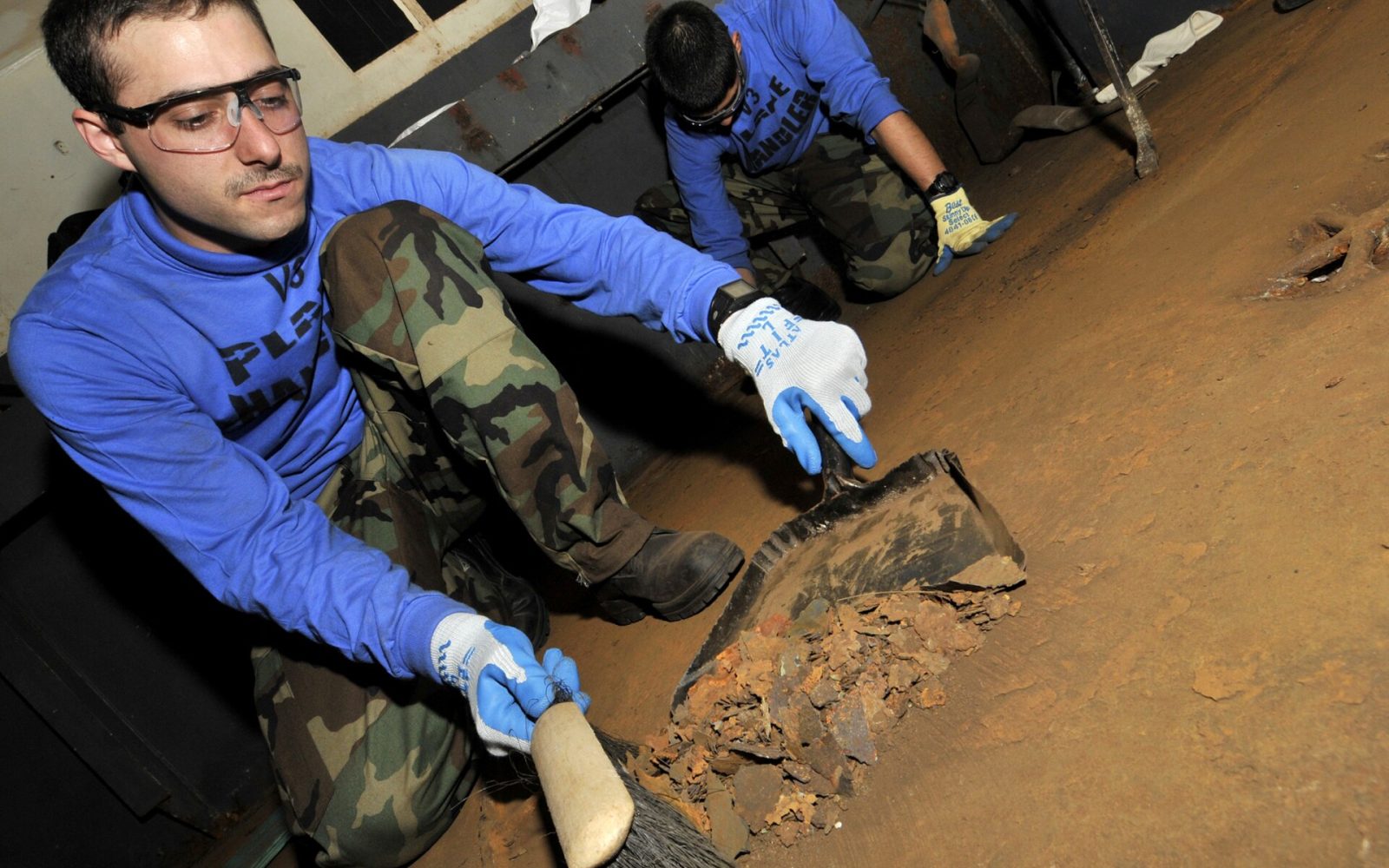
- Prepare. Remove loose rust and coating with hand or power tools; feather edges of sound coating.
- Stripe coat. Brush mastic into edges, welds, fasteners and pitted areas.
- Apply the full coat. Build to the specified thickness and check wet film as you go.
- Topcoat if exposed to sunlight. Apply a UV-stable finish such as an aliphatic polyurethane within the recoat window.
Mastics fit naturally into a structured maintenance program: regular condition assessments identify areas where spot repair and overcoating are still viable, before deterioration forces full removal.
Frequently asked questions
Can epoxy mastic be applied directly over rust?
Over tightly adherent rust after loose material is removed, yes. Over loose, flaking or pack rust, no — the rust layer will fail beneath the coating.
Is epoxy mastic a primer or a topcoat?
It is often used as a self-priming, one- or two-coat system. Outdoors it is usually topcoated with a UV-stable finish.
Can mastic encapsulate lead paint?
Overcoating with surface-tolerant coatings is a common strategy for lead-containing systems, but it requires assessment, adhesion testing and compliance with lead safety regulations for any surface disturbance.
Educational reference. Coating performance varies by formulation. Always follow the manufacturer’s product data sheet, safety data sheet and your project specification.