Power Tool Cleaning
How SSPC-SP 3, SP 15 and SP 11 differ, which power tools achieve each grade, and how to use power tool cleaning for spot repair and maintenance painting.
Key takeaways
- Power tool cleaning uses powered hand-held tools to remove rust, mill scale and coatings where abrasive blasting is impractical or not allowed.
- SSPC defines three grades: SP 3 (loose material only), SP 15 (commercial grade) and SP 11 (bare metal). SP 15 and SP 11 also require a profile of at least 1 mil (25 µm).
- Tool choice decides what grade is achievable. Wire brushes remove loose material; needle guns, rotary peeners, bristle blasters and grinders can reach bare metal.
- Polishing or burnishing the steel to a smooth shine harms adhesion. Use tools that leave a textured surface.
- Always solvent clean first, and use shrouded, vacuum-equipped tools where old coatings contain lead or other hazards.
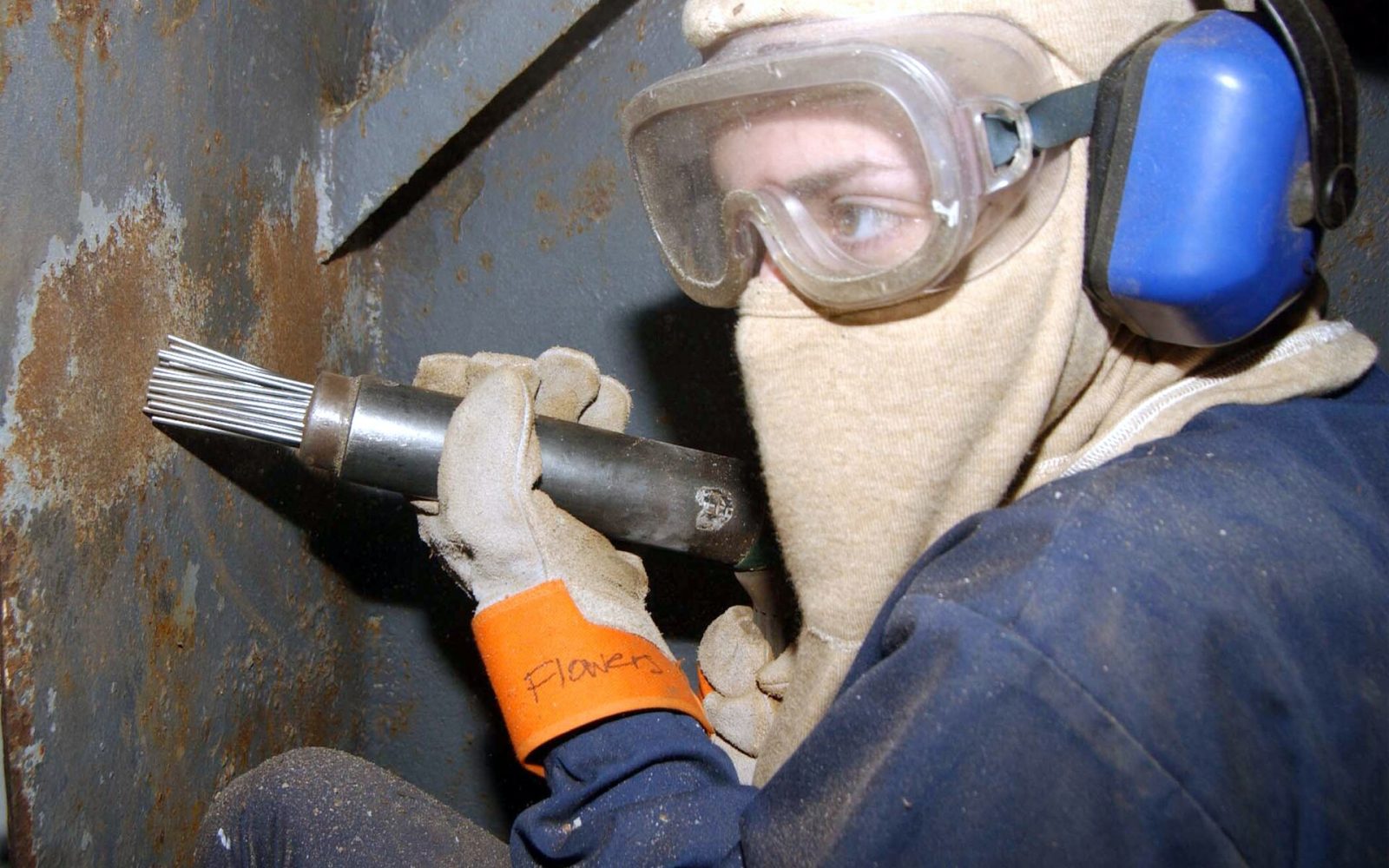
Power tool cleaning is the preparation of steel and other surfaces with electric or pneumatic hand-held tools, such as wire brushes, needle scalers, rotary peeners, bristle blasting tools, grinders and sanders. It is the standard approach for spot repairs, small areas, maintenance painting of operating plants, and locations where blast debris, dust or abrasive would be unacceptable. It costs more per square foot than blasting on large areas, but it avoids containment, spent abrasive and the need to shut down surrounding operations.
The three SSPC power tool grades
| Standard | Name | What remains | Profile requirement |
|---|---|---|---|
| SSPC-SP 3 | Power Tool Cleaning | Tightly adherent mill scale, rust and coating | None |
| SSPC-SP 15 | Commercial Grade Power Tool Cleaning | Random staining on no more than 33% of each unit area; traces in pit bottoms | At least 1 mil (25 µm) |
| SSPC-SP 11 | Power Tool Cleaning to Bare Metal | Only slight residues of rust and paint in the bottoms of pits on originally pitted steel | At least 1 mil (25 µm) |
SP 3 is a loose-material standard: material is considered adherent if it cannot be lifted with a dull putty knife. SP 15 and SP 11 are true bare-metal standards that remove all visible mill scale, rust and coating, apart from the residues listed, and leave a measurable profile. SSPC-VIS 3 provides reference photographs for hand and power tool cleaning. Internationally, ISO 8501-1 uses St 2 and St 3 for hand and power tool cleaning, which correspond broadly to the loose-material grades rather than to SP 11. See SSPC, NACE and ISO surface preparation standards for how these fit with the blast-cleaning grades.
Choosing the tool
| Tool | Best for | Profile | Caution |
|---|---|---|---|
| Wire cup or wheel brush | Loose rust and paint (SP 3) | Little or none | Burnishes mill scale and rust if overused |
| Needle scaler (needle gun) | Heavy rust, scale, welds, corners, bolted joints | Rough, peened texture | Can be slow on large flat areas; vibration |
| Rotary flap peener | Removing rust and coatings to bare metal | Yes, when used correctly | Requires proper speed and technique |
| Rotary bristle blasting tool | Bare metal with profile (SP 11, SP 15) | Yes, sharp and textured | Bristle belts wear and must be replaced |
| Grinder with abrasive disc | Fast removal, weld spatter, sharp edges | Some, depends on grit | Can gouge or leave a smooth, scratched surface |
| Orbital sander or non-woven abrasive | Scuff sanding sound coatings; light rust | Shallow | Not for heavy rust or scale |
No single tool does everything. Crews commonly use a needle scaler or grinder for heavy deposits and welds, then a bristle blasting tool or rotary peener to reach the specified grade and profile. Weld spatter and sharp edges are often treated at the same time; see edge and weld preparation.
Wire brushing tight mill scale or rust until it shines does not clean it; it polishes it. A burnished surface gives coatings very little to grip. If the steel looks glossy rather than matte, change the tool or method.
Procedure
- Solvent clean. Remove oil, grease and soil according to SSPC-SP 1, because power tools smear these contaminants rather than removing them.
- Remove heavy deposits. Knock off thick rust scale, weld spatter and loose coating with a needle scaler, chipping hammer or grinder.
- Clean to grade. Use the appropriate tool to achieve SP 3, SP 15 or SP 11 over the whole area.
- Feather edges. Taper the edges of surrounding intact coating so the repair coating blends smoothly.
- Remove dust. Brush, blow down with clean, dry air or vacuum the surface.
- Inspect. Compare with the specification and SSPC-VIS 3. For SP 15 and SP 11, measure profile using a method from ASTM D4417; see surface profile measurement.
- Prime promptly. Coat before rust re-forms, keeping the surface above the dew point.
Advantages and limitations
Advantages
- No spent abrasive and little debris
- Works in operating plants, near machinery and in tight spaces
- Low equipment cost and quick setup
- SP 11 and SP 15 give bare metal with profile for spot repairs
Limitations
- Slow and labor-intensive over large areas
- Hard to reach consistent quality in pits, crevices and back-to-back angles
- Does not remove soluble salts from pits
- Vibration, noise and dust exposure for workers
Matching the coating to the preparation
SP 3 surfaces retain tightly adherent rust and mill scale, so the coating must be able to wet and seal them. Surface-tolerant products such as epoxy mastics, penetrating sealers and some alkyds are formulated for this. Zinc-rich primers and many immersion linings need bare metal with a profile, so they generally require SP 11 or abrasive blasting. Always check the minimum preparation stated on the product data sheet.
For a lower grade that removes only loose material by hand, see hand tool cleaning.
Health and safety
Power tools generate dust and fragments of whatever coating is being removed. Where coatings contain lead, chromium or other hazards, use tools with integral shrouds and HEPA vacuum extraction, monitor exposure and follow the applicable regulations, such as OSHA 29 CFR 1926.62 for lead in construction; see lead paint removal. Other hazards include flying particles, hand–arm vibration, noise, rotating-tool entanglement and sparks near flammable materials. Wear eye and face protection, hearing protection and gloves, keep guards fitted, and follow the tool manufacturer’s instructions and your employer’s safety program.
Frequently asked questions
What is the difference between SP 3 and SP 11?
SP 3 removes only loose rust, mill scale and paint. SP 11 removes all visible rust, mill scale and paint, except slight residues in pit bottoms, and requires a profile of at least 1 mil (25 µm).
Is SP 11 equivalent to near-white blast cleaning?
No. They are different standards. SP 11 can give a bare, profiled surface suitable for many coatings, but its profile and appearance differ from a blast-cleaned surface. Follow what the specification and coating manufacturer require.
Can a wire brush achieve SP 11?
Generally not. Wire brushes tend to remove loose material and burnish what remains. Bristle blasting tools, rotary peeners and suitable grinding methods are normally used to reach SP 11.
Educational reference. Coating performance varies by formulation. Always follow the manufacturer’s product data sheet, safety data sheet and your project specification.