PPE for Coating Applicators
How to select, wear and care for respirators, gloves, coveralls, eye, hearing and foot protection for painting, spraying and blasting — and why PPE is the last line of defense.

Key takeaways
- Personal protective equipment (PPE) is the last line of defense — it supplements, but never replaces, elimination, substitution, engineering and administrative controls.
- Selection starts with a documented hazard assessment and the safety data sheet (SDS) for every product on the job, including thinners and cleaners.
- Glove and coverall materials must be matched to the specific chemicals; no single material resists every solvent, resin and curing agent.
- Respirators require a full program — medical evaluation, fit testing and training — under rules such as OSHA 29 CFR 1910.134.
Coating applicators face many hazards in one shift: solvent vapors and spray mist, reactive resins that can sensitize skin and lungs, abrasive dust, noise, high-pressure fluid injection, heat and work at height. PPE controls whatever exposure remains after the job has been engineered as safely as practical.
This article explains how PPE is selected for coating work and what each item is meant to do. It is general guidance only: always follow the product SDS, your employer’s written safety program and the regulations that apply where you work.
Where PPE fits in the hierarchy of controls
Occupational safety bodies such as OSHA, NIOSH, HSE and EU-OSHA rank controls in a similar order:
- Elimination — for example, shop-applying a coating instead of spraying it inside a tank.
- Substitution — choosing a lower-VOC, waterborne or otherwise less hazardous product or abrasive.
- Engineering controls — ventilation, spray booths, enclosures and dust collection.
- Administrative controls — scheduling, restricted areas, training and hygiene practices.
- PPE — respirators, gloves, suits, eye and face protection, hearing protection and similar items.
PPE ranks last because it depends on correct selection, fit, maintenance and consistent use. If any link fails, the exposure goes straight to the worker.
Start with a hazard assessment
In the United States, OSHA’s general PPE rule (29 CFR 1910.132) requires employers to assess the workplace for hazards and certify that assessment in writing, and construction work carries parallel duties. Other jurisdictions have comparable requirements. For coating work, a useful assessment asks:
- What products are in use? Read the SDS for each component — base, curing agent, thinner, cleaner and abrasive. Section 8 lists exposure limits and recommended PPE; Sections 2 and 11 describe health hazards. See reading safety data sheets.
- How is it applied? Spraying puts far more material in the air than brushing or rolling, and plural-component spraying adds reactive aerosols.
- Where is the work? Open air, a booth, or an enclosed or confined space changes vapor concentrations dramatically.
- What else is present? Lead or other toxic metals in old paint, silica in abrasives or concrete, noise, heat, traffic and fall hazards.
PPE by body area
Typical choices are summarized below; actual selection must come from the assessment and the SDS.
| Body area | Typical coating-work hazards | Common protection |
|---|---|---|
| Lungs | Solvent vapor, spray mist, isocyanates, dust, lead, silica | Air-purifying or supplied-air respirator within a respiratory protection program |
| Eyes and face | Splash, overspray, rebounding abrasive, dust | Safety glasses or goggles; face shield over goggles for splash; blast hood for blasting |
| Hands | Solvents, resins, amines, abrasion, cuts | Chemical-resistant gloves matched to the SDS; liners or cut-resistant gloves where needed |
| Body | Overspray, skin contact, contamination carried home | Disposable or reusable chemical-protective coveralls; blast suit for blasting |
| Head and feet | Falling objects, impact, slips on coated surfaces | Hard hat; safety footwear with slip-resistant soles |
| Ears | Blasting, compressors, grinders, dust collectors | Earplugs or earmuffs — often both for blasting |
Respiratory protection
Respirator selection depends on the contaminant, its concentration, its exposure limit and the oxygen level. Organic-vapor cartridges with particulate prefilters are common for solvent-borne coatings applied with good ventilation, while isocyanate-containing products, confined spaces and abrasive blasting often call for supplied-air respirators. OSHA 29 CFR 1910.134 requires a written program, medical evaluation, fit testing for tight-fitting facepieces and a cartridge change schedule. The details are covered in respiratory protection for coating work and isocyanate safety.
Eye and face protection
Safety glasses with side protection meeting ANSI/ISEA Z87.1 (or EN 166 in Europe) are a baseline. Indirect-vent or non-vented goggles are better against splash and mist, and a face shield worn over goggles is appropriate when mixing, pouring or handling corrosive amine curing agents.
Skin and body protection
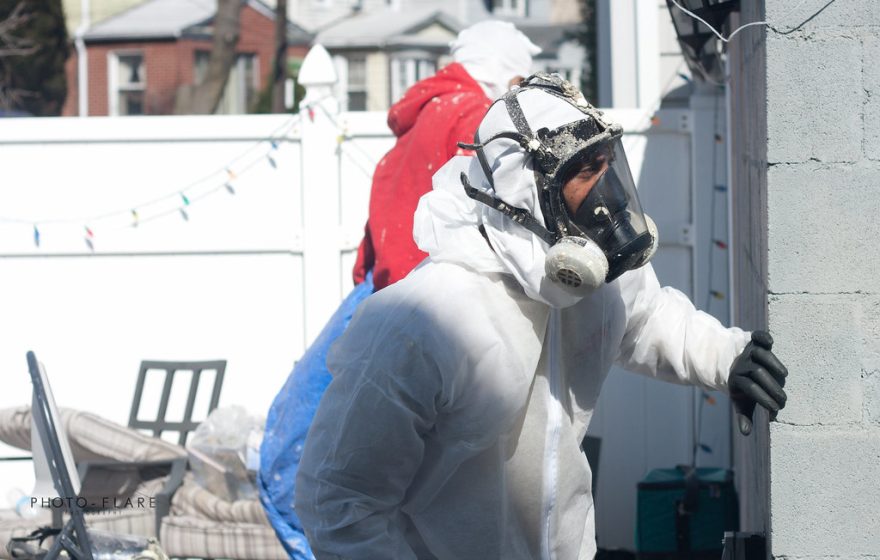
Skin is a major exposure route that is easy to underestimate. Solvents defat skin and some are absorbed through it; epoxy resins and amines are well-known skin sensitizers (see epoxy skin sensitization); isocyanates can sensitize through skin as well as the lungs. Hooded disposable coveralls keep overspray off clothing and hair, and wrist and ankle closures — taped where needed — reduce gaps. Workers disturbing lead paint need dedicated work clothing that stays on site (see lead paint hazards).
Hearing, head and feet
Abrasive blasting, compressors and grinding can easily exceed the noise levels that trigger hearing-conservation requirements. Hard hats meeting ANSI/ISEA Z89.1 and safety footwear meeting ASTM F2413 (or regional equivalents) are standard on industrial sites, and slip-resistant soles matter on freshly coated or oversprayed surfaces.
Choosing chemical-resistant gloves
Gloves are the item most often chosen badly. A thin disposable glove that is adequate for brief contact with a waterborne acrylic may offer only minutes of protection against strong solvents such as ketones or aromatic hydrocarbons. Three properties matter:
- Breakthrough time — how long before the chemical is detected on the inside of the glove under test conditions.
- Permeation rate — how quickly it passes through once breakthrough occurs.
- Degradation — swelling, softening, cracking or loss of strength on contact.
Glove manufacturers publish chemical-resistance charts covering these properties, and SDS Section 8 often names a suitable glove material. Coatings are mixtures, so resistance to the most aggressive component usually governs. In general terms, nitrile is a common all-round choice for many coating tasks, butyl rubber tends to resist ketones and esters better, and multilayer laminate gloves offer broad chemical resistance but poor dexterity — they are often worn under a nitrile outer glove. Natural rubber latex generally performs poorly against organic solvents and can itself cause allergy.
Treat disposable gloves as splash protection, not immersion protection. Change them as soon as they are contaminated or torn, and never wash and reuse them. If you can smell solvent on your hands or see resin on your skin, the glove system has failed.
Donning, doffing and care
PPE can spread contamination as easily as it prevents it. A consistent routine helps:
- Inspect before use. Check gloves for pinholes and tears, coveralls for rips, and respirator valves, straps and seals; perform a user seal check every time a tight-fitting respirator is donned.
- Don in order. Coveralls, footwear, respirator, eye protection, hood, then gloves — with glove cuffs over or taped to the sleeves as the task requires.
- Doff carefully. Remove the most contaminated items first, peeling gloves and coveralls inside-out so the dirty surface is enclosed.
- Clean and store. Clean reusable respirators and face shields according to the manufacturer’s instructions and store them away from solvent vapor, dust and sunlight.
- Wash. Wash hands and face with soap and water before eating, drinking, smoking or using the restroom. Never clean skin with solvent.
An airless or plural-component spray gun can inject coating through skin and gloves. Injection injuries can look minor at first but are medical emergencies — seek treatment immediately and tell the clinician it is an injection injury. Never point a gun at anyone, keep the tip guard fitted, engage the trigger lock and relieve pressure before cleaning. Gloves do not protect against injection.
Frequently asked questions
Is a disposable dust mask enough for spray painting?
Usually not. Filtering facepiece particulate respirators capture mist and dust but not solvent vapors, and they are not appropriate for isocyanate-containing coatings. Respirator selection should follow the SDS, exposure assessment and your employer’s respiratory protection program.
Do waterborne coatings still need PPE?
Yes. Waterborne products can contain co-solvents, amines, biocides and other irritants or sensitizers, and spraying any coating creates an inhalable mist. Eye and skin protection are still needed, and respiratory protection depends on the product and method.
How often should respirator cartridges be changed?
On the schedule set by your respiratory protection program, which is based on the contaminants, concentrations and manufacturer data. Waiting until you smell solvent is not a reliable change-out method.
Educational reference. Coating performance varies by formulation. Always follow the manufacturer’s product data sheet, safety data sheet and your project specification.