Soluble Salt Testing Methods
How inspectors extract and measure chlorides, sulfates and nitrates on prepared steel — Bresle patches, sleeves, swabs, conductivity and ion-specific tests — and how to read the results.
Key takeaways
- Every field salt test has two parts — extracting salts from a known area into a known volume of water, then analyzing that extract — and both steps affect the number you get.
- The Bresle patch (ISO 8502-6) combined with conductivity measurement (ISO 8502-9) is the most widely used field method; chloride-specific tests target the most aggressive ion.
- Results are only meaningful when the method, ion basis and units match what the specification states. Values from different methods are not directly interchangeable.
- Test after final surface preparation, as close to coating as practical, and at the locations most likely to be contaminated.
Soluble salts such as chlorides, sulfates and nitrates are invisible on a freshly blasted surface, yet small amounts trapped beneath a coating can draw water through the film and drive blistering and under-film corrosion. Because you cannot see them, the only way to know whether a surface is clean enough is to test it.
This article covers how salts are measured in the field: the extraction techniques, the analysis methods, where and when to sample, and how to interpret the results. For why salts cause failures and how they get onto steel in the first place, see soluble salt contamination.
How field salt testing works
Salts concentrate in corrosion pits and crevices, where abrasive blasting can leave them behind even when the surface visually meets a near-white blast standard. Field methods all follow the same principle:
- Extraction — dissolving salts from a defined surface area into a measured volume of high-purity (deionized or distilled) water or a specified extraction solution.
- Analysis — measuring how much salt, or which specific ions, ended up in that solution.
The result is expressed as mass per unit area, most often micrograms per square centimetre (µg/cm²) or milligrams per square metre (mg/m²). The conversion is simple: 1 µg/cm² equals 10 mg/m². SSPC Guide 15 describes the common field methods for steel and other nonporous substrates.
No field extraction method retrieves all of the salt present, particularly from deeply pitted steel. Retrieval efficiency varies with the method, the extraction liquid and the surface condition, which is why a specification should name the extraction and analysis method along with the limit.
Extraction methods
Adhesive patch cell (Bresle method)
Described in ISO 8502-6, the Bresle patch is a flexible adhesive patch with a sealed compartment of known area (a standard size of 1,250 mm² is common). The patch is pressed onto the steel, a measured volume of water is injected through the adhesive with a syringe, and the liquid is drawn out and reinjected several times to dissolve surface salts before being withdrawn for analysis. It is inexpensive and widely recognized, but can leak on very rough, pitted, hot or dusty steel.
Sleeve extraction
Sleeve methods use a flexible cylindrical sleeve with an adhesive ring that seals against the surface. The sleeve is filled with extraction liquid and massaged against the steel. Some sleeve kits supply a proprietary extraction solution intended to improve retrieval from pitted surfaces; results obtained with such solutions are not directly comparable to those from pure water extraction.
Swabbing
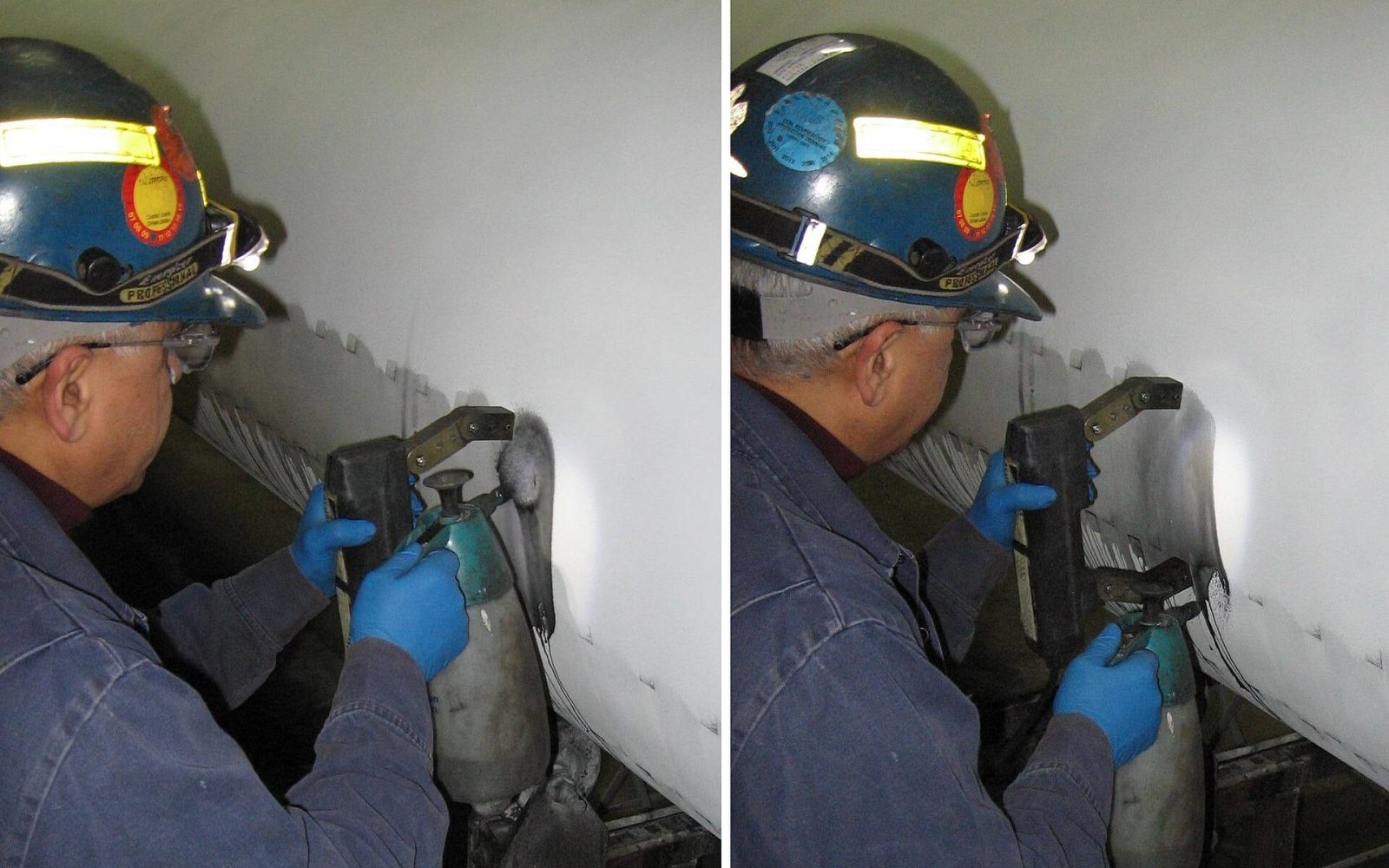
A template defines the test area, which is swabbed with cotton or gauze wetted from a known volume of water; the swab and rinse water are collected in a clean container. Swabbing works on irregular, overhead or hot surfaces where patches will not stick, but it is more operator-dependent.
Analysis methods
Conductivity (ISO 8502-9) is the most common analysis. A conductivity meter measures the extract, the reading of the blank water is subtracted, and a formula based on the extraction volume and area converts the result to surface density. Conductivity responds to all dissolved ions, so it reports total ionic contamination — often expressed as a sodium chloride equivalent — rather than chloride alone.
Ion-specific tests measure one contaminant. Chloride is usually measured with titration strips or ion detection tubes (ISO 8502-5); sulfate and nitrate have their own colorimetric, turbidimetric or strip-based kits. Laboratories can provide an ion-by-ion breakdown by ion chromatography.
| Analysis method | Measures | Strengths | Limitations |
|---|---|---|---|
| Conductivity (ISO 8502-9) | All dissolved ionic salts | Fast, digital, low cost per test | Not ion-specific; needs conversion |
| Chloride titration strip | Chloride | Simple, ion-specific | Coarse resolution at low levels; development time |
| Ion detection tube (ISO 8502-5) | Chloride | Ion-specific, no meter needed | Limited range; reading judgment |
| Sulfate or nitrate kits | Sulfate or nitrate | Catches non-chloride salts | More steps; less often specified |
| Laboratory ion chromatography | Individual anions | Most precise and complete | Not real-time; sample handling risk |
Where, when and how to test
Test after final surface preparation — blasting or waterjetting — and as close to the start of coating as practical. Retest if the surface has been rained on, splashed, left overnight in a marine atmosphere, or shows flash rust. The specification normally sets the number of tests per area or per unit of surface; maintenance projects on previously corroded steel usually justify more tests than new construction.
Bias sampling toward worst-case locations: heavily pitted areas, tank bottoms and splash zones, crevices and back-to-back angles, areas beneath former rust nodules, and surfaces exposed to sea spray, de-icing salts or process chemicals.
- Check the kit. Confirm the conductivity meter is calibrated and measure the conductivity of the blank water.
- Prepare the spot. The area must be dry and free of loose dust; avoid touching it with bare hands.
- Apply the cell. Press the patch or sleeve firmly so it seals all round.
- Extract. Inject the measured volume and cycle it in and out the number of times the method requires.
- Analyze. Withdraw the liquid and read conductivity or run the ion-specific test promptly.
- Calculate. Subtract the blank and convert to µg/cm² or mg/m² using the method’s formula.
- Record. Note location, method, raw reading, result, ion basis and surface condition in the daily inspection report.
Interpreting results and acceptance limits
Acceptance limits come from the project specification or the coating manufacturer and depend on the service. Immersion and buried service generally demand stricter limits than atmospheric exposure, because water driven through the film by osmosis feeds osmotic blistering. Chloride limits for immersion linings are commonly in the low single digits of µg/cm², while atmospheric service tolerates more. The IMO Performance Standard for Protective Coatings (PSPC) for ballast tanks, for example, sets a maximum expressed as 50 mg/m² of sodium chloride.
Check the basis of every limit. A limit stated as chloride ion cannot be compared directly with a conductivity result expressed as sodium chloride equivalent — chloride is only about 61% of the mass of sodium chloride, and conductivity also picks up sulfates and other ions.
If results exceed the limit, typical remedies include washing with clean water, pressure washing or waterjetting, the use of salt-removal products where the coating manufacturer accepts them, and re-blasting. Retest after remediation and record both the failing and passing results.
Common testing errors
- Using tap water or contaminated syringes and beakers instead of high-purity water and clean equipment.
- Skipping the blank reading of the water.
- Applying patches over dust, or using too few extraction cycles.
- Testing before the final blast, or on hot steel where the extract evaporates.
- Applying the wrong conversion formula for the patch size or water volume used.
Salt testing is one checkpoint among many; see the coating inspection checklist for where it fits in the overall sequence.
Frequently asked questions
Is the Bresle test chloride-specific?
No. The Bresle patch is only an extraction method. If the extract is analyzed by conductivity, the result reflects all dissolved ions; a chloride-specific test on the same extract is needed to report chloride alone.
How do I convert µg/cm² to mg/m²?
Multiply by 10. A result of 3 µg/cm² equals 30 mg/m².
Doesn’t abrasive blasting remove salts?
Not reliably. Dry blasting removes rust and old coating but can leave salts at the bottom of pits or drive them into the surface. Waterjetting or washing followed by retesting is usually needed on heavily contaminated steel.
Can these methods be used on concrete?
The common patch and sleeve methods are designed for steel and other nonporous substrates. Concrete is porous and can release salts from within, so results are not equivalent; follow the specification and the coating manufacturer’s guidance for concrete.
Educational reference. Coating performance varies by formulation. Always follow the manufacturer’s product data sheet, safety data sheet and your project specification.