Vinyl Ester Coatings & Linings
Vinyl ester resins cure by free-radical reaction into dense, acid-resistant linings that protect steel and concrete in some of the harshest chemical services in industry.
Key takeaways
- Vinyl esters are epoxy-backbone resins with reactive methacrylate ends, dissolved in styrene and cured with an organic peroxide.
- They are chosen for strong acids, oxidizing chemicals such as bleach and chlorine dioxide, and hot, wet, corrosive exposures where epoxies struggle.
- Most protective uses are thick glass-flake linings or fiber-reinforced laminates rather than thin paint films.
- Short working time, cure shrinkage and air inhibition make surface preparation, catalyst control and cure verification critical.
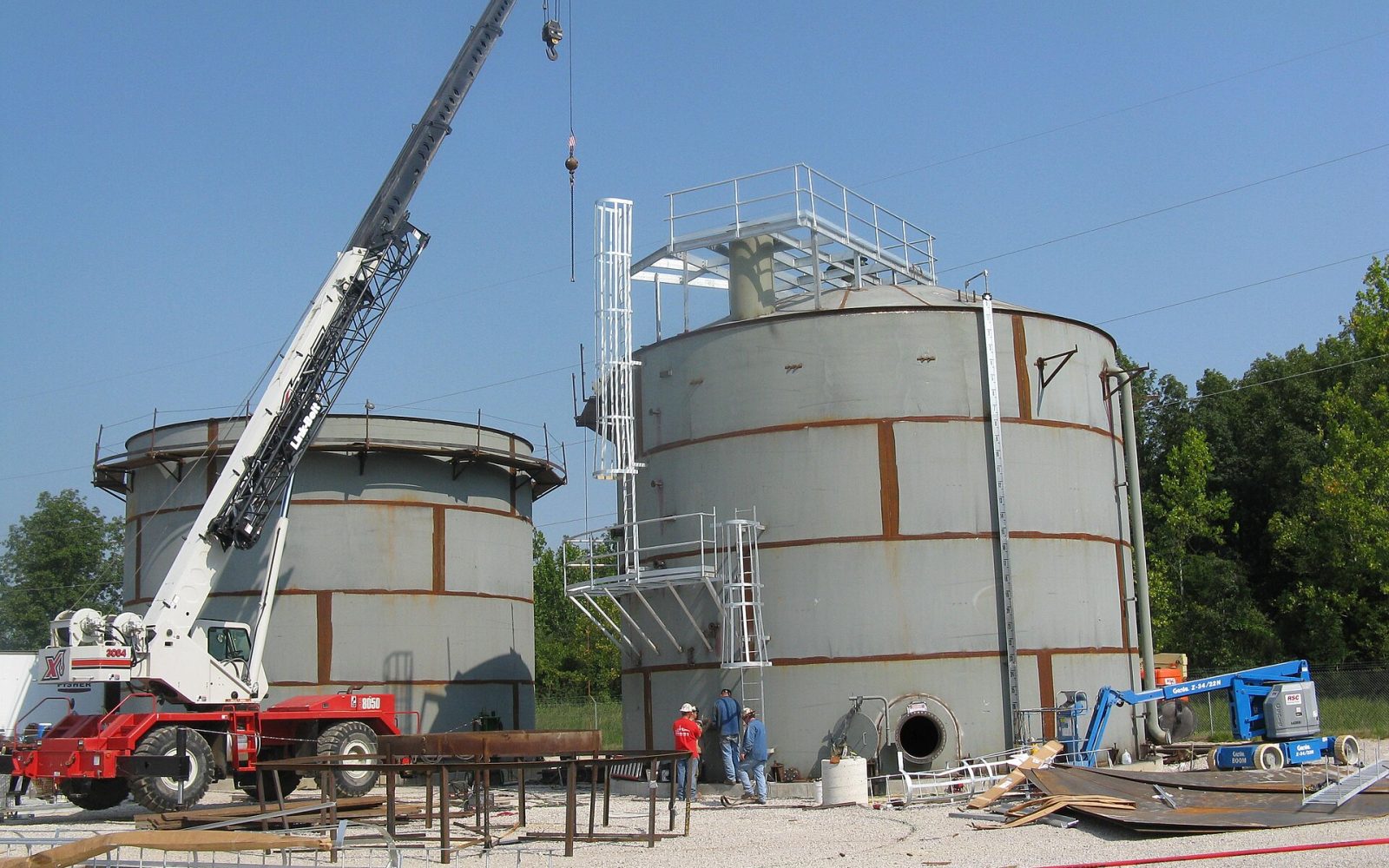
Vinyl ester coatings and linings sit at the heavy-duty end of the protective coatings range. They are widely used in pulp and paper bleach plants, flue gas desulfurization (FGD) scrubbers, acid storage tanks, wastewater structures and chemical plant floors and trenches — places where the chemical is aggressive, the temperature may be elevated and failure means a costly shutdown.
Although vinyl esters share a backbone with epoxies, they behave much more like polyester resins in the way they are mixed, applied and cured. Treating them like a conventional two-part epoxy is a common source of problems.
The chemistry of vinyl esters
A vinyl ester resin is made by reacting an epoxy resin with methacrylic acid. The result is a molecule with an epoxy-derived backbone and a reactive carbon–carbon double bond at each end. The resin is then dissolved in a reactive monomer, usually styrene, which becomes part of the cured network rather than evaporating like a solvent.
Cure is a free-radical polymerization. An organic peroxide initiator (often called the catalyst), such as methyl ethyl ketone peroxide (MEKP) or cumene hydroperoxide, is added just before use. A promoter, commonly a cobalt salt, sometimes with an amine accelerator, breaks the peroxide into free radicals at ambient temperature. Those radicals link the resin ends and the styrene into a tightly cross-linked thermoset. Because only a small amount of initiator is used — typically one to two percent by weight, per the product data sheet — small measuring errors have large effects on gel time and final cure.
Compared with polyester resins, vinyl esters have fewer ester groups that can be attacked by hydrolysis, and the backbone provides toughness and adhesion. Compared with amine-cured epoxies, they are much more resistant to strong acids and oxidizers. For background on network formation, see how coatings cure.
Resin types and lining systems
Several resin grades and system architectures are in common use. The right one depends on the chemical, the temperature and whether the lining must bridge cracks or tolerate movement.
| Type | Typical thickness | Characteristics | Common uses |
|---|---|---|---|
| Bisphenol A epoxy vinyl ester | Varies by system | Tough, broad acid, alkali and bleach resistance | General chemical tanks, scrubbers, ducts |
| Novolac epoxy vinyl ester | Varies by system | Higher cross-link density; better heat and solvent resistance | Hot acids, solvent-bearing streams |
| Glass-flake vinyl ester lining | Commonly 30–60 mils (0.75–1.5 mm) | Overlapping flakes slow permeation; spray or trowel applied | Tank interiors, FGD absorbers, sumps |
| Reinforced laminate (mat or veil) | Often 1/8 in (3 mm) or more | Glass reinforcement adds strength and crack bridging | Concrete containment, trenches, pits |
| Fire-retardant (brominated) grades | Varies by system | Reduced flame spread | Ducts and stacks where fire codes apply |
Flake-filled systems rely on the lamellar glass flake to create a long, tortuous path for permeating water and chemicals. Laminates combine resin with chopped strand mat, woven roving and a surface veil, and are often used on concrete where substrate cracking is a concern.
Where vinyl esters excel
Vinyl esters are a first choice for many acidic and oxidizing services, including sulfuric, hydrochloric and phosphoric acids across a wide concentration range, sodium hypochlorite, chlorine dioxide, wet chlorine gas and acidic condensates. Novolac grades extend service into higher temperatures and some solvent-bearing streams. Typical uses include:
- Acid and caustic storage tanks and day tanks in chemical processing plants
- FGD absorbers, ducts and stacks in power generation
- Bleach towers and washers in pulp and paper mills
- Secondary containment floors, trenches and sumps
- Wastewater headworks and structures exposed to hydrogen sulfide and biogenic acid
Resistance is specific to chemical, concentration and temperature. Manufacturers publish chemical resistance guides for their resins, and these — not general statements — should drive selection.
Advantages and limitations
Advantages
- Outstanding resistance to strong acids and oxidizers
- Good performance at elevated temperatures, especially novolac grades
- Fast cure allows rapid return to service
- Thick, low-permeability films with glass flake or reinforcement
- Can be repaired and built up with compatible resin
Limitations
- Short pot life and sensitivity to catalyst level and temperature
- High cure shrinkage stresses the bond line and edges
- Styrene odor, flammability and exposure limits
- Air-inhibited surfaces can stay tacky without a wax topcoat
- Demands a high standard of surface preparation and skilled crews
Surface preparation and application
Because vinyl esters shrink as they cure, they need a clean, sharp anchor. Steel for immersion is normally blast cleaned to SSPC-SP 5/NACE No. 1 (white metal) or at least SSPC-SP 10/NACE No. 2, with a dense, angular surface profile commonly in the 3–5 mil (75–125 µm) range. Welds should be ground smooth and sharp edges radiused. Concrete must be sound, dry and abraded to the profile required by the system, typically with a primer and sometimes a reinforced layer to bridge cracks.
- Verify conditions. Check air and surface temperature, humidity and dew point; many resins are sensitive to cold, which slows cure dramatically.
- Prime promptly. Apply the specified primer before flash rust or contamination forms on the blasted surface.
- Catalyze accurately. Measure initiator by weight or calibrated dispenser, adjusting only within the range the data sheet allows for temperature.
- Apply and consolidate. Spray or trowel flake coats; roll laminates to remove entrapped air and fully wet the reinforcement.
- Seal the surface. Apply a topcoat containing paraffin wax, or a sealer, so oxygen does not inhibit the final surface cure.
- Inspect. Check thickness, hardness and continuity before putting the lining into service.
Never premix the promoter and the peroxide initiator directly. Combining them undiluted can cause a violent reaction. Add each to the resin separately as the product data sheet and safety data sheet direct.
Inspection and cure verification
Undercure is a leading cause of vinyl ester lining failure, so cure checks matter as much as thickness. Common checks include Barcol hardness (ASTM D2583) against the value given by the resin supplier and a simple solvent sensitivity test, in which a wipe with acetone that leaves the surface tacky suggests incomplete cure. Thickness is measured with magnetic gauges on steel or by destructive methods on concrete. Continuity is checked by high-voltage spark testing per NACE SP0188; see holiday testing. Some services also call for a post-cure at elevated temperature to reach full chemical resistance.
Frequently asked questions
Is vinyl ester the same as polyester?
No. Both cure by free-radical reaction in styrene, but vinyl esters have an epoxy-derived backbone and fewer hydrolyzable ester groups, giving better toughness, adhesion and chemical resistance than general-purpose polyesters.
Can vinyl ester go over an existing epoxy lining?
Usually not without full removal. Bonding to a cured epoxy is unreliable and the shrinkage stress of vinyl ester can pull the old film off. Follow the manufacturer’s written recommendation.
How long until a vinyl ester lining can go into service?
Many systems reach service cure within a day or a few days at moderate temperatures, but cold weather slows cure substantially. Confirm with hardness and solvent checks rather than the calendar.
Is vinyl ester better than epoxy for every tank?
No. Epoxies and novolac epoxies are often preferred for fuels, many solvents and water, and are easier to apply. Vinyl esters earn their place in strong acid, oxidizing and hot, wet chemical service.
Educational reference. Coating performance varies by formulation. Always follow the manufacturer’s product data sheet, safety data sheet and your project specification.