Liquid-Applied Waterproofing Membranes
Seamless, fluid-applied membranes that waterproof foundations, plaza decks, balconies, planters and wet rooms by curing into one continuous rubbery skin.
Key takeaways
- Liquid-applied membranes cure into a seamless, fully bonded skin, which eliminates lap seams and makes complex shapes and penetrations easier to waterproof.
- Performance depends on achieving a uniform minimum thickness; liquids are only as good as the film-build control on site.
- Most buried or overburden membranes are not designed to be exposed and need protection board, drainage layers or a wearing course.
- Flood testing and electronic leak detection should be performed before the membrane is covered and becomes inaccessible.
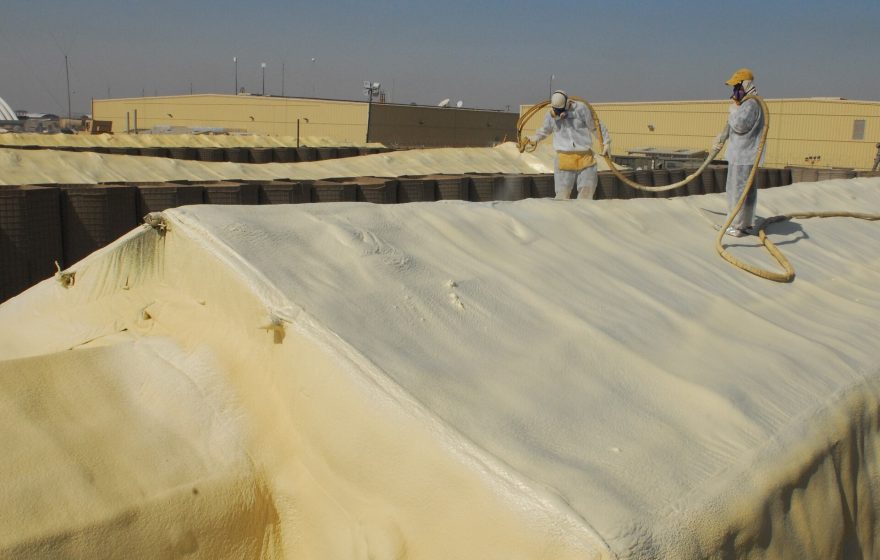
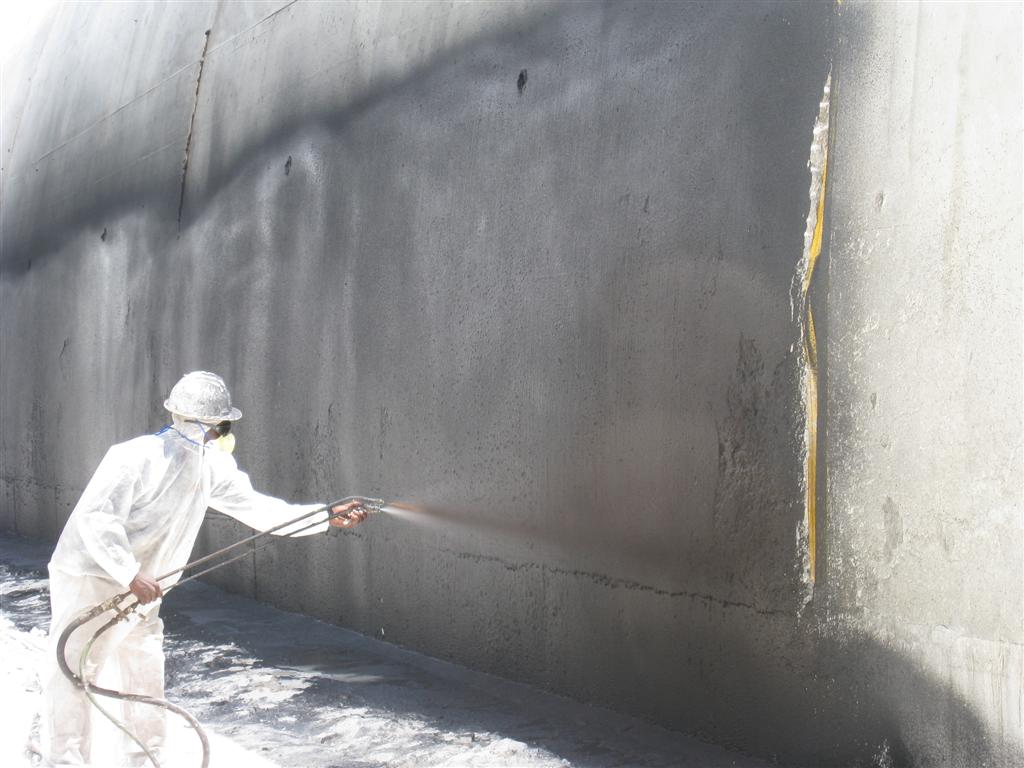
A liquid-applied waterproofing membrane is a fluid coating, sprayed, rolled or troweled onto a structure, that cures into a continuous elastomeric film able to resist water under hydrostatic or ponding conditions. Unlike sheet membranes, there are no seams to weld or lap, and the material adheres across its full area, which limits lateral water migration if the membrane is ever punctured.
These systems are widely used on foundation walls, split-slab plaza decks, podium decks, balconies, planters, green roofs, fountains and wet areas beneath tile. ASTM C836 is the commonly referenced specification for high-solids, cold liquid-applied elastomeric membranes used with a separate wearing course, and ASTM C898 is its companion installation guide. Exposed membranes that serve as the driving surface are a separate category covered in parking deck traffic coatings.
Where liquid membranes are used
Waterproofing is classified by which side of the structure it sits on relative to the water source:
- Positive side — the face exposed to water, such as the exterior of a foundation wall or the top of a plaza deck. Positive-side membranes keep water out of the concrete entirely and are the preferred approach for new construction.
- Negative side — the interior face, used when the exterior is inaccessible. Only certain cementitious or specially formulated products are suited to resisting water pushing from behind, and they do not protect the concrete itself.
- Blind side — applied before the structure is cast, for example against shoring. This is usually done with sheet products rather than liquids.
Liquid membranes are also used under tile in showers and commercial kitchens, and as linings for planters, reflecting pools and decorative water features.
Common membrane chemistries
| Chemistry | Strengths | Limitations | Typical uses |
|---|---|---|---|
| Polyurethane (one- or two-component) | High elongation, good crack bridging, roll or spray | Moisture-sensitive cure; some grades need UV protection | Plaza decks, balconies, foundations |
| Polyurea and hybrids | Cures in seconds; heavy build in one pass | Plural-component rig; sensitive to substrate outgassing | Large decks, fast-track work, tanks |
| Hot-applied rubberized asphalt | Thick, self-healing, long track record | Kettle on site; needs protection board | Plaza decks, podium and green roofs |
| Cold-applied asphalt emulsion / modified bitumen | Low cost, easy to apply | Lower elongation; not for high hydrostatic head | Foundation dampproofing to light waterproofing |
| Acrylic or polymer-modified cementitious | Water-based, low odor, tile-compatible grades | Lower build per coat; slower drying in cold, humid weather | Wet rooms, balconies, under-tile |
| Reinforced PMMA | Fast cure, cold-weather capable, fleece-reinforced | Strong odor; flammable components | Balconies, roof details, refurbishment |
For chemistry background see polyurethane coatings and polyurea coatings. Crystalline admixtures and sealers are sometimes marketed as waterproofing, but they treat the concrete pore structure rather than forming a crack-bridging membrane.
Liquid versus sheet membranes
Advantages
- No seams or laps, the most common leak points in sheet systems
- Conforms to penetrations, drains, curbs and irregular shapes
- Fully bonded, so leaks do not travel far beneath the membrane
- Easy to repair and to tie into existing work
Limitations
- Thickness depends on applicator skill and must be verified
- Cure is sensitive to weather, substrate moisture and temperature
- Substrate cracks and outgassing can telegraph into pinholes
- Lower puncture resistance than some reinforced sheets unless fabric-reinforced
Preparation and installation
Concrete should be cured, structurally sound and dry enough for the product chosen; manufacturers specify cure time and moisture limits, which may be checked with the methods described in concrete moisture testing. A typical installation sequence:
- Prepare the substrate. Remove laitance, form-release agents and curing compounds by grinding or light blasting; fill bugholes and honeycombing so the membrane is not stretched over voids.
- Prime. Apply the specified primer to seal porosity and reduce outgassing.
- Detail first. Treat cracks, cold joints, inside corners, drains and penetrations with sealant, fillets and reinforcing fabric embedded in a detail coat.
- Apply the field membrane. Apply in one or more coats to reach the specified minimum thickness, with each coat in a different direction where possible.
- Verify and test. Measure thickness, inspect for pinholes and blisters, then leak-test before covering.
- Protect. Install protection board, drainage composite, insulation or the wearing course promptly.
Thickness control and leak testing
Liquid membranes are commonly specified at roughly 40–120 mils (1–3 mm) depending on chemistry and exposure, often with an average and a minimum value. Wet film is checked continuously with notched gauges, as explained in wet film thickness measurement; some projects also take small cut samples or use ultrasonic gauges on cured film. Crack-bridging capability of candidate products can be compared with ASTM C1305.
Snap a grid on the deck and assign a measured quantity of material to each square. Spreading a known volume over a known area is the simplest way to guarantee average film build, while wet-film readings catch thin spots.
Before overburden is installed, horizontal membranes are usually flood tested in accordance with ASTM D5957, typically holding a shallow depth of water for a set period while the underside is checked. Electronic leak detection methods covered by ASTM D7877 locate breaches precisely and avoid loading the structure with water, but they generally require a conductive substrate beneath an electrically insulating membrane.
Protection and overburden
Most buried and split-slab membranes are not designed for UV exposure or traffic. Damage from backfill rocks, rebar chairs, wheelbarrows and following trades is one of the most common causes of leaks, so protection board is placed as soon as the membrane has cured. On plaza and green roofs, drainage composites relieve hydrostatic pressure, and insulation may be placed above the membrane in a protected-membrane configuration. Exposed waterproofing on low-slope roofs is a different design problem addressed in roof coatings.
Frequently asked questions
What is the difference between waterproofing and dampproofing?
Dampproofing resists moisture in the absence of hydrostatic pressure, such as soil moisture against a well-drained wall. Waterproofing is designed to resist water under pressure, so it is thicker, more elastic and more carefully detailed.
Can a liquid membrane be left exposed?
Only if the product is rated for exposure or is topcoated with a UV-stable layer. Many buried-grade membranes degrade quickly in sunlight.
Can you apply a liquid membrane to green concrete?
Some products tolerate young or damp concrete, but most require a minimum cure period and moisture limit. Check the product data sheet and perform an adhesion test patch.
How are leaks found after the membrane is buried?
It is difficult and costly, which is why flood testing or electronic leak detection is done before covering. Some projects install a permanent leak-detection grid beneath the membrane for later surveys.
Educational reference. Coating performance varies by formulation. Always follow the manufacturer’s product data sheet, safety data sheet and your project specification.