Parking Deck Traffic Coatings
Elastomeric membranes with built-in wearing surfaces that keep salt-laden water out of parking structures and withstand constant tire traffic.
Key takeaways
- Traffic coatings are waterproofing membranes with an integral wearing surface that keep chloride-laden water out of reinforced and post-tensioned concrete.
- A typical system layers a flexible base membrane, an aggregate-filled wear coat and a UV-stable topcoat, with heavier build in drive aisles, ramps and turns.
- Detailing of cracks, joints, drains and wall transitions decides as much of the outcome as the field membrane does.
- Concrete preparation, moisture checks and the timing of application (to limit outgassing) govern long-term bond.
- Wear coats are consumable; planned topcoat renewal keeps the base membrane intact for far longer.
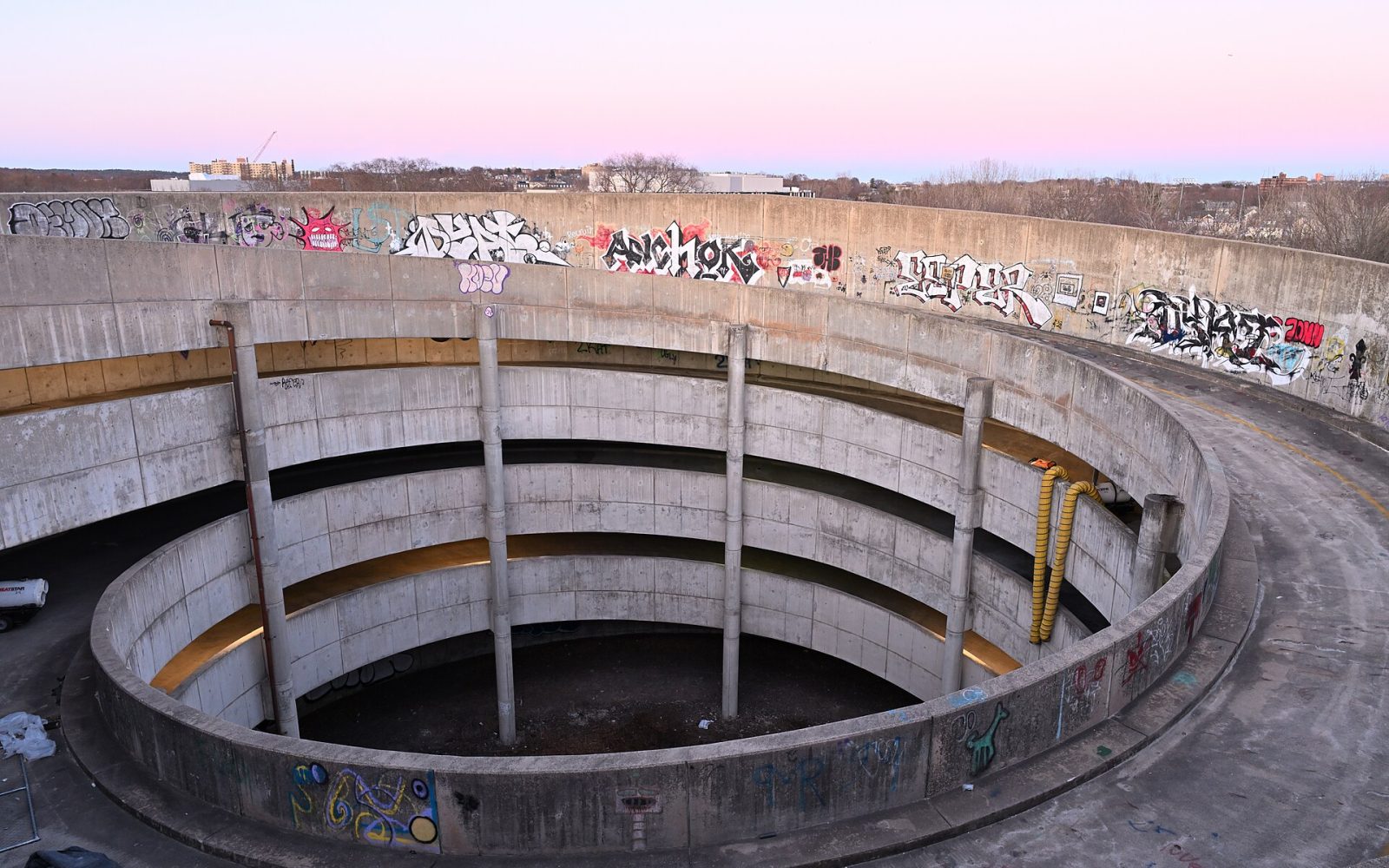
Parking structures take a punishing combination of loads: tire abrasion and scuffing, power steering turns, snowplow blades, oil drips, freeze–thaw cycling and, above all, water carrying deicing salts. Once chloride ions reach the reinforcing steel or post-tensioning tendons, corrosion begins, the rust occupies more volume than the original steel, and the concrete cracks and spalls. Repairs to a corroded deck are disruptive and expensive, so owners protect the slab before damage starts.
A traffic coating (also called a traffic-bearing membrane or vehicular deck coating) is a liquid-applied, crack-bridging elastomer topped with a wear-resistant, slip-resistant surface. ASTM C957 is the commonly cited material specification for high-solids, cold liquid-applied elastomeric waterproofing membranes with an integral wearing surface. On elevated decks over occupied or retail space, the coating doubles as the waterproofing that keeps water from dripping onto cars and people below.
Why parking decks need protection
Concrete is porous and almost always cracked to some degree from shrinkage, thermal movement and structural restraint. Each crack is a direct path for salt water to reach the steel. The mechanism is explained in corrosion science basics; in a parking structure the practical consequences are delaminated top surfaces, exposed rebar, leaking joints and, in post-tensioned decks, the risk of tendon failure.
Owners have three broad options for the riding surface:
- Penetrating sealers such as silanes and siloxanes reduce water absorption into sound concrete but do not bridge cracks.
- Elastomeric traffic membranes bridge existing and future hairline cracks and fully waterproof the surface.
- Rigid wear coatings (epoxy or MMA overlays) resist abrasion and chemicals but crack along with the slab.
Many decks combine approaches: full membranes on the roof level and over occupied space, sealers on lower supported levels, and membranes on ramps and in drive aisles where water and wear concentrate.
Types of traffic coating systems
| System | Strengths | Limitations | Typical use |
|---|---|---|---|
| Aromatic polyurethane base + aliphatic polyurethane top | Proven crack bridging, good elongation, wide range of duty levels | Moisture-sensitive during cure; slower return to service | Most vehicular and pedestrian decks |
| Polyurea or hybrid membrane | Very fast cure, high build in one pass, quick return to service | Requires plural-component equipment; aromatic grades need a UV-stable topcoat | Fast-track projects, ramps |
| Methyl methacrylate (MMA) | Cures in cold weather, traffic-ready within hours | Strong odor; requires careful ventilation and fire precautions | Winter work, occupied structures |
| Epoxy wear overlay | Hard, abrasion and chemical resistant | Not crack-bridging; can yellow outdoors | Interior levels, overlays on sealed decks |
Chemistry details are covered in polyurethane coatings and MMA resin systems.
How a vehicular system is built
Most manufacturers publish light-, standard- and heavy-duty build-ups for the same product family. While thicknesses vary by product, a typical polyurethane vehicular system looks like this:
- Primer (where required) to seal the concrete and improve adhesion.
- Base membrane, often about 20–30 mils (500–750 µm) dry, which provides waterproofing and crack bridging.
- Wear coat, roughly 15–25 mils (380–640 µm), with silica sand or aluminum oxide aggregate broadcast into the wet film.
- Topcoat, commonly 10–20 mils (250–500 µm), which locks in the aggregate and provides UV and color stability.
Heavy-duty zones such as entrance and exit lanes, ramps, turning radii, ticket booths and areas in front of elevators receive an extra wear coat and a coarser or denser aggregate. Pedestrian walkways and stair landings use lighter systems. Aggregate size and loading set both the slip resistance and how quickly the surface wears; see anti-slip coatings for the trade-offs. Always follow the manufacturer’s published build-up and spread rates.
Concrete preparation and testing
Shot blasting is the usual method on horizontal decks, typically to a concrete surface profile in the CSP 3–5 range of ICRI 310.2R, though the manufacturer sets the exact target. Preparation must remove laitance, curing compounds, old sealers, rubber tire marks and oil contamination; heavily oil-soaked areas may need degreasing, hot-water washing or removal. Spalls and delaminations are repaired with compatible patching mortars before coating.
New concrete is commonly allowed to cure at least 28 days. Moisture testing follows the manufacturer’s preferred method, which may include the plastic sheet test (ASTM D4263), and adhesion is confirmed on a test patch with pull-off testing per ASTM D7234. Background is covered in concrete surface preparation.
Detailing cracks, joints and transitions
Most traffic coating failures start at details rather than in the field. A typical sequence:
- Map and rout cracks. Cracks wider than a hairline are routed and filled with sealant or a flexible filler, then reinforced with a stripe of base membrane.
- Treat cold joints and control joints. Non-moving joints are sealed and pre-striped; working joints receive a sealant with a bond breaker so the membrane does not tear.
- Respect expansion joints. Structural expansion joints get a dedicated joint system; the membrane terminates into it rather than spanning it.
- Cove and turn up. At walls, columns and curbs, the membrane runs up the vertical face, typically several inches, over a sealant cove.
- Detail drains and penetrations. Membrane is carried into drain bodies and around penetrations so water cannot track beneath the edge.
Application conditions and outgassing
Most urethane membranes are sensitive to moisture and temperature during cure. Typical requirements are a substrate temperature at least 5 °F (3 °C) above the dew point, dry concrete, and no rain or heavy dew before the coat skins over.
Concrete exhales air as it warms. Coating a sunlit deck in the morning, when the slab temperature is rising, is a classic cause of pinholes and blisters. Many applicators coat in the afternoon or evening as the slab cools, and use a primer or sealer coat to reduce outgassing.
Each coat must be applied within the manufacturer’s recoat window, and traffic is held off until the full system reaches its specified cure. Fast-cure polyurea and MMA systems can shorten closures to hours, which often justifies their higher material cost in busy structures.
Inspection and maintenance
A traffic coating is a maintenance asset, not a one-time installation. Good practice includes washing decks each spring to remove accumulated salt, inspecting at least annually for worn wear coats, torn joint sealants and debonded areas, and repairing small defects promptly. When the topcoat in drive lanes wears thin, a wear-coat and topcoat renewal can be applied over the cleaned, abraded existing system, preserving the base membrane underneath. Snowplows with steel blades are a frequent cause of damage; rubber-edged blades and raised plow shoes help. Long-term budgeting is covered in coating maintenance planning.
Frequently asked questions
How long does a parking deck traffic coating last?
Service life depends on traffic, climate and maintenance. Wear coats in heavy drive lanes may need renewal after several years, while a well-maintained base membrane can last considerably longer when topcoats are renewed on schedule.
Can traffic coatings be applied to post-tensioned decks?
Yes, and they are frequently used there because tendon corrosion is so consequential. Any coring, grinding or anchoring must avoid the tendons, so locate them before work begins.
Is a penetrating sealer enough?
On sound, lightly cracked concrete with modest exposure, a sealer may be adequate. Over occupied space, on roof levels or where cracking is extensive, an elastomeric membrane is generally preferred because sealers do not bridge cracks.
Can parking decks be coated in winter?
Standard urethanes generally need moderate temperatures, but MMA and some fast-cure systems are formulated for cold conditions. Follow the product data sheet’s minimum substrate temperature and dew point limits.
Educational reference. Coating performance varies by formulation. Always follow the manufacturer’s product data sheet, safety data sheet and your project specification.