Pigment Volume Concentration (PVC) and CPVC
How pigment volume concentration is calculated, what the critical concentration means, and why particle packing, binder demand and formulation testing matter more than a universal cutoff.
Key takeaways
- PVC compares the volume of pigment and extender particles with the combined volume of those particles and nonvolatile binder.
- CPVC marks a formulation-dependent transition where binder is no longer sufficient to fill the particle network without voids.
- Equal pigment weights do not imply equal pigment volumes, and PVC is not the same quantity as volume solids.
- Neither PVC nor a calculated PVC/CPVC ratio is a stand-alone performance specification.
What pigment volume concentration describes
Pigment volume concentration (PVC) describes the particle fraction of a coating’s pigment–binder solids. It includes both prime pigments and extenders. In the conventional calculation, volatile water and solvent are excluded, and the binder contribution is its nonvolatile volume.
PVC (%) = 100 × Vp ÷ (Vp + Vb), where Vp is the combined volume of pigments and extenders and Vb is the nonvolatile binder volume.
This composition ratio should not be confused with the volume fraction measured against a porous film’s external dimensions, because air voids are not an ingredient in the conventional calculation. State the calculation basis when a formulation contains hollow particles, unusual additives or other components whose allocation is not obvious. The American Chemical Society chapter on fillers and pigment packing explains the connection between particle volume, binder demand and critical concentration.
A simple volume calculation
Consider an illustrative formulation with 12 L of pigment and extender solids plus 18 L of nonvolatile binder. Its PVC is 100 × 12 ÷ (12 + 18) = 40%. If 20 L of volatile carrier is then included, the conventional PVC remains 40%; the particle-to-binder solids ratio has not changed. Under a simple additive-volume assumption, that mixture has 30 L of nonvolatile ingredients in 50 L of wet material, or 60% volume solids. Actual measured volume solids can differ from an ingredient-volume estimate.
This example is arithmetic, not a coating recipe or an experimental result. PVC asks how the dry solid ingredients are divided between particles and binder. Volume solids asks how much of the wet coating volume remains after the specified drying process. Coverage calculations use the latter. See volume solids and coverage for that separate calculation.
When the formulation is recorded by mass, convert each relevant ingredient using its appropriate density before adding volumes. For example, 10 kg of an idealized pigment with density 4 kg/L occupies 2.5 L, whereas 10 kg at 2 kg/L occupies 5 L. A one-for-one mass replacement therefore changes PVC unless other quantities are adjusted. These chosen densities are illustrative, not values assigned to particular commercial grades.
What changes at the critical concentration
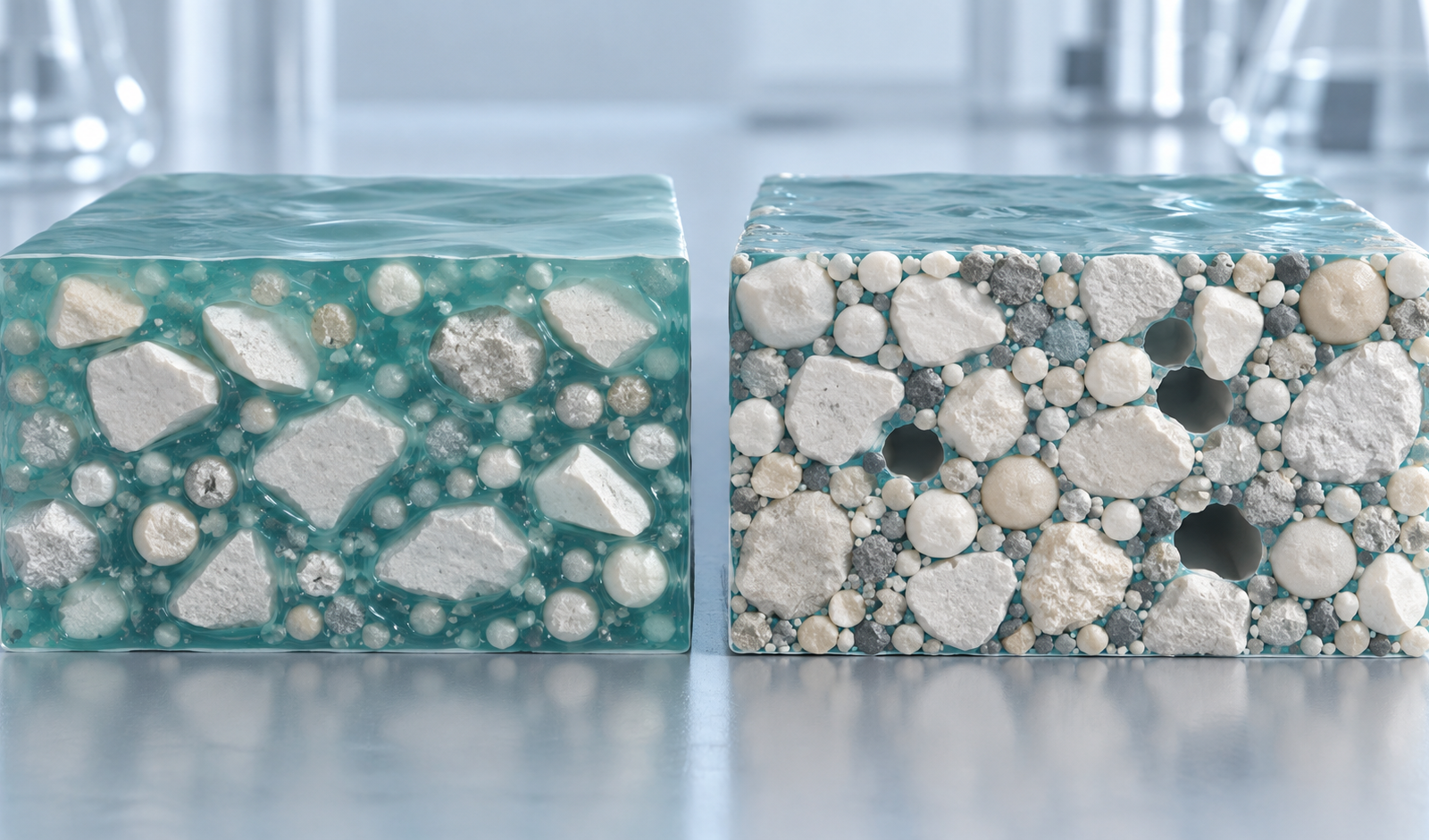
The critical pigment volume concentration (CPVC) describes the point at which the available binder just satisfies the particle system’s binder demand. Above that point, voids appear in the developed film because the polymer cannot fully occupy the interparticle structure. The transition can be detected through changes in porosity-related properties or by observing film morphology; it need not appear as one perfectly sharp boundary in every measurement.
Wang and colleagues’ research on fluorescence microscopy for CPVC determination describes experimental approaches based on property changes and void detection. The authors also note that nonuniform dispersion can produce local voids even below the bulk critical concentration. Finding one pore therefore does not necessarily locate the whole formulation’s CPVC. The important implication is that CPVC should be tied to the actual material system and the method used to identify it.
A higher particle loading can reduce gloss as the surface becomes less smooth, and voids can increase liquid or vapor transport. Dry hiding may rise when air contributes additional scattering, even while other properties deteriorate. The balances depend on pigment type, particle distribution, dispersion and film formation. Omya’s opacity technical brochure describes both particle spacing and the optical contribution of porosity.
Why there is no universal CPVC
Particles differ in size, size distribution, shape, surface characteristics and tendency to agglomerate. Those differences alter their packing and the binder volume needed to integrate them into a film. A mixture can pack differently from either ingredient alone. Binder–particle interactions also matter; a change of pigment surface treatment or polymer chemistry can change film structure even when the nominal PVC is unchanged.
In a study of calcium-carbonate/latex blends, Tang and colleagues found that changing the latex-particle surface chemistry affected pigment distribution and film gloss. Its measured critical concentration belongs to that experimental system; it is not a general value for all calcium carbonate paints. This is why a supplier’s particle data or another formulation’s CPVC cannot automatically become a finished coating limit.
Oil absorption: useful screening, limited inference
Oil absorption characterizes how much vehicle a pigment requires in a defined paste-forming test. ASTM D281-12(2021) uses a spatula rub-out procedure. ASTM’s public description also distinguishes it from the gentler procedure in D1483; the endpoints and resulting values differ. Always retain the method alongside an oil-absorption value. ASTM D281.
Oil-absorption data can support a theoretical estimate of binder demand, but the oil used in the test is not every coating binder, and a paste endpoint is not a complete film-performance assessment. Treat estimated CPVC as a formulation aid that needs experimental checks in the intended system. Particle wetting, dispersion quality and the film-formation route remain relevant.
Reduced PVC and performance decisions
The ratio PVC/CPVC is often called reduced PVC or expressed as lambda. A ratio below one places the formulation below its assigned critical point; a ratio above one places it above. It can organize comparisons within a coherent experimental program, but the ratio inherits uncertainty in CPVC and does not encode every chemical or mechanical difference between coatings.
Rodríguez and colleagues investigated this ratio in an epoxy-primer system using mechanical testing, electrochemical methods and accelerated exposure. Their published study demonstrates the need to evaluate multiple properties rather than infer corrosion resistance from composition alone.
Dense barrier coatings often benefit from avoiding interconnected porosity, while some deliberately porous or highly filled coatings pursue other functions. High pigment loading is therefore not automatically a formulation error. The appropriate question is whether the complete coating meets its intended performance requirements at the specified thickness and conditions. Compare gloss, hiding, cohesion, liquid uptake and relevant exposure performance as separate outcomes.
What to document
Record the complete formulation basis, pigment and extender volumes, binder solids and density assumptions, treatment of special ingredients, dispersion and application conditions, dry-film thickness, cure or conditioning, the CPVC estimation or measurement method, and the properties used to judge the result. Keep theoretical calculations distinguishable from measured values.
For applicators and specifiers, PVC is chiefly a tool for understanding formulation behavior. It does not authorize adding fillers, tinting with unapproved materials or changing the supplied binder ratio. The finished product’s instructions and qualification data remain the basis for use. The companion pigments and fillers entry describes the roles of different particle families.
Public technical references checked October 14, 2026. The cover is a conceptual cutaway, not to scale and not a measured composition.
Educational reference. Coating performance varies by formulation. Always follow the manufacturer’s product data sheet, safety data sheet and your project specification.