Minimum Film-Forming Temperature (MFFT)
What MFFT measures in polymer dispersions, how a temperature-gradient bar is interpreted, and why the result differs from glass transition and a coating’s field application limits.
Key takeaways
- MFFT is a film-formation threshold measured under specified conditions for a polymer dispersion.
- It is related to, but different from, glass-transition temperature and the minimum application temperature on a finished coating’s data sheet.
- Coalescent level, formulation and the chosen endpoint affect interpretation.
- A continuous film on a test bar does not establish full cure, weather resistance or readiness for immersion.
Definition and scope
Minimum film-forming temperature (MFFT) is the lowest temperature at which a polymer dispersion forms an adequately continuous film under the conditions of a defined test. The term is particularly relevant to waterborne latex binders and coatings. It describes the physical ability of dispersed polymer particles to join during drying, rather than the completion of every chemical reaction in the coating.
ISO 2115:1996 addresses both white-point temperature and minimum film-forming temperature of polymer dispersions. These are separate endpoints. A change from an opaque deposit to a transparent region is not automatically the same observation as a continuous, homogeneous, crack-free film. Pigmentation can obscure the optical change further. ISO 2115 remains the published edition listed by ISO when checked for this entry.
Why a latex needs sufficient temperature
As water leaves a latex coating, polymer particles become concentrated and meet. To produce a coherent layer, they must deform and develop contact across particle boundaries. A polymer that is too rigid under the drying conditions may leave an incompletely integrated deposit. The result can be a weak, powdery or cracked region rather than the intended film.
This is a different mechanism from a dissolved polymer simply remaining after its solvent evaporates. It is also different from a two-component resin reacting to form a network, although a waterborne formulation may combine coalescence and later crosslinking. The broader mechanisms are discussed in film formation and how coatings cure.
How a temperature-gradient bar works
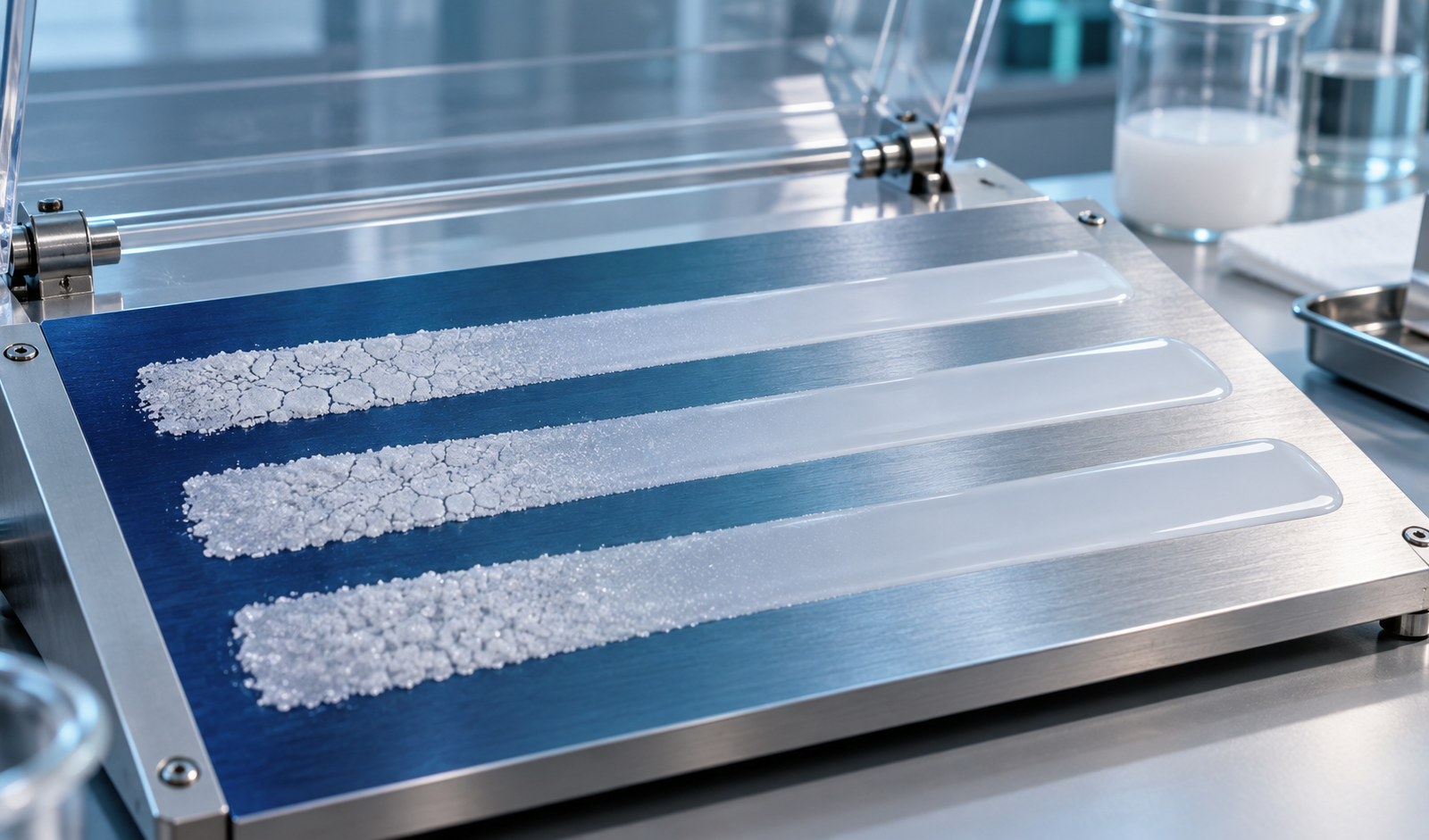
A typical MFFT instrument maintains a controlled temperature gradient along a metal platen. Thin tracks of the specimen cross that gradient. Once the material has dried under the specified conditions, the operator locates the relevant transition along each track and relates that position to the measured platen temperature. This allows one drawdown to sample a range of temperatures.
The selected range must bracket the transition. A track that is coherent over its entire length establishes only that the threshold is at or below the coldest tested temperature; a track that fails throughout does not locate the threshold either. The platen must be stable, and the instrument’s temperature checks, film application and endpoint instructions must be followed. Rhopoint’s instrument description explains the gradient arrangement and visual interpretation.
ASTM D2354-10(2023) is the current reapproval listed in ASTM’s coatings standards catalogue for MFFT of emulsion vehicles. Its scope concerns coalescence of emulsion and latex vehicles. A test report should identify the actual edition and procedure used; a general description of a gradient bar is not evidence that a specimen was tested in compliance. ASTM’s coating standards catalogue.
MFFT is not the same as Tg
Glass-transition temperature, Tg, describes a change in polymer segmental mobility. MFFT describes whether a dispersion can form a film during a specified drying experiment. The two are related, but the dispersion also contains water and may contain coalescing aids or other ingredients that affect the developing film. Particle architecture and the route from wet dispersion to dry film matter.
Consequently, a dry polymer’s Tg should not be substituted for an MFFT measurement. Nor should a low MFFT be read as proof that the mature coating will be soft at all service temperatures. Rhopoint’s MFFT explanation explicitly distinguishes the quantities. See also glass transition in coatings.
Coalescents and formulation trade-offs
Coalescing aids facilitate particle deformation by increasing polymer mobility during drying. Conventional volatile coalescents can soften the particles temporarily and subsequently leave the film. Their effectiveness depends on the polymer and formulation; one dosage cannot be transferred confidently between unrelated latexes. Eastman’s technical account of latex coalescence describes this mechanism and the relationship with polymer Tg.
A binder-plus-coalescent screening series is a starting point, not the final paint qualification. Pigments, other formulation ingredients and drying conditions can alter the amount required for acceptable finished-film performance. Evaluate the complete coating at several appropriate levels and assess the properties that matter to its intended use. Eastman’s coalescent formulation guidance makes this distinction between initial MFFT screening and paint optimization.
Some low-volatility coalescing aids remain in the coating. Depending on the system and loading, this can affect hardness development or resistance to blocking, where contacting coated surfaces stick together. Therefore, “lower MFFT” is not an unlimited optimization target. The manufacturer’s discussion of volatile and nonvolatile coalescent blends illustrates why film formation and final properties must be balanced. These supplier examples explain mechanisms; they are not universal dosage recommendations.
Reading pigmented films and reporting results
An opaque paint may not reveal the same clear-to-cloudy transition as an unpigmented binder. An observer may need the method’s film-integrity criteria rather than color alone. Rhopoint’s operating manual describes the additional difficulty of interpreting pigmented emulsions. Do not invent an endpoint or report more precision than the transition and instrument justify.
A useful report identifies the material and batch, whether it is a neat binder or complete formulation, additions and equilibration, drawdown thickness, platen range, temperature verification, drying atmosphere, substrate or release layer, endpoint criterion, repeat results and any ambiguous transition. Retain an image or specimen record that shows where the endpoint was assigned. This checklist supports interpretation and does not replace the selected standard.
What the number means on a job
The application limits on a finished product’s data sheet govern field use. MFFT alone does not include every constraint imposed by substrate temperature, evaporation, humidity, condensation, film build or the need for later chemical cure. A surface can also cool during the drying period. A laboratory threshold must not be used to justify applying outside the manufacturer’s instructions.
Similarly, a film that appears continuous has not necessarily developed its specified adhesion, water resistance, hardness or chemical resistance. Those are separate performance questions. MFFT is most useful for comparing film-formation behavior under controlled conditions and investigating whether inadequate coalescence is a plausible contributor to a problem.
Public technical references checked October 14, 2026. The cover illustrates the gradient-bar principle and is not an actual test record.
Educational reference. Coating performance varies by formulation. Always follow the manufacturer’s product data sheet, safety data sheet and your project specification.