Salt Spray & Cyclic Corrosion Testing
What accelerated corrosion tests such as ASTM B117, ISO 9227 and modern cyclic protocols can and cannot tell you about how a coating will perform in the field.
Key takeaways
- Neutral salt spray (ASTM B117, ISO 9227) exposes panels to a continuous warm salt fog; it is reproducible and useful for quality control, but correlates poorly with most real environments.
- Cyclic tests alternate wet, dry, UV and sometimes freezing conditions, and generally rank coatings more like field exposure does.
- Panels are judged on scribe creep, blistering and rusting using standards such as ISO 4628 and ASTM D1654, D714 and D610.
- Test hours do not convert into years of service. Compare products only when they were tested on the same protocol.
Real-world corrosion takes years. Coating developers, specifiers and quality-control laboratories need answers in weeks. Accelerated corrosion tests bridge that gap by exposing coated panels to conditions far harsher, or far more constant, than nature provides. Used well, they screen out weak formulations, qualify systems to a specification and catch production problems. Used badly — especially when hours are quoted as if they were years — they mislead.
Neutral salt spray (ASTM B117 and ISO 9227)
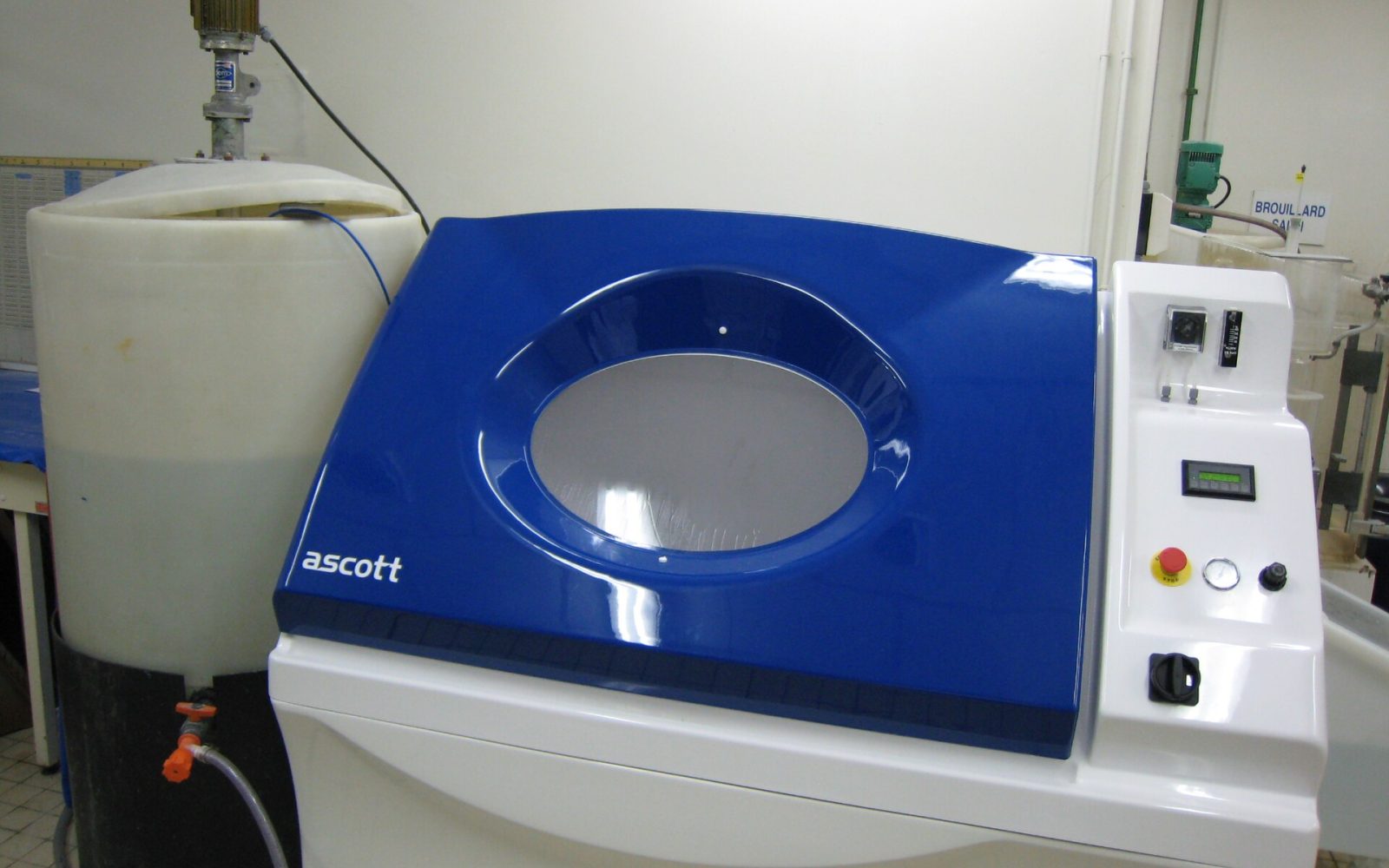
The oldest and most widely quoted test places coated panels in a closed cabinet filled with a fog of atomised salt solution. ASTM B117 and the neutral salt spray (NSS) method of ISO 9227 are broadly similar:
- Salt solution of about 5% sodium chloride by mass (50 g/L under ISO 9227)
- Collected solution pH between 6.5 and 7.2
- Cabinet temperature of 35 °C (95 °F)
- Fog collection rate of 1–2 mL per hour over an 80 cm² collecting area
- Panels supported at a specified angle from vertical, exposed continuously, typically for hundreds to a few thousand hours
ISO 9227 also defines two acidified variants used mainly for decorative and metallic finishes.
| Method | Solution | pH | Temperature | Typical use |
|---|---|---|---|---|
| NSS (neutral) | 5% NaCl | 6.5–7.2 | 35 °C (95 °F) | Organic coatings, metallic coatings, QC |
| AASS (acetic acid) | 5% NaCl + acetic acid | 3.1–3.3 | 35 °C (95 °F) | Decorative copper–nickel–chromium plating, anodising |
| CASS (copper-accelerated) | 5% NaCl + acetic acid + copper(II) chloride | 3.1–3.3 | 50 °C (122 °F) | Rapid testing of decorative plating |
Cyclic corrosion testing
Outdoors, coatings get wet and dry, are heated by the sun, degraded by UV, and in many climates freeze. The wet–dry transitions matter: as a salt film dries, its concentration rises sharply, and oxygen reaches the steel more easily. Constant fog misses all of this. Cyclic tests attempt to reproduce the mechanisms, not just the salt.
- ASTM D5894 alternates one week in a fluorescent UV/condensation cabinet with one week of cyclic fog and dry-off using a dilute solution of sodium chloride and ammonium sulfate — a protocol aimed at industrial maintenance coatings.
- ISO 12944-9 (which superseded ISO 20340) qualifies systems for CX offshore exposure with a weekly cycle of 72 hours UV/condensation, 72 hours neutral salt spray and 24 hours at −20 °C (−4 °F), typically repeated for 25 cycles (4,200 hours). Systems for immersion with cathodic protection are also checked for cathodic disbondment.
- ISO 11997-1 specifies several wet/dry/humidity cycles for coatings, and automotive programmes use cyclic methods such as SAE J2334.
These tests generally reproduce the rust creep and blistering seen in service more faithfully than continuous fog, and they are less likely to rank coating systems in the wrong order. See ISO 12944 corrosivity categories for how such testing ties into system selection.
Panel preparation and scribing
Results depend as much on the panels as on the cabinet. A meaningful test controls:
- Substrate. Use the same steel, galvanizing or aluminium as the real structure, prepared to the same standard and profile.
- Application. Apply the full system at the specified dry film thickness, and measure and record DFT on every panel.
- Cure. Condition panels for the time and temperature specified before exposure; undercured films perform poorly.
- Edges and backs. Protect edges and reverse faces so that corrosion starts only where intended.
- Scribe. Cut a scribe through the coating to the substrate as described in ISO 17872 or ASTM D1654, to simulate damage and measure undercutting.
- Replicates. Expose multiple panels per system, plus a known reference system, so results can be judged against scatter.
Evaluating test panels
After exposure, panels are rinsed, inspected and rated using recognised scales:
- Scribe creep — the width of undercutting and rust creep from the scribe, measured per ASTM D1654 or ISO 4628-8, often after removing loose coating.
- Blistering — size and density per ASTM D714 or ISO 4628-2. See blistering for causes.
- Rusting — the percentage of rusted area per ASTM D610 or rust degree per ISO 4628-3.
- Adhesion — pull-off values before and after exposure, as used in ISO 12944-6 and -9 qualification.
When a data sheet quotes salt spray hours, ask for the full report: substrate, surface preparation, DFT, cure schedule, scribe method and the actual ratings at the end. “Passed 3,000 hours” means little without knowing what was rated and against what criteria.
Limitations and field correlation
Continuous salt fog never lets the panel dry, delivers no UV, and holds a single temperature. The result is that some coating types are favoured and others penalised. Zinc-rich and galvanized systems are a well-known example: their protective zinc corrosion products depend on wet–dry cycling, so continuous fog tends to understate their real-world performance relative to barrier coatings. Rankings from B117 can therefore differ from — and sometimes reverse — rankings from outdoor exposure or cyclic testing.
Advantages
- Widely available and well standardised
- Good for batch-to-batch quality control and spotting gross defects
- Cyclic methods rank systems more realistically
Limitations
- No reliable conversion from test hours to field years
- Continuous fog can mis-rank zinc-rich and galvanized systems
- Results are sensitive to panel preparation and cabinet control
Claims such as “1,000 hours of salt spray equals 10 years outdoors” have no recognised technical basis. Field life depends on the environment, design, surface preparation and maintenance, not on a cabinet multiplier.
Using test data wisely
Accelerated tests are most valuable when they are comparative: several candidate systems, prepared identically, run side by side with a reference system of known field history. For specifications, cite a defined protocol (for example ISO 12944-6 for atmospheric exposure up to C5, or ISO 12944-9 for CX and Im4) rather than a bare number of hours. For marine and offshore work and other severe exposures, combine cyclic test data with documented field track records. The underlying electrochemistry is explained in corrosion science basics.
Frequently asked questions
How many years does 1,000 hours of salt spray represent?
There is no valid conversion. The relationship between cabinet hours and field life varies with coating type, substrate and environment, so salt spray hours should be used only to compare systems tested the same way.
Is ASTM B117 the same as ISO 9227?
The neutral salt spray method in ISO 9227 is very similar to ASTM B117 in solution, pH and temperature, but the documents differ in detail. Specify the one your project requires.
Why do zinc-rich primers sometimes look poor in salt spray?
Zinc protects steel partly by forming stable corrosion products during wet–dry cycles. In constant fog these products do not stabilise the same way, so zinc is consumed faster and white corrosion products appear sooner than in service.
What is the most realistic accelerated test?
Cyclic tests that include wet, dry and UV phases generally correlate better than continuous fog, but long-term outdoor exposure at a representative site remains the most reliable evidence.
Educational reference. Coating performance varies by formulation. Always follow the manufacturer’s product data sheet, safety data sheet and your project specification.