Coating Masonry & Concrete Block
How to assess, prepare and coat concrete block, brick and stone — managing moisture and alkalinity, filling porous CMU and choosing breathable or high-performance systems.
Key takeaways
- Concrete block, brick and stone are porous, alkaline and full of voids, so coatings must tolerate moisture vapor and high pH while bridging an open texture.
- New mortar and block need time to cure and dry before most coatings; many manufacturers call for around 28 days or a specified pH or moisture level.
- Block fillers close the pores of concrete masonry units (CMU) so topcoats form a continuous film; breathable sealers and water repellents protect without forming a film.
- Most masonry coating failures trace back to water — rising damp, leaks, poor flashing or condensation — rather than to the coating itself.
Masonry covers concrete masonry units (CMU or concrete block), clay brick, stone and the mortar that binds them. It is found in warehouses, schools, food plants, retaining walls, foundations and below-grade spaces. Coatings on masonry provide weather resistance, cleanability, sanitation, chemical resistance or simply color and light reflection.
Masonry shares much with cast-in-place concrete — alkalinity, porosity and moisture — but adds its own problems: open, rough block faces, thousands of mortar joints, cores that hold water, and a surface that can absorb a coating like a sponge. This article focuses on block and brick walls; for slabs and poured concrete see coating concrete.
Masonry types and their behavior
| Substrate | Surface character | Main coating concerns | Common approach |
|---|---|---|---|
| Standard CMU | Open, porous, rough | Pinholes, high absorption, alkalinity | Block filler + acrylic or epoxy topcoat |
| Split-face or ground-face block | Textured, decorative | Appearance change, water entry | Clear water repellent or breathable stain |
| Clay brick | Dense units, porous joints | Efflorescence, trapped moisture | Water repellent, or breathable masonry coating |
| Natural stone | Varies widely | Staining, moisture trapping, appearance | Usually penetrating sealer only |
| Mortar joints | Softer, more porous | Cracking, differential absorption | Repoint before coating |
Moisture, alkalinity and efflorescence
Water is the controlling factor. Masonry walls take on rain, ground moisture and interior humidity, and they release it as vapor. A coating that blocks vapor on the wrong side of a wet wall can blister or peel; a coating that is not alkali-resistant can be destroyed by saponification. Dissolved salts carried to the surface by evaporating water crystallize as white deposits — efflorescence — which can push coatings off from beneath.
Assessing moisture
- Look for staining, damp patches, efflorescence and failed sealant or flashing.
- Use a moisture meter suited to masonry for comparative readings across the wall.
- Tape a clear plastic sheet to the surface (ASTM D4263) and check for condensation underneath after the test period as a simple qualitative check.
- For below-grade walls, find out whether there is any exterior waterproofing; without it, hydrostatic pressure from outside will act on any interior coating.
Coating the interior of a below-grade wall that leaks will not stop the water — it will usually just move the failure. Fix drainage, cracks and leaks first, and use only products specifically rated for negative-side (back-side) water pressure where that is the intent.
Surface preparation
- Let it cure. New block and mortar should generally cure for about 28 days, or until the coating manufacturer’s moisture and pH limits are met.
- Repair. Rake out and repoint cracked or soft mortar, patch spalls and voids with a compatible repair mortar, and route and seal moving cracks with a flexible sealant.
- Remove contaminants. Brush or wash off dirt, loose material, efflorescence and laitance. Remove form oil, mildew (with a suitable cleaner) and any chalky or failing old coating.
- Clean appropriately. Low-pressure washing, brush-off abrasive blasting or waterjetting are used for heavily soiled or previously coated walls. Avoid pressures that erode mortar joints or the block face.
- Dry. Allow the wall to dry thoroughly after washing before applying film-forming coatings.
Acid washing can remove mortar smears and efflorescence but leaves soluble salts behind if not neutralized and rinsed thoroughly, and it can etch or stain some masonry. Use it with care and only where the coating manufacturer permits.
Block fillers and primers
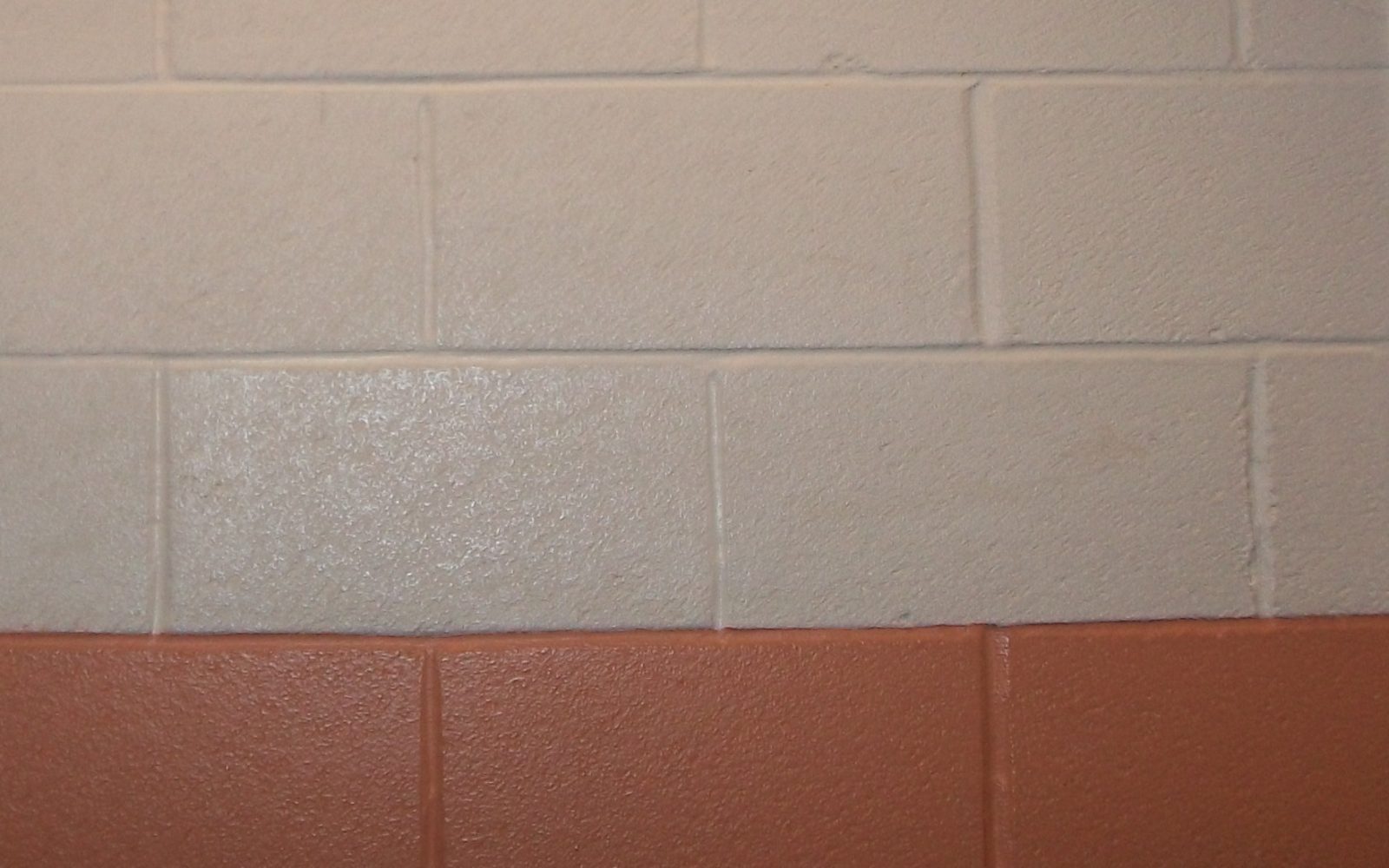
Standard CMU has so many pores and pinholes that a topcoat alone will not form a continuous film. A block filler — a heavy-bodied, highly filled primer — is applied first and worked into the surface to close the pores.
- Acrylic latex block fillers — common for interior and exterior architectural walls; breathable and alkali-resistant.
- Epoxy block fillers — for high-performance systems in food plants, washdown areas and correctional facilities, under epoxy or polyurethane topcoats.
- Cementitious fillers and parge coats — used to level very rough block or to fill before waterproof coatings.
Spray the block filler and immediately backroll it to drive material into the pores. Spray alone tends to bridge pinholes, which then open up as tiny voids in the finish coat. Inspect in raking light before topcoating.
Coverage on CMU is much lower than on smooth surfaces because of texture and absorption, and the filler’s spread rate on the data sheet already assumes a rough surface. Estimate quantities with the coverage calculator and adjust for block texture.
Coating systems
Breathable, non-film-forming
Penetrating silane and siloxane water repellents line the pores of the masonry and repel liquid water while letting vapor out. They do not change appearance much and are often preferred for brick and decorative block exteriors.
Breathable film-formers
Acrylic masonry paints and high-build elastomeric wall coatings form a film that sheds rain and, in the case of elastomerics, bridges fine cracks. They allow some vapor transmission, which is important on exterior walls.
High-performance film-formers
Epoxy and polyurethane systems provide hard, cleanable, chemical-resistant finishes for interior walls in industrial and sanitary environments. They are relatively low in vapor permeability, so the wall must be dry and not subject to significant moisture from behind.
Common failures
- Blistering and peeling — moisture moving through the wall behind a low-permeance coating.
- Efflorescence under or through the coating — water carrying salts from within the masonry.
- Pinholes — inadequate block filling or spray-only application.
- Cracking along mortar joints — structural or thermal movement, not addressed with control joints or flexible coatings.
- Uneven sheen or color (flashing) — differing absorption between mortar and block or patched areas.
Frequently asked questions
Do I need a block filler on concrete block?
For a continuous paint film on standard CMU, yes. Without it, pinholes remain in the finish and coverage of the topcoat is poor. Split-face or decorative block is often treated with clear sealers instead.
Can I paint brick?
Brick can be coated with breathable masonry coatings, but it is a long-term commitment and may trap moisture if the wrong product is used. Many owners prefer a penetrating water repellent that preserves appearance.
How long should new block cure before painting?
A common guideline is about 28 days, but follow the coating manufacturer’s requirements for moisture content or surface pH.
Will a coating waterproof a leaking basement wall?
Usually not on its own. Address drainage and cracks first and use products specifically designed for negative-side water pressure where needed.
Educational reference. Coating performance varies by formulation. Always follow the manufacturer’s product data sheet, safety data sheet and your project specification.