Tensile Strength and Elongation of Coating Free Films
What free-film tensile strength, elongation and stiffness measure, how test conditions affect comparisons, and why these results do not replace adhesion or crack-bridging evidence.
Key takeaways
- Tensile testing describes a coating film’s response to pulling.
- Strength, elongation and stiffness answer different questions.
- Compare results only when methods and test conditions match.
- Free-film results need separate adhesion, tear and crack-bridging evidence.
What tensile strength and elongation mean
Tensile strength and elongation describe how a cured coating film carries a pulling load and stretches before rupture. A free-film test examines the coating without a supporting substrate. It helps characterize the film material, while an installed coating also depends on its bond and surrounding system.
Engineering stress is force divided by the specimen’s original cross-sectional area; elongation is the increase in a defined gauge length expressed as a percentage of its original length. Strength concerns the stress sustained, while stiffness concerns resistance to deformation. The stress–strain curve adds context beyond a single endpoint. ZwickRoell’s tensile-testing overview explains these measurements.
Which test method applies?
Organic coating films
ASTM D2370-16(2021) covers elongation, tensile strength and stiffness of organic coatings tested as free films. Its catalog identifies specimen preparation, thickness, gauge length, loading rate, instrument response and grips as factors affecting comparisons. ASTM also identifies these measurements as useful for investigating changes associated with aging and weathering.
In outline, a prepared film specimen is aligned between grips and stretched at a controlled rate until rupture. Force and elongation are recorded. This is an overview, not a complete laboratory procedure; preparation and operating details must follow the applicable standard. ADMET’s D2370 guide describes the basic arrangement.
Rubbery and elastomeric materials
ASTM D412-16(2021) addresses vulcanized thermoset rubbers and thermoplastic elastomers. It includes dumbbell/straight-section and ring methods, whose results are not identical. Choose the method required for the material and specification; citing D412 does not make a result interchangeable with D2370.
Limits of interpretation
A larger strength or elongation number does not establish the better coating for every application. ASTM D412 cautions that tensile properties alone may not represent overall end-use performance. Temperature, extension rate, humidity, geometry and conditioning affect results. Comparisons therefore need matching conditions and a defined application requirement, rather than a universal pass mark. See ASTM D412’s significance and use.
- Adhesion: Pull-off testing loads a coating system perpendicular to its substrate. Failure can occur at different interfaces or within layers; free-film tension cannot establish this system property. ASTM D4541
- Tear: Tear methods examine resistance to tearing using specified specimen geometries. They answer a different question from ordinary tensile strength. ZwickRoell’s D624 explanation
- Crack bridging: This concerns membrane integrity across a substrate crack. ASTM C1305/C1305M examines that behavior at low ambient temperatures; free-film elongation cannot replace this test. ASTM C1305/C1305M-25
Measurement method matters, too. Crosshead movement can include extension outside the gauge length. Identify how strain was measured before comparing percentages. Instron’s D412 guide explains this limitation.
Practical reporting checklist
The following is an editorial checklist for reviewing a report, not a substitute for the standard’s reporting requirements:
- Identify the coating, batch, preparation, cure schedule and age at testing.
- State the standard edition, specimen shape, dimensions, thickness and gauge length.
- Record conditioning, test temperature, humidity, extension rate and any prior exposure.
- Identify grips and strain measurement; distinguish peak stress from stress at break where relevant.
- Give units, individual results, replicate count, summary statistics and observed failure locations.
- State the comparison or acceptance requirement and keep service-life claims separate from measured results.
Frequently asked questions
Does high elongation mean high adhesion?
No. Elongation describes stretching; adhesion testing examines the bonded coating system.
Can two datasheet values be compared directly?
Only after checking the method, specimen preparation and test conditions. Missing details make the comparison uncertain.
Does 100% elongation mean complete elastic recovery?
No. It means the measured length increased by its original length. Recovery requires separate evidence; stretching can leave residual deformation. ASTM D412 discusses tensile set.
At a glance
- Test object: Cured free coating film
- Main outputs: Tensile stress, elongation and stiffness
- Typical units: MPa and percent
- Coating standard: ASTM D2370
- Comparison basis: Matching methods and conditions
Related reference: adhesion testing, impact and flexibility testing and product data sheets.
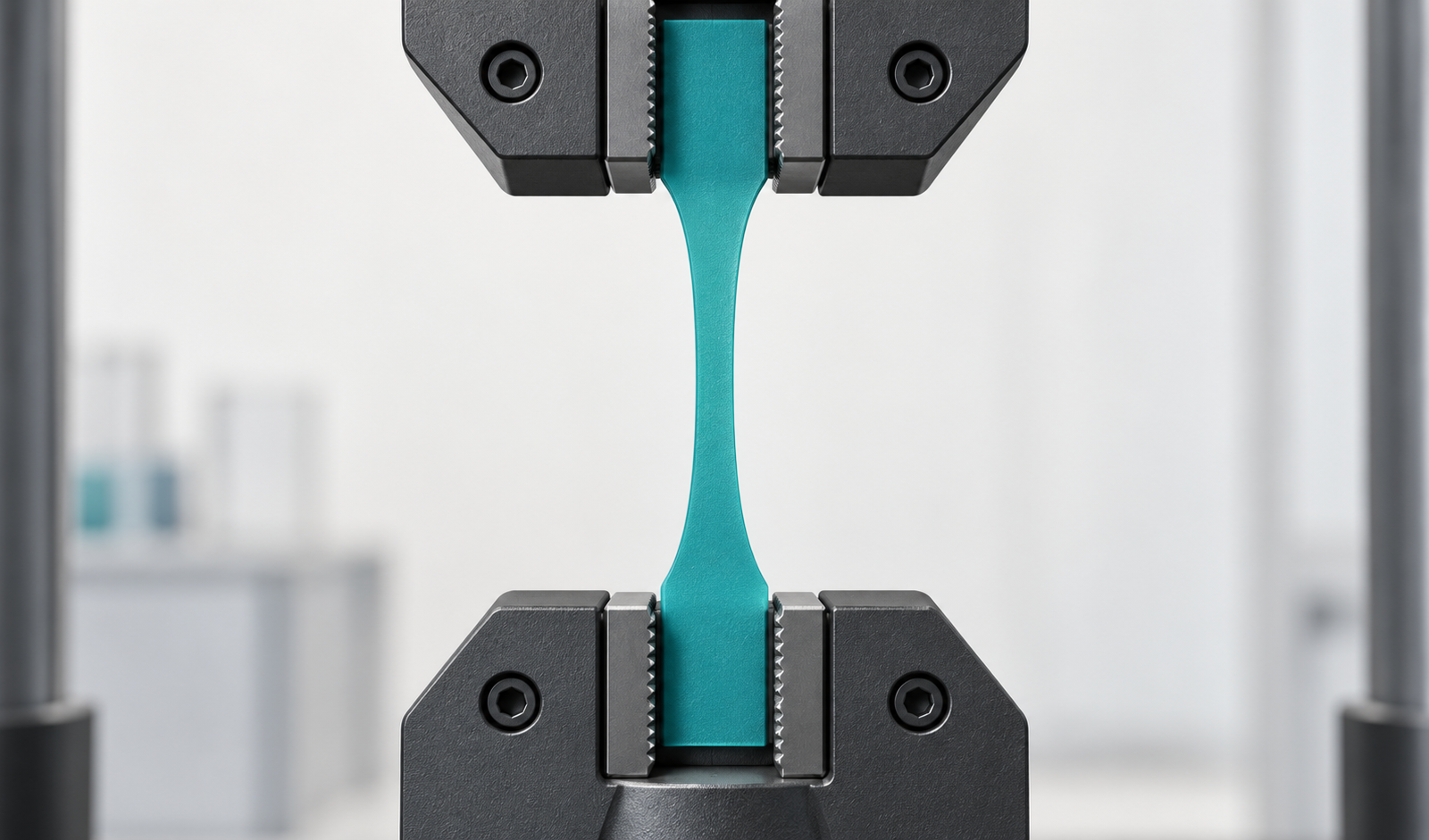
Educational reference. Use the applicable full standard, instrument instructions and project specification. Cover: original AI-generated illustration; it does not depict a recorded test.
Educational reference. Coating performance varies by formulation. Always follow the manufacturer’s product data sheet, safety data sheet and your project specification.