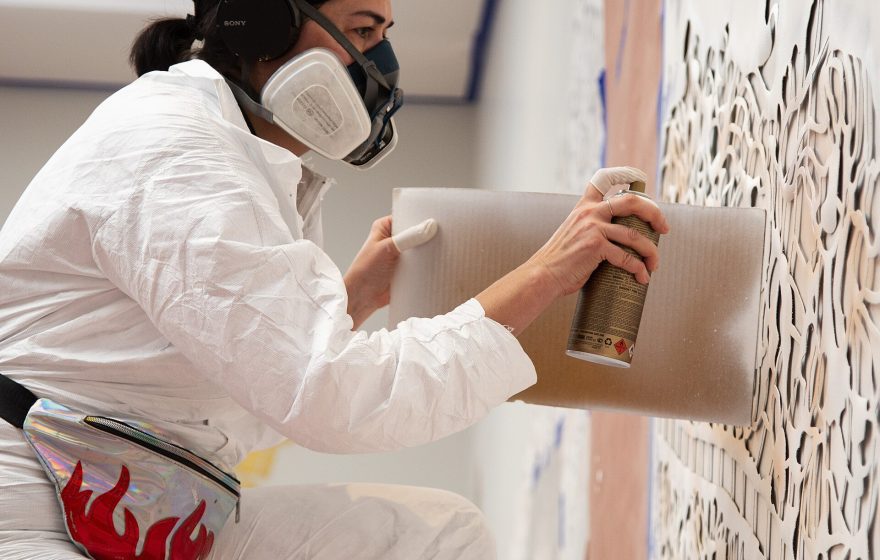
Air-Assisted Airless Spray
Air-assisted airless spray atomizes coating with moderate fluid pressure through an airless tip, then uses low-pressure air to refine the pattern. It sits between airless and air spray in speed and finish.
Air-assisted airless spray, sometimes called air-assist or by the trade name type “AA,” is a spray method that atomizes coating by forcing it through a small airless tip at moderate fluid pressure, then adds a small amount of compressed air from horns on the air cap to refine atomization and shape the fan. It combines some of the speed and film build of airless spray with some of the finish quality and control of HVLP and conventional spray. It is widely used in industrial finishing of wood, metal fabrications, machinery and equipment.
How it works
- A pump delivers coating at a fluid pressure typically lower than full airless pressure.
- The coating passes through a carbide airless tip, which begins atomization and forms a fan.
- Air from the air cap horns, at low pressure, strikes the edges of the fan, removing “tails” and breaking up coarse droplets.
- The result is a soft-edged, uniform pattern with finer atomization than airless at the same pressure.
Because fluid pressure is lower, the spray stream has less velocity. That reduces bounce-back and overspray compared with airless.
Comparison with other spray methods
| Feature | Airless | Air-assisted airless | HVLP / conventional |
|---|---|---|---|
| Atomization source | Fluid pressure only | Fluid pressure plus shaping air | Air |
| Fluid pressure | High | Moderate | Low |
| Production speed | Highest | High | Lower |
| Finish quality | Good to fair | Very good | Very good to excellent |
| Transfer efficiency | Good | Good to very good | Variable |
| Film build per pass | High | Medium to high | Low to medium |
| Typical use | Structural steel, tanks, walls | Industrial finishing, machinery, cabinets | Fine finishing, refinish |
Exact performance depends on material, equipment and technique.
Equipment
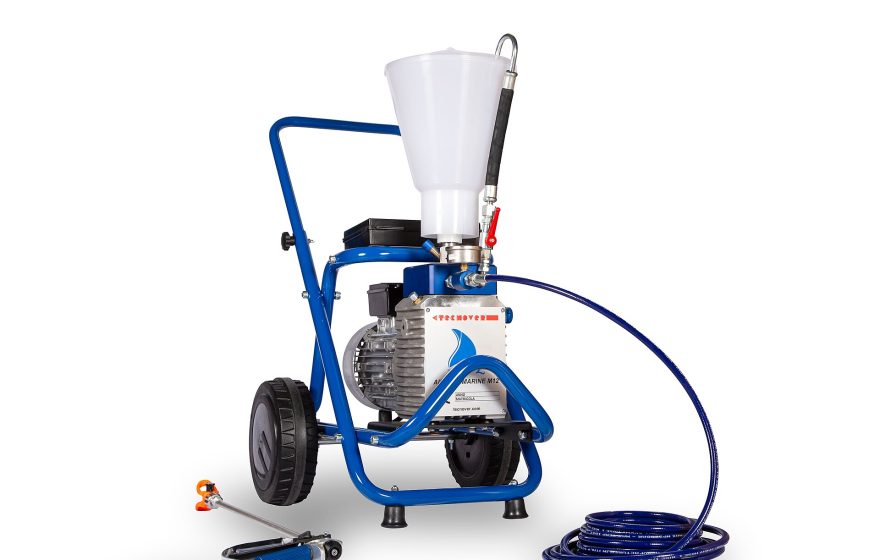
- Pump. Usually an air-operated piston pump with a moderate pressure ratio, or an electric pump.
- Fluid regulator to fine-tune pressure at the gun.
- Air regulator for the atomizing air.
- Fluid filter to protect the small tip.
- Air-assisted gun with an airless tip and air cap.
- Dual hose carrying fluid and air.
- Tips in a range of orifice sizes and fan widths; see spray tip selection.
Plural-component versions use a meter-mix system to feed mixed material to an air-assisted gun (see static mixers and meter-mix equipment). Electrostatic air-assisted guns add an electrical charge for higher transfer efficiency (see electrostatic application).
Setup procedure
- Strain the material and confirm viscosity is within the data sheet range (see flow cup viscosity testing).
- Select a tip suited to the material and part size.
- Set fluid pressure low and raise it until the fan is nearly fully formed with small tails.
- Add atomizing air gradually until tails disappear and the pattern is uniform. Too much air causes dry spray and overspray.
- Test spray on a panel and check wet film with a gauge.
- Adjust fluid pressure, air and travel speed to reach target thickness without sags.
Materials commonly sprayed
- Industrial enamels and alkyds (see alkyd coatings)
- Two-component polyurethanes and epoxies
- Direct-to-metal (DTM) coatings
- Wood stains, sealers, lacquers and conversion varnishes (see lacquer coatings)
- Waterborne industrial coatings
Very high-build or heavily filled coatings are often better suited to full airless.
Advantages
- Finer finish than airless at similar production.
- Less overspray and bounce-back than airless, which can reduce material use and cleanup.
- Softer pattern edges that blend well between passes.
- Lower tip wear because of lower fluid pressure.
- Good control on complex parts and edges.
Limitations
- More complex than airless, with two hoses and two regulators to balance.
- Requires compressed air of good quality (see compressed air cleanliness).
- Slower than airless on very large flat areas.
- Tips can clog with poorly strained material.
Common faults
| Problem | Likely cause | Correction |
|---|---|---|
| Tails on pattern | Fluid pressure or air too low | Raise fluid, then air |
| Dry spray, rough finish | Too much air, gun too far | Reduce air, move closer |
| Orange peel | Poor atomization, viscosity too high | Adjust air, thin within limits |
| Sags and runs | Too much material, slow travel | Smaller tip, faster passes |
| Spitting | Partly blocked tip, air in fluid line | Clean tip, bleed line |
| Uneven film | Poor overlap, tilting the gun | Maintain 50 percent overlap and perpendicular gun |
Safety
- Fluid at moderate pressure can still cause injection injuries; never point the gun at skin and use trigger locks.
- Relieve pressure before cleaning or changing tips.
- Ground equipment and parts when spraying flammable materials.
- Use ventilation and respiratory protection appropriate to the coating (see respiratory protection).
Frequently asked questions
Is air-assisted airless the same as HVLP?
No. HVLP uses air as the main atomizing force at low pressure. Air-assisted airless uses fluid pressure through an airless tip, with air only refining the pattern.
Can I convert an airless pump to air-assist?
Some systems allow it with a dual hose and air-assisted gun, but pressure ratios and regulators must suit the method. Check with the equipment manufacturer.
Does air-assist reduce VOC emissions?
It can reduce wasted material through less overspray, which lowers total emissions per part, but emissions also depend on the coating’s VOC content (see VOC regulations).
Related entries
- Airless spray
- HVLP and conventional spray
- Spray tip selection
- Spray gun technique
- Flow cup viscosity testing (new)
- Static mixers and meter-mix equipment (new)
Educational reference. Coating performance varies by formulation. Always follow the manufacturer’s product data sheet, safety data sheet and your project specification.