Concrete Floor Coatings
Resinous systems that turn bare slabs into durable, cleanable, chemical-resistant floors — and why preparation and moisture control decide whether they last.
Key takeaways
- Most concrete floor coating failures trace back to surface preparation or slab moisture, not to the coating chemistry itself.
- Mechanical preparation to the correct Concrete Surface Profile (CSP) per ICRI 310.2R is the industry norm; acid etching is discouraged by many manufacturers.
- Measure slab moisture with ASTM F2170 (in-situ relative humidity) and/or ASTM F1869 (calcium chloride) before choosing a primer.
- System choice — thin film, broadcast, slurry or mortar — should follow the actual service: traffic, chemicals, temperature, cleaning regime and required return-to-service time.
Concrete floor coatings are resinous systems applied to slabs to make them easier to clean, more resistant to abrasion, chemicals and impact, safer underfoot and better looking. They range from a single thin sealer coat in a residential garage to a ¼-inch (6 mm) troweled mortar in a food-processing plant that is steam-cleaned every shift.
Concrete is porous, alkaline, often damp and rarely as flat or clean as it looks. A floor coating is therefore as much a surface-preparation and moisture-management project as it is a coating project. This article covers the main system types, how they are installed, and how to match a system to the environment.
Types of floor coating systems
The industry commonly groups resinous floors by thickness and build-up method rather than by chemistry alone:
- Sealers and thin-film coatings — roughly 2–10 mils (50–250 µm) dry, usually one or two rolled coats. Dust-proofing and light traffic.
- High-build coatings — roughly 10–30 mils (250–750 µm), typically a primer plus one or two body coats.
- Broadcast systems — resin layers into which quartz, aluminum oxide or decorative vinyl flake is broadcast to refusal, then sealed. Commonly 1/16–1/8 in (1.5–3 mm) or more, with built-in slip resistance.
- Self-leveling slurries — flowable, filled resin poured and spread with a gauge rake, typically 1/16–3/16 in (1.5–5 mm), giving a smooth, seamless surface.
- Troweled mortars — heavily filled resin mortars placed with a power or hand trowel, commonly ¼ in (6 mm) or more, for heavy impact, thermal shock or slope-to-drain work.
Common chemistries
| Chemistry | Typical role | Strengths | Watch-outs |
|---|---|---|---|
| Epoxy (often 100% solids) | Primer, body coat, slurry, mortar binder | Excellent adhesion to concrete, good chemical and abrasion resistance, builds thickness economically | Aromatic epoxies yellow and chalk in UV; sensitive to cold cure and amine blush; limited recoat windows |
| Novolac epoxy | Chemical-resistant body or topcoat | Higher resistance to many acids and solvents than standard epoxy | More brittle; shorter pot life |
| Aliphatic polyurethane | Topcoat over epoxy | Color and gloss retention, scratch resistance | Moisture-sensitive during cure; thin film |
| Urethane cement (urethane-modified concrete) | Slurry or trowel at roughly 1/8–3/8 in (3–10 mm) | Thermal shock and hot-water/steam cleaning resistance; tolerant of damp concrete | Matte, utilitarian finish; edge termination (keying) is mandatory |
| Polyaspartic (aliphatic polyurea) | Topcoat or full system | Fast return to service, UV stable, wide cure temperature range | Very short working time; wetting into concrete can be poorer than epoxy primers |
| Methyl methacrylate (MMA) | Full system | Cures in about an hour, even at low temperatures; good for cold rooms | Strong odor during application; requires ventilation and careful handling |
See epoxy coatings and polyaspartic coatings for the chemistry behind the two most common floor resins.
Surface preparation
The goal of preparation is a clean, sound, open-pored surface with a profile suited to the system thickness. Laitance (the weak, cement-rich skin on top of a troweled slab), curing compounds, sealers, oil, old coatings and efflorescence must all be removed.
ICRI 310.2R defines ten Concrete Surface Profiles, CSP 1 (nearly flat) through CSP 10 (very rough), illustrated with reference replica chips. Manufacturers commonly call for roughly CSP 2–3 for thin-film coatings and CSP 3–5 for slurries, broadcast systems and mortars, but the product data sheet governs. Diamond grinding typically produces the lower profiles, steel shot blasting covers a broad middle range, and scarifying or scabbling produces heavy profiles.
After profiling, the surface should be vacuumed, not swept. Where adhesion is in doubt, a pull-off test per ASTM D7234 checks the tensile strength of the prepared concrete; many specifications look for a minimum in the range of roughly 200–300 psi (1.4–2.1 MPa) with failure in the concrete rather than at the bond line. More detail is in concrete surface preparation and CSP.
Acid etching is still marketed for DIY garage kits, but it can leave reaction salts and moisture in the slab, does little to remove sealers or curing compounds, and gives an inconsistent profile. Most professional specifications call for mechanical preparation instead.
Slab moisture and vapor drive
Moisture moving up through a slab is a leading cause of floor coating blistering and debonding. Moisture vapor emission can build osmotic pressure beneath a relatively impermeable film, and soluble alkalis carried with the moisture can attack the bond line. Slabs on grade without an effective vapor retarder are the highest risk.
- ASTM F2170 measures relative humidity inside the slab with probes set in drilled holes, typically at 40% of slab depth for a slab drying from the top only.
- ASTM F1869 measures the moisture vapor emission rate (MVER) from the surface using an anhydrous calcium chloride dish under a sealed dome, reported in lb/1,000 ft²/24 h.
Limits are set by the coating manufacturer, not by the test standard. Conventional epoxy systems are often limited to roughly 75–85% RH or about 3 lb/1,000 ft²/24 h MVER, while dedicated moisture-mitigation epoxy primers are commonly rated much higher. The traditional “wait 28 days” rule refers to concrete strength gain; it does not guarantee the slab is dry enough to coat. See concrete moisture testing for method details.
How a resinous floor is installed
- Assess. Confirm service conditions, test moisture, check for contamination, map cracks and joints, and record ambient, surface and dew point temperatures.
- Prepare. Grind or shot blast to the specified CSP, remove coatings and contaminants, and vacuum thoroughly.
- Repair. Fill spalls and bugholes with epoxy mortar or paste; treat static cracks; key in terminations at edges, drains and doorways with saw cuts so thick systems do not lift at their ends.
- Prime. Apply a penetrating primer (or moisture-mitigation primer where required) to seal the pores. Applying on a stable or falling slab temperature reduces outgassing pinholes.
- Build. Apply body coats, slurry or mortar to the specified thickness, broadcasting aggregate or flake where the system calls for it.
- Topcoat. Scrape and vacuum excess broadcast, then apply the grout coat and topcoat(s), adding fine aggregate if slip resistance is required.
- Cure and return to service. Respect the manufacturer’s times for foot traffic, wheeled traffic and chemical exposure, which lengthen considerably at low temperatures.
Joints and cracks
Coatings do not stop concrete from moving. Moving joints (isolation and expansion joints) should be carried up through the coating and finished with a flexible sealant. Saw-cut contraction joints in slabs that have finished most of their shrinkage are often filled with a semi-rigid epoxy or polyurea joint filler so forklift wheels do not break the joint edges. Active cracks will usually reflect through a rigid coating.
Choosing a system for the environment
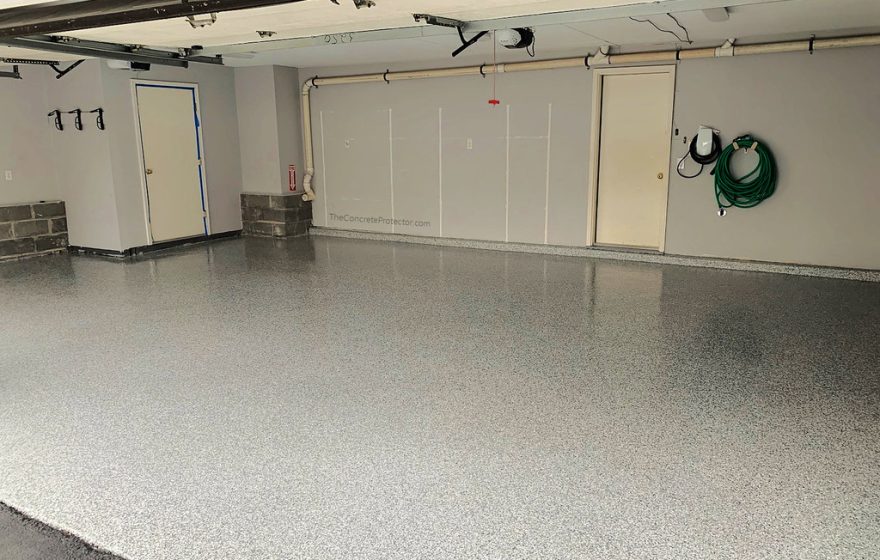
- Residential garages. Epoxy or polyaspartic systems, often with a decorative flake broadcast and a clear, UV-stable topcoat. Hot-tire pickup — where warm tires soften and lift a thin coating — is a known risk with thin, poorly bonded films.
- Warehouses and distribution. High-build epoxy or broadcast systems for forklift traffic; abrasion resistance is often compared with Taber testing per ASTM D4060.
- Food and beverage. Urethane cement slurries or mortars for thermal shock, hot washdown and organic acids, with integral coves and slope to drains.
- Chemical processing and battery rooms. Novolac epoxy or vinyl ester systems selected against the specific chemicals, concentrations and temperatures involved.
- Cold storage and fast turnarounds. MMA or polyaspartic systems that cure at low temperatures and return to service in hours.
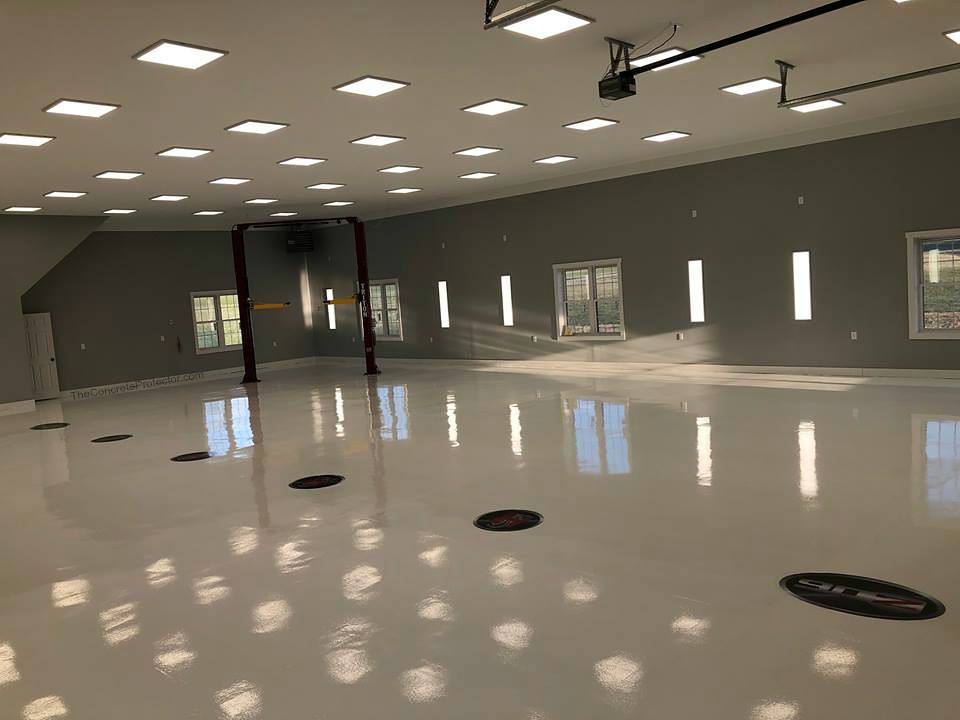
- Commercial and retail. Decorative quartz, flake or metallic epoxy systems, usually with a polyurethane or polyaspartic wear coat.
Before committing to a large area, install a small test section on the actual slab. It reveals outgassing, wetting, adhesion and appearance problems while they are still cheap to fix.
Common failures and how to avoid them
- Delamination — usually from laitance, sealers, curing compounds or oil left on the surface, or an inadequate profile.
- Blisters — commonly osmotic, driven by slab moisture; prevented by testing and, where needed, a moisture-mitigation primer.
- Pinholes and craters — air escaping from the porous slab into the curing film. See pinholes and outgassing.
- Greasy, blotchy or poorly bonding recoats — often amine blush on epoxies cured in cool, humid conditions.
- Soft or tacky areas — off-ratio or poorly mixed material, or cure below the minimum temperature.
Frequently asked questions
How long does an epoxy garage floor last?
It depends heavily on thickness, preparation and use. A properly prepared high-build or broadcast system can last many years in residential use, while a thin, acid-etched DIY coating may fail within months, often through hot-tire pickup or peeling.
Can I coat a brand-new slab?
Only after it has dried sufficiently. Strength gain and drying are different processes; test moisture per ASTM F2170 or F1869 and compare against the primer manufacturer’s limits, or use a primer specifically rated for higher moisture levels.
Do resinous floors get slippery?
Smooth, glossy finishes can be slippery when wet or oily. Fine aggregate in the final coats adds texture; the right texture balances slip resistance against cleanability.
Is polyaspartic better than epoxy?
Neither is universally better. Polyaspartics cure faster and resist UV; epoxies generally wet and seal concrete well and build thickness economically. Many systems combine an epoxy primer and body coat with a polyaspartic or polyurethane topcoat.
Educational reference. Coating performance varies by formulation. Always follow the manufacturer’s product data sheet, safety data sheet and your project specification.