Contact Angle Measurement in Coatings
How contact angles describe wetting, why advancing and receding values differ, and what surface preparation, test liquids and reporting conditions mean for coating decisions.
Key takeaways
- A smaller angle generally indicates greater spreading of the chosen liquid under comparable test conditions.
- Static, advancing and receding angles describe different observations and should not be used interchangeably.
- Roughness, absorption, contamination, drop size and elapsed time can change the result.
- Contact angle supports surface investigation. It does not by itself prove adhesion, identify a contaminant or establish coating service life.
Contact angle measurement describes how a liquid meets a solid surface. In coatings work, it helps investigate substrate wetting, cleaning and pretreatment, the behavior of cured films, and the compatibility of liquids with pigments. The measured angle belongs to a particular liquid–surface pair under stated conditions; it is not a universal rating of a material.
What the angle represents
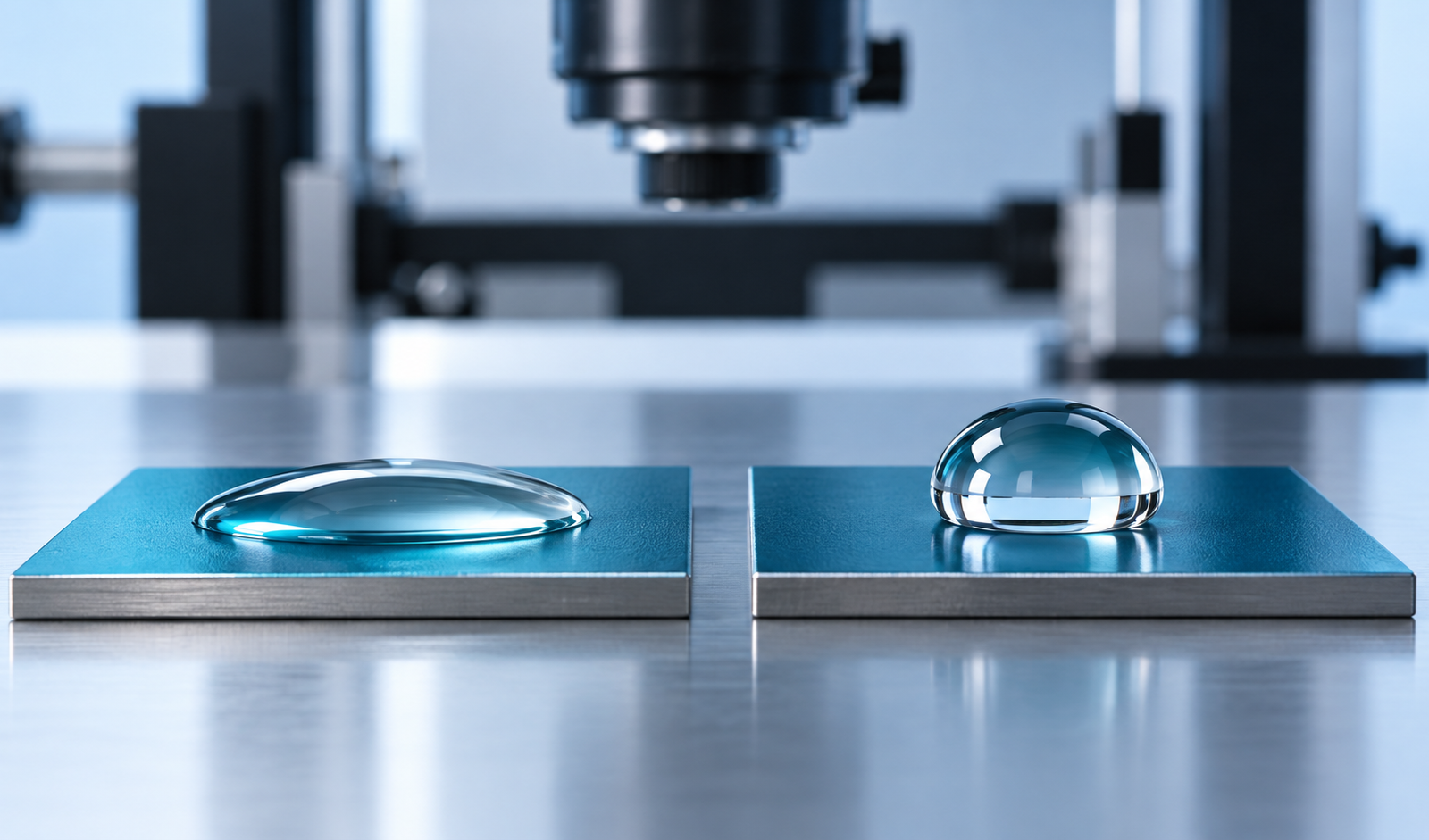
At the edge of a sessile drop, solid, liquid and the surrounding gas meet along a contact line. The contact angle is measured through the liquid between the solid surface and the tangent to the drop profile. An optical goniometer records the drop from the side and fits its outline. A flatter drop has a smaller apparent angle than a rounded bead. These observations are useful only when the liquid, preparation and measurement procedure are identified.
Young’s equation relates an equilibrium angle to the interfacial energies of an ideal system: a smooth, chemically uniform solid and a pure liquid at equilibrium. Real coating surfaces often depart from those assumptions. A value obtained from a textured or heterogeneous film is therefore normally an apparent angle rather than a direct measurement of an ideal surface property. KRÜSS explains the assumptions behind Young’s equation.
Static, advancing and receding measurements
A static measurement records a deposited drop at a defined time. Describing it as static does not establish that the system has reached thermodynamic equilibrium. The report should state when the image was acquired because spreading, evaporation, absorption or surface rearrangement may continue.
An advancing angle is associated with a contact line moving onto previously unwetted surface. A receding angle accompanies withdrawal of that line. With a needle-in method, the drop can be enlarged by adding liquid and reduced by withdrawing it. The difference between the two angles is contact-angle hysteresis. Chemical variation and surface texture can pin a contact line, so two surfaces with similar static values may behave differently during wetting and dewetting. See the instrument manufacturer’s explanations of dynamic measurements and receding angles.
Choosing the question and test liquid
Water is useful for comparing how surfaces interact with water, including comparisons before and after cleaning. It is not a substitute for every coating liquid. A solvent-borne formulation, surfactant solution and water can behave differently on the same substrate. ASTM D7334-08(2022) addresses advancing contact-angle measurements on coatings, substrates and prepared pigment disks; its public scope includes several types of test liquid.
A low value can support a finding of improved wetting in a controlled comparison. It cannot demonstrate that an unknown residue has been removed completely, nor identify the residue’s chemistry. Similarly, easy spreading is only one factor in forming a durable coating bond. Cure, substrate integrity, intercoat compatibility and exposure still require appropriate investigation. ASTM D7334 is a wettability practice, not a universal adhesion acceptance criterion.
Common sources of misleading comparisons
- Surface history: fingerprints, cleaning residues, aging and the interval after pretreatment can change the surface being measured.
- Texture and porosity: a drop may follow surface contours, bridge air pockets or enter pores. Identical chemistry does not guarantee identical apparent angles.
- Drop size and time: changing the sampled area or allowing liquid to penetrate can alter the observed value. Use a consistent volume and timing protocol.
- Image analysis: baseline placement, focus and the selected fitting method affect how the tangent is determined.
- Sampling: one drop on one location cannot characterize a visibly variable panel. Keep individual readings and their spread, as well as the average.
Biolin Scientific’s drop-volume study illustrates why scale and porous substrates matter. The DataPhysics description of drop-shape analysis explains the optical arrangement.
Contact angle versus surface free energy
A single angle does not directly supply the solid’s surface tension or surface free energy. Estimation requires suitable probe liquids and an interaction model. ASTM D7490-13(2022), for example, uses two liquids to calculate polar and dispersive contributions. The result is model-dependent, and roughness or porosity can complicate comparison, especially for compressed pigment disks. ASTM explicitly describes that method as unsuitable for a quality-control or specification test. Do not turn a calculated number into a pass/fail limit without a separately validated application-specific basis. ASTM D7490.
What a useful report includes
Record specimen identification; coating and cure history; cleaning or pretreatment; storage and conditioning; test-liquid identity and purity; instrument and fitting method; static, advancing or receding procedure; drop volume; measurement timing; temperature and humidity; number and locations of drops; individual values, summary statistics and representative images. State deviations and observations such as absorption, asymmetric drops or a moving baseline. This reporting checklist is an interpretive aid, not a replacement for the selected method.
Using the result
The strongest use is a controlled comparison tied to a real question: did the specified treatment alter wetting, is the surface uniform, or has its behavior changed after exposure? Pair the result with relevant adhesion testing and chemical or topographic analysis when the decision requires them. A contact-angle photograph is evidence of the drop’s behavior at that moment, not a coating performance certificate.
Related entries: the science of adhesion and surface profile.
Public technical references checked October 14, 2026. The cover is a conceptual illustration, not a measured test result.
Educational reference. Coating performance varies by formulation. Always follow the manufacturer’s product data sheet, safety data sheet and your project specification.