Dynamic Mechanical Analysis (DMA) of Coatings
How DMA measures coating stiffness, damping and glass transition, and why specimen geometry, frequency, conditioning and interpretation matter.
Key takeaways
- DMA measures stiffness and damping under oscillating deformation.
- Frequency, temperature, deformation mode and conditioning define the comparison.
- A free film and a coated substrate are different mechanical specimens.
- Report how Tg was assigned; a DMA transition alone does not establish service suitability.
What does DMA measure?
Dynamic mechanical analysis (DMA) investigates how a material responds to a small, repeating mechanical deformation. The instrument measures force, displacement and their phase relationship while conditions such as temperature or frequency are controlled. For coating films, this provides a way to examine changing stiffness, energy dissipation and transitions in the polymer network.
The principal quantities in tensile or flexural measurements are:
- Storage modulus, E′: the elastic component of the dynamic response, associated with stored energy and stiffness.
- Loss modulus, E″: the component associated with dissipated energy.
- Loss factor, tan δ: the ratio E″/E′, describing damping relative to elastic response.
NETZSCH’s DMA technical overview explains these quantities. Shear measurements use corresponding shear moduli, G′ and G″; values should retain their deformation-mode labels.
What coating questions can it answer?
DMA can compare films made with different formulations or cure schedules, investigate mechanical changes after conditioning, and characterize the temperature region where a film becomes more compliant. A temperature sweep follows properties during heating or cooling; a frequency sweep examines response at different deformation rates.
These comparisons are useful when a room-temperature hardness value does not explain behavior across the intended operating range. Published research on DMA in the coatings industry describes applications to automotive basecoats and clearcoats. The method provides supporting material evidence, rather than a universal ranking of coating quality.
Free films and coated panels need different interpretation
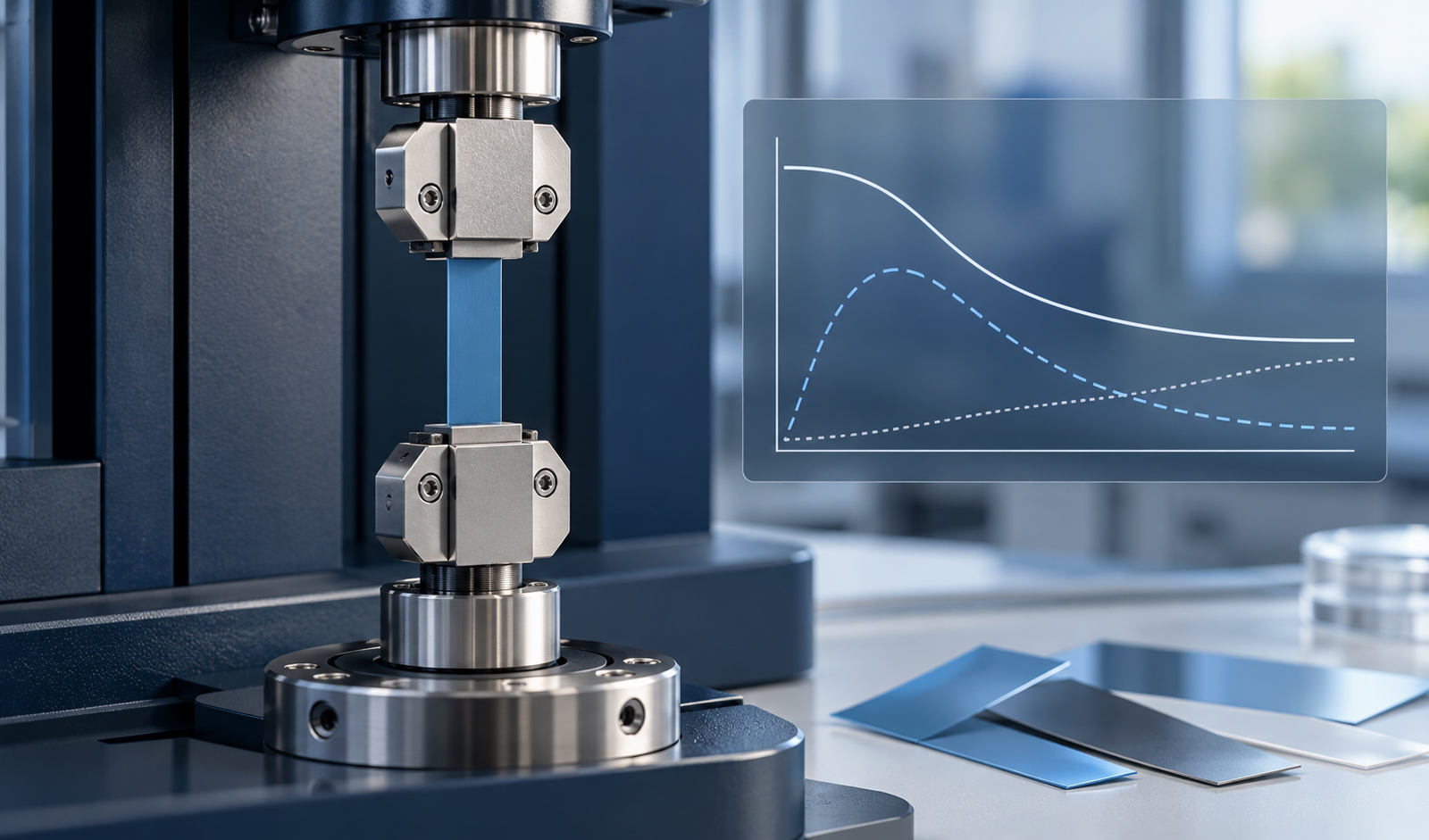
A self-supporting film can be tested in tension when its dimensions and strength suit the instrument and fixture. Thin films need careful alignment and appropriate preload so that wrinkling, slack or specimen damage does not dominate the signal. TA Instruments’ thin-sheet guidance discusses handling, geometry and repeatability.
Testing a coated panel in bending includes the substrate’s mechanical contribution. The measured response must not simply be relabeled “coating modulus.” Separating the layer response requires a suitable mechanical model and accurate geometry and substrate properties. A painted-steel study using three-point bending found the calculated coating modulus particularly sensitive to thickness and substrate properties.
More generally, tensile and flexural results are not automatically interchangeable. The public scope of ISO 6721-1:2019 explains that deformation modes weight specimen regions differently and sets out the general linear-viscoelastic framework for rigid plastics.
Keep the measurement in its valid range
For linear DMA, select an oscillation amplitude within the specimen’s linear viscoelastic region, where the measured moduli remain effectively independent of amplitude. An amplitude sweep helps establish that range. It can change with temperature, so a setting appropriate for a stiff film may become unsuitable after the film softens. TA Instruments’ linear-range guidance explains amplitude sweeps and temperature-dependent testing.
Record specimen dimensions, fixture, preload, amplitude, frequency and thermal program. Check whether a sudden change could reflect grip movement, loss of tension, cracking or an instrument limit before assigning a molecular explanation. A graph with many data points still needs a valid specimen and measurement.
Report the Tg convention
The glass transition appears over a temperature region. DMA commonly assigns a representative temperature from the storage-modulus onset, loss-modulus peak or tan δ peak. These criteria can produce different values from the same experiment. The construction used to identify an onset also matters.
Frequency affects the observed transition because the response depends on the timescale of deformation. Consequently, compare results using the same frequency and stated analysis convention. TA Instruments’ Tg interpretation note explains the criteria and their frequency dependence.
ASTM E1640-23 addresses assigning Tg with dynamic mechanical analyzers for thermoplastic, thermoset and partially crystalline materials that remain thermally stable in the transition region. A report claiming this method should identify the edition and follow the complete applicable procedure. A public scope summary cannot demonstrate compliance.
Conditioning and cure history matter
Match cure time, cure temperature and post-treatment when comparing formulations. DMA can help investigate thermoset cure through changes in mechanical response and Tg, as illustrated by TA Instruments’ composite-cure study. A difference alone does not identify its cause or yield a universal percentage-cure value.
Also record moisture or solvent exposure and the environment during testing. Dry, humid and immersed measurements answer different questions. TA Instruments’ electronic-materials overview identifies temperature-, frequency- and humidity-dependent mechanical characterization for films and cured polymers. For failure analysis, label as-received and conditioned specimens separately.
Related reference entries explain glass transition temperature and crosslink density in the broader coating system.
Limits and reporting checklist
DMA measures a response under defined loading conditions. It does not independently measure substrate adhesion, establish chemical resistance or set a maximum service temperature. A high Tg cannot compensate for a defective interface. Likewise, a room-temperature modulus should not be treated as a universal prediction of flexibility or cracking in a coating system.
A useful report includes specimen identity and layer structure; preparation and conditioning; dimensions and fixture; loading and temperature settings; E′, E″ and tan δ curves; the Tg criterion; repeats and uncertainty; and observations of slip, damage or changing specimen condition. Keep the full curves alongside summary values so that a reviewer can see what the reported number represents.
Educational reference. Coating performance varies by formulation. Always follow the manufacturer’s product data sheet, safety data sheet and your project specification.