Differential Scanning Calorimetry (DSC) for Coating Analysis
DSC helps investigate coating glass transition, residual cure and thermal history. Learn why first and second heating differ and which reporting details make a comparison meaningful.
Key takeaways
- DSC measures thermal response and can investigate glass transition and residual curing reactions.
- First and second heating runs answer different questions about a coating.
- Cure estimates need a suitable same-formulation reference and a consistent mass basis.
- A DSC result alone cannot establish adhesion or authorize return to service.
What does DSC measure?
Differential scanning calorimetry (DSC) measures the difference in heat flow between a specimen and a reference during a controlled temperature program. A laboratory plots the response against temperature or time to investigate transitions and reactions. Heating, cooling, and constant-temperature segments can reveal different behavior. METTLER TOLEDO’s DSC overview explains the measurement.
For coatings, useful questions include whether a binder shows a glass transition, whether a thermosetting film retains a detectable curing reaction, and how conditioning changes its thermal response. Begin with a specific question and a relevant comparison material.
Read the curve before interpreting a number
Heat absorption is endothermic; heat release is exothermic. Check which direction the plotted axis assigns to each. A peak may indicate melting, crystallization, a reaction, or another event. Its position alone does not identify the mechanism. Moisture, changes in specimen mass, and instrument-related effects can complicate the trace. TA Instruments’ interpretation note illustrates these pitfalls.
The glass transition usually appears as a step associated with changing heat capacity. ASTM E1356-25 addresses assigning glass-transition temperatures in amorphous materials and amorphous regions of partially crystalline materials, provided the material remains stable in the transition region.
A reported glass-transition temperature, or Tg, needs its evaluation convention. An extrapolated onset, midpoint, and inflection-point result are not interchangeable labels. Baseline construction and overlapping relaxation can influence the assigned value. Use consistent analysis when comparing specimens, as explained in TA Instruments’ glass-transition analysis guide.
First heating and second heating mean different things
The first heating contains evidence of the specimen’s condition on arrival at the instrument. Previous processing, aging, and storage may influence its response. That evidence can change during measurement: the specimen may undergo further curing, relaxation, or other transitions. METTLER TOLEDO’s DSC applications discussion explains how first-heating behavior can retain processing-history information.
A second heating, following controlled cooling, examines material that has already experienced the laboratory’s first cycle. For a thermoset, this may include additional crosslinking. TA Instruments’ thermoset study uses the second heat to examine the newly cured material and any remaining reaction.
Consequently, a higher second-heating Tg cannot be reported as the original field coating’s Tg. Nor does a smooth second trace demonstrate that the coating arrived fully cured. Retain and identify both curves when the investigation concerns as-received condition. “Thermal history removed” should not imply that chemical changes have been reversed or that every specimen now has an equivalent composition.
What can residual cure establish?
A residual curing exotherm represents heat released by additional reaction during the selected test. Integrating an appropriately assigned peak gives a reaction enthalpy. ASTM E2160-23 covers exothermic heat-of-reaction measurements and discusses their use in assessing previously completed reaction. Its public guidance also warns against using onset temperature alone to establish storage or processing conditions.
A percentage-cure estimate requires the total reaction heat of an appropriate unreacted reference. TA Instruments’ degree-of-cure note illustrates this comparison. For coating work, establish that the reference represents the same formulation and that preparation, reaction assignment, integration, and normalization are compatible. A generic epoxy value is not an adequate substitute.
Specify whether enthalpy is reported per gram of the complete coating or its reactive fraction. Fillers change the relationship between specimen mass and polymer mass; TA Instruments’ filled-polymer example demonstrates why mass normalization matters. Differences in pigment or filler content can confound a comparison.
An undetected exotherm means no residual event was resolved under the selected conditions. It is not proof of universal “100% cure.” Overlapping effects can obscure interpretation; NETZSCH’s epoxy application note describes temperature-modulated DSC as one way to separate overlapping glass-transition and post-curing contributions.
Make the specimen representative
A small laboratory specimen cannot automatically characterize an entire coated structure. Identify the sampled layer and location, and distinguish suspect areas from suitable comparison areas. Mixing several layers changes what the result represents. Ask the laboratory to plan collection and conditioning before sampling; deliberate drying or heating may alter evidence relevant to the investigation.
Pan selection, specimen contact, and mass also influence measurement, as described in NETZSCH’s specimen guidance. Laboratory personnel should select safe, appropriate preparation and temperature limits for the chemistry.
What should the report include?
- Coating identity, sampled layer and location, age, exposure, storage, and conditioning.
- Specimen mass, preparation, pan configuration, atmosphere, instrument, and calibration information.
- Heating and cooling rates, temperature limits, holds, and clearly identified cycle numbers.
- Tg convention, integration boundaries, baseline approach, units, and mass-normalization basis.
- Reference identity, repeat measurements, unresolved overlaps, uncertainty, and interpretation limits.
This is a practical review checklist, not a replacement for the applicable full method.
For the broader context, see how coatings cure and testing coating cure.
Does DSC establish readiness for service?
No single thermal trace verifies the bond to the substrate or performance throughout the coating system. Use DSC alongside the specified cure assessment, application records, appropriate adhesion or performance tests, and the coating manufacturer’s requirements. Acceptance limits must come from an applicable, validated specification.
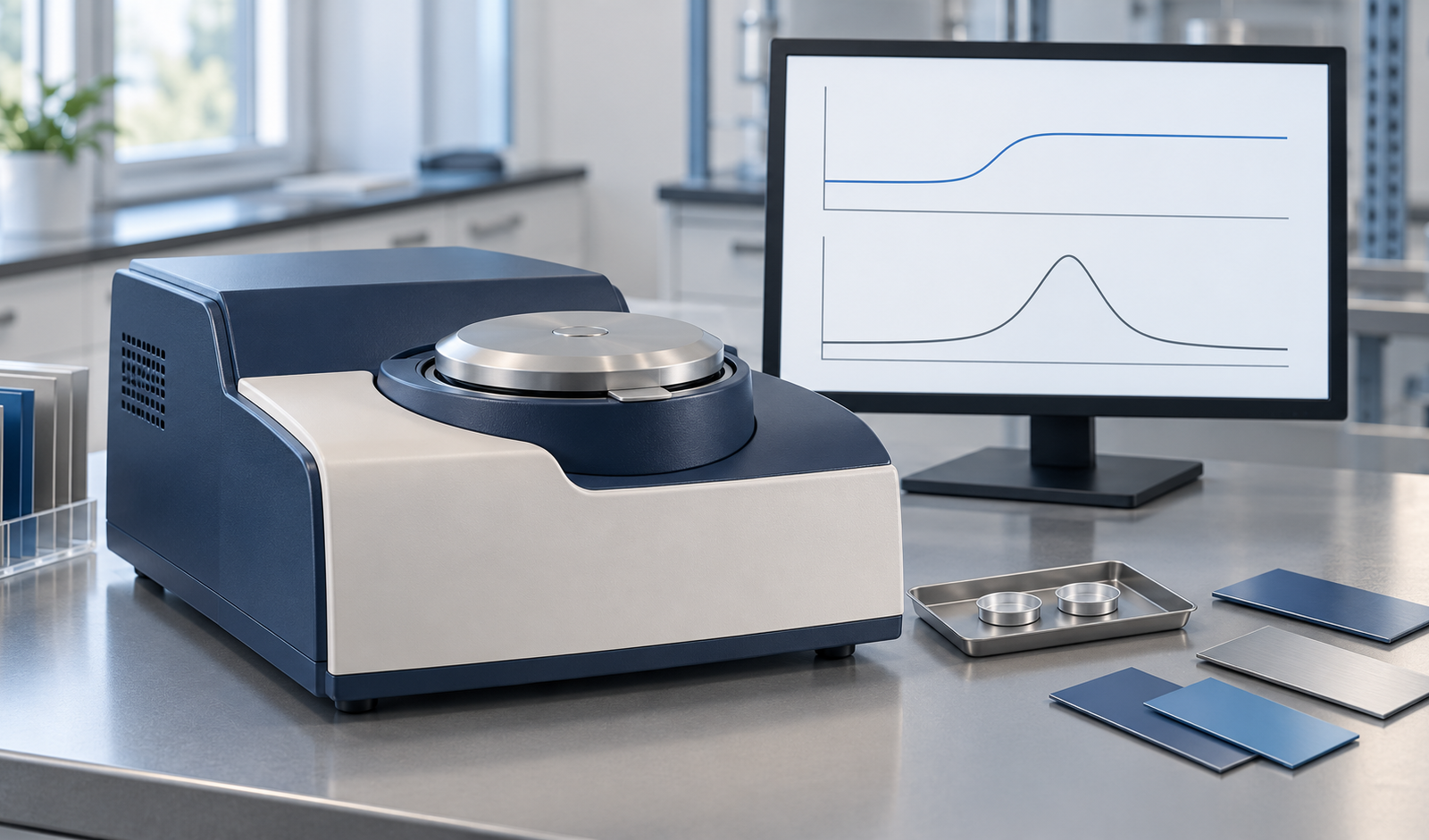
Educational reference. No laboratory testing was performed for this article. Consult the applicable full method and a laboratory experienced in coating analysis. Cover: original AI-generated illustration; its curves are schematic, not measured results.
Educational reference. Coating performance varies by formulation. Always follow the manufacturer’s product data sheet, safety data sheet and your project specification.